Band 6.0 IELTS Writing Task 1 Model Answer
Overall Band Score: 6.0 · Cambridge IELTS 16 · 2026-11-14
IELTS Writing Task 1 question
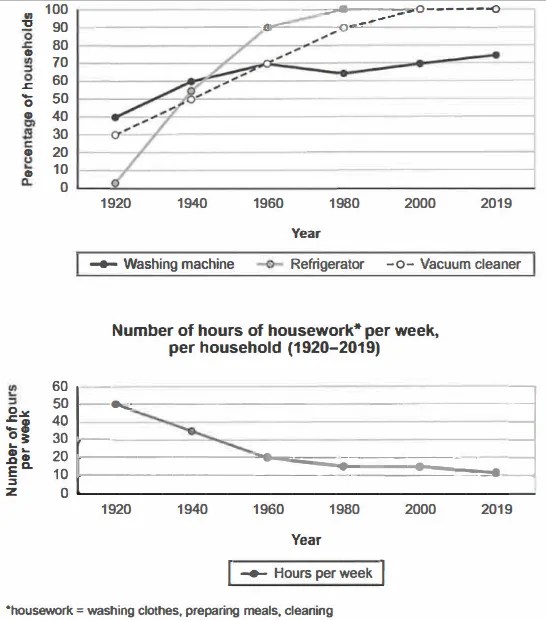
The charts below show the changes in ownership of electrical appliances and amount of time spent doing housework in households in one country between 1920 and 2019.
Summarise the information by selecting and reporting the main features, and make comparisons where relevant.
Percentage of households with electrical appliances (1920-2019)
Student answer (Band 6.0)
The first line graph illustrates changes in the holding of electrical appliances like washing machines, refrigerators, and vacuum cleaners for basic home tasks by the households from 1920 till 2019. The second line graph shows the duration of the timespan for acomplishment of the household tasks.
Overall, what comes out of charts is that over the passage of time, machines like refrigerators and vacuum cleaners had become more accessable for common people with 100 percent of households holding the ownership in 2019 and have inclining trend since 1920. Washing machines ownership is 70 percent with fluctuation in the trend.Moreover, with the introduction of these electrical appliances to common household the number of hours spent on the basic tasks is reduced to only 10 hours per week only saving around 40 hours per week as compared to year 1920.
In the year 1920, none of the housholds had refrigerators and then there is a sharp rise in 1940 to more then 50% had this appliance at their home. Until 1980, 100% of the household had refrigerators. Similarly, vacuum cleaners also gained the popularity and almost households holding their own vacuums number doubled every 20 years reachin 100% in the year 2000. For the washing macine the proportion is fluctuating first increased to 70 percent in 1960 and then a slight downfall in 1980 and again incline leadind to only around 71% in 2019.
With the availabilty of electrical appliances in
AI examiner evaluation
| Criterion | Band |
|---|---|
| Task Achievement / Task Response | 6.5 |
| Coherence and Cohesion | 5.5 |
| Lexical Resource | 5.5 |
| Grammatical Range and Accuracy | 5.5 |
| Overall | 6.0 |
Task Achievement / Task Response: Band 6.5
You identify the main overall patterns: appliance ownership generally rose, while weekly housework time fell substantially. You also make relevant comparisons, including refrigerators reaching full ownership by 1980 and vacuum cleaners by 2000. This is a solid account of the task, with several key figures included. However, some details are inaccurate: refrigerators were at about 2% in 1920, not absent, and washing-machine ownership was about 75% in 2019 rather than 71%. The final paragraph is unfinished, so the decline in housework hours is not fully described with the chart’s stages or endpoint. The overview also says washing-machine ownership was 70% without clearly distinguishing its fluctuations. More precise reporting and a complete account of both graphs would strengthen the response.
Coherence and Cohesion: Band 5.5
The response has a recognisable structure: an introduction, an overview, and a paragraph describing appliance ownership. The sequence from general trends to individual appliances is broadly understandable, and linking expressions such as “Overall,” “Similarly,” and “Moreover” help signal relationships. However, progression is weakened because the second graph is introduced but not developed in a complete paragraph; the final sentence breaks off at “With the availability of electrical appliances in”. Some connections are also imprecise, such as linking appliance availability directly to the reduction in housework without clearly presenting the hours data. Organise the details into clear paragraphs—one for appliance ownership and one for housework hours—and use references and transitions to make the comparisons explicit.
Lexical Resource: Band 5.5
You use a reasonable range of task-related vocabulary, including “proportion,” “sharp rise,” “fluctuation,” and “reduced,” which helps communicate the main trends. There are also attempts at more formal phrasing, such as “the passage of time.” However, several word choices and collocations are unnatural or imprecise: “holding of electrical appliances,” “duration of the timespan,” and “gained the popularity” do not express the data naturally. Spelling errors, including “acomplishment,” “accessable,” “housholds,” and “availabilty,” are noticeable and reduce accuracy. Prefer standard chart language such as “ownership,” “the number of hours spent on housework,” and “became more widespread,” and check spelling carefully before submitting.
Grammatical Range and Accuracy: Band 5.5
You attempt a mix of simple and complex sentences, including clauses beginning “with the introduction” and “then,” and the main trends are generally understandable. However, some grammatical errors recur in sentence construction, articles, agreement, and punctuation. For example, “the proportion is fluctuating first increased” combines incompatible verb forms, while “almost households holding their own vacuums number doubled” lacks a clear grammatical structure. In “100 percent of households holding the ownership … and have inclining trend,” the clause structure and agreement are also unclear. The unfinished final sentence further interrupts grammatical completeness. Use a consistent past-tense description for the historical data, build complete clauses around each comparison, and proofread for articles and sentence boundaries.
See this exact question answered at other band scores. The same prompt compared across bands.
Browse more IELTS Writing model answers or get your own writing scored by the same AI examiner.