Band 6.0 IELTS Writing Task 1 Model Answer
Overall Band Score: 6.0 · Cambridge IELTS 16 · 2026-11-14
IELTS Writing Task 1 question
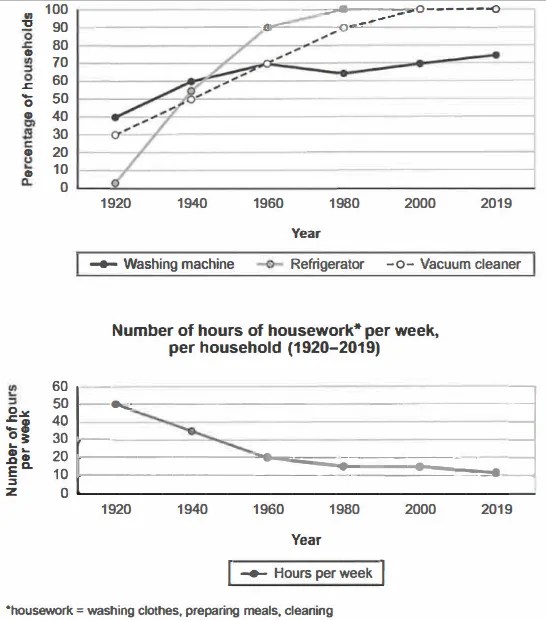
The charts below show the changes in ownership of electrical appliances and amount of time spent doing housework in households in one country between 1920 and 2019.
Summarise the information by selecting and reporting the main features, and make comparisons where relevant.
Percentage of households with electrical appliances (1920-2019)
Student answer (Band 6.0)
The line graph illustrates the percentage of households in three electrical appliances and the amount of time spend in per week from 1920 to 2019.
Overall, it is clear that the ownership of all three appliances increased significantly during the period, while the amount of housework find sharply.
To begin with in 1920, the refrigerator it was almost 0% while, washing machine it was 40% and the vacuum cleaner it was 30%. By 2019, both the refrigerator and vacuum cleaner reached almost 100% it was a most popular during the period. In contrast, washing machine shows a different pattern. It rose from 40% in 1920 and to about 70% in 1960, before failing to slightly to 65% in 1980. It then remained stable, ending at just over 70% in 2019.
In contrast, in 1920 people spend about 50 hours per week. This figure dropped sharply to 20 hours per week in 1960, and then continued to fall gradually to just 10 hours in 2019.
AI examiner evaluation
| Criterion | Band |
|---|---|
| Task Achievement / Task Response | 6.5 |
| Coherence and Cohesion | 6.5 |
| Lexical Resource | 6.0 |
| Grammatical Range and Accuracy | 5.5 |
| Overall | 6.0 |
Task Achievement / Task Response: Band 6.5
You identify the main overall contrast accurately: appliance ownership generally rose, while weekly housework declined. The response also selects useful starting and ending figures and describes the washing machine’s dip around 1980, so the key trends are recognisable. Some details, however, are incomplete or imprecise. The refrigerator reaches 100% by 1980 and remains there, and the vacuum cleaner reaches 100% by 2000; saying both reach almost 100% only “by 2019” misses these important stages. The washing-machine figure rises again after 1980 rather than remaining stable throughout, and housework levels off at about 15 hours from 1980 to 2000 before falling. Including these comparisons would make the report more fully developed and precise.
Coherence and Cohesion: Band 6.5
The response has a clear overall arrangement: an introduction, an overview, a paragraph on appliance ownership and a final paragraph on housework. The sequence from the initial figures to later years is generally easy to follow, and phrases such as “Overall,” “To begin with” and “In contrast” help signal the organisation. Some linking is mechanical or confusing, however. “In contrast” is used to introduce the housework data even though it is not clearly contrasting with the preceding point, and the appliance paragraph combines several trends without consistently guiding the reader through their different timelines. The sentence beginning “By 2019” also runs together several ideas. Use more precise transitions and organise comparisons by trend or period to make progression smoother.
Lexical Resource: Band 6.0
You use a suitable range of task vocabulary, including “percentage,” “ownership,” “increased significantly,” “dropped sharply” and “remained stable.” These choices communicate the broad trends, and the language is generally appropriate for describing a graph. Some word choices and collocations are inaccurate or awkward, such as “the amount of time spend in per week,” “housework find sharply,” and “failing to slightly.” “A most popular” is also not a natural way to describe appliance ownership. These errors do not prevent the reader from understanding the main message, but they reduce precision and naturalness. Aim for standard graph-reporting phrases such as “the number of hours spent on housework fell” and “declined slightly,” and check word forms and collocations when editing.
Grammatical Range and Accuracy: Band 5.5
You attempt both simple and more complex sentence forms, including a useful contrast structure in “while the amount of housework…” and a sequence using “before.” The main trends remain understandable, but several grammatical errors occur in basic sentence patterns. For example, “the refrigerator it was” and “washing machine it was” contain unnecessary subjects, while “the amount of time spend” needs a correctly formed participle. In “It rose from 40% in 1920 and to about 70%,” the preposition pattern is faulty, and “before failing to slightly” has an incorrect verb construction. There are also punctuation problems where clauses are joined without clear boundaries. Practise accurate subject–verb structures and verb forms, then proofread each sentence for complete, correctly joined clauses.
See this exact question answered at other band scores. The same prompt compared across bands.
Browse more IELTS Writing model answers or get your own writing scored by the same AI examiner.