Band 4.5 IELTS Writing Task 1 Model Answer
Overall Band Score: 4.5 · Cambridge IELTS 16 · 2026-11-15
IELTS Writing Task 1 question
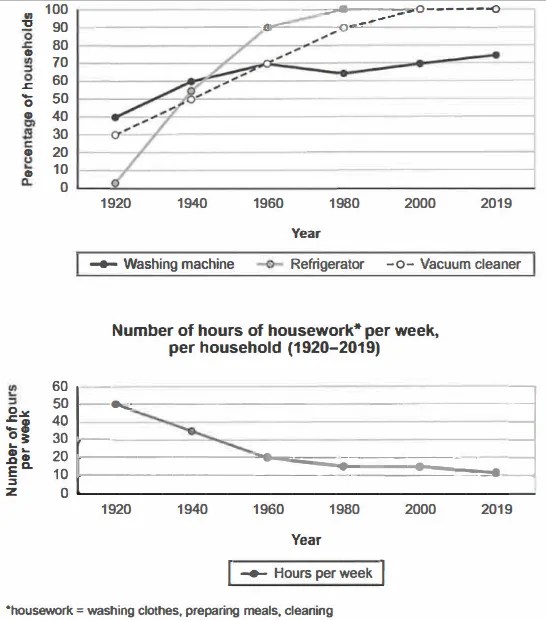
The charts below show the changes in ownership of electrical appliances and amount of time spent doing housework in households in one country between 1920 and 2019.
Summarise the information by selecting and reporting the main features, and make comparisons where relevant.
Percentage of households with electrical appliances (1920-2019)
Student answer (Band 4.5)
In this we are talking about the electronics appliances which are being used in households as hours in thew comparisions are of three products washing machine , refrigerator , vacuum cleaner from year [redacted phone]
in year 1920 the use of vacuum cleaner in households spikes while the other products rises in slow speed as compared to vacuum cleaner
in year 1960 the consumption of washing machine and refrigerator meets at the same point or same point of consumption but the vacuum cleaner growth increases
in 1920 the households take so much time as compared to 2019 because of the consumption of highly helpful devices.
the consumption of refrigerator rapidly goes upwards it helps to save time in 2019
we understand that all the products have helped us so much from [redacted phone] the only consumption changed but all are worth of using. this devices helps to manage our households work in easy mode and fast in speed.
AI examiner evaluation
| Criterion | Band |
|---|---|
| Task Achievement / Task Response | 4.5 |
| Coherence and Cohesion | 4.0 |
| Lexical Resource | 5.0 |
| Grammatical Range and Accuracy | 5.0 |
| Overall | 4.5 |
Task Achievement / Task Response: Band 4.5
The response identifies the three appliances and recognises that housework took longer in 1920 than in 2019, so it includes a few relevant features. However, the main trends are only minimally reported, and some statements are inaccurate or unclear. For example, saying vacuum-cleaner use “spikes” in 1920 does not describe the overall period, when ownership rose from about 30% to 100%. The claim that washing-machine and refrigerator use meet in 1960 is also incorrect: the figures are about 70% and 90%. The response gives no clear overview of the appliances’ broad rise or the decline in housework hours, and it omits key comparisons such as refrigerators reaching full ownership by 1980. Focus on accurate trends and selected figures rather than personal conclusions about usefulness.
Coherence and Cohesion: Band 4.0
There is a basic sequence of time references, and the response moves from appliance ownership to housework hours. However, ideas are not arranged into clear paragraphs or a consistent overview-and-details structure, so the reader has difficulty following the comparison. The opening sentence is difficult to interpret, and the repeated use of “in year” does not create a clear progression. Connections between claims are also weak: the statement about refrigerator growth and saving time in 2019 is not clearly linked to the figures, while the final comments about the devices’ value shift away from summarising the chart. Group the appliance trends together, then describe the housework-hours trend, using clear links such as “by contrast” and “overall” only where they accurately show relationships.
Lexical Resource: Band 5.0
The response uses some relevant topic vocabulary, including “washing machine,” “refrigerator,” “vacuum cleaner,” “consumption,” and “households.” This gives the reader a basic sense of the subject. However, the range is limited and several choices are imprecise or unnatural for describing a graph. “Consumption” is repeatedly used where “ownership” or “the proportion of households owning” would be clearer, and “spikes” does not accurately describe the gradual rise in vacuum-cleaner ownership. Phrases such as “rises in slow speed,” “helps to save time,” and “easy mode and fast in speed” are awkward and sometimes obscure the intended meaning. Use precise trend language such as “increased,” “remained stable,” and “reached 100%,” and avoid evaluative claims about whether appliances are useful.
Grammatical Range and Accuracy: Band 5.0
The response attempts both simple statements and longer sentences, but control is uneven. Several sentences lack clear grammatical structure, as in “In this we are talking about the electronics appliances which are being used in households as hours in thew comparisions are of three products.” The sentence beginning “in year 1920 the use…” also has unclear relationships between its clauses. Articles and plural forms are inconsistent, and punctuation is often missing or misplaced, making sentence boundaries difficult to identify. There are some understandable statements, such as “in 1920 the households take so much time as compared to 2019,” but tense and agreement need attention. Practise writing short, complete comparisons first, then combine them with accurate clauses—for example, “Housework fell from 50 hours in 1920 to 11 hours in 2019.”
See this exact question answered at other band scores. The same prompt compared across bands.
Browse more IELTS Writing model answers or get your own writing scored by the same AI examiner.