Band 5.5 IELTS Writing Task 1 Model Answer
Overall Band Score: 5.5 · Cambridge IELTS 16 · 2026-11-15
IELTS Writing Task 1 question
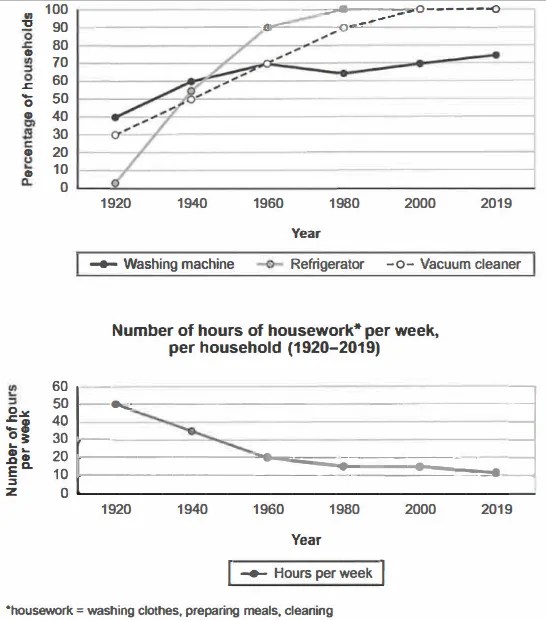
The charts below show the changes in ownership of electrical appliances and amount of time spent doing housework in households in one country between 1920 and 2019.
Summarise the information by selecting and reporting the main features, and make comparisons where relevant.
Percentage of households with electrical appliances (1920-2019)
Student answer (Band 5.5)
The line chart illustrates the changesin ownership of electrical appliances , while the another line chart shows the time spent doing housework in households in one country, over the 100 years period , between 1920 and 2019.
Overall, The use of electrical appliances has incrased over the period, Most of houses has Vacuum cleaner and Refrigerator . From 1920, the usage of both have increased .Furthermore, The use usage of refrigerator and vacuum cleaner has reached 100% by the year 2019.While, Washing machine had the highest percantage at begining at 40%. But the usage remained the same over the years.
Looking first at Refrigerator, It was 0% at first, but in 1940, it recorded the second highest a 55% and by 1980 it recorded the highest at 100% . Similarly the usage of vacum cleaner hit 100% by 1980 and both remainded the same over the years .
By 2019, Lowest figure recorded was at 75%for washing machine.
Because of the helps of technology , The daily number of housework decreases over the years . From 50 hours per week to 11 hours in those 100 years all thanks to technology.
AI examiner evaluation
| Criterion | Band |
|---|---|
| Task Achievement / Task Response | 6.5 |
| Coherence and Cohesion | 5.5 |
| Lexical Resource | 5.0 |
| Grammatical Range and Accuracy | 5.0 |
| Overall | 5.5 |
Task Achievement / Task Response: Band 6.5
You cover both charts and identify the main overall patterns: appliance ownership generally rose, while housework time fell from 50 to 11 hours per week. You also report useful endpoint and milestone figures, including refrigerators reaching 100% by 1980 and washing machines standing at 75% in 2019. This meets the task well, with some features more fully reported than others. However, the overview says washing-machine ownership “remained the same,” which conflicts with the data: it rose from 40% to 75%, despite a dip around 1980. The vacuum cleaner reached 100% in 2000, not 1980, and the refrigerator began at about 2%, rather than 0%. More precise comparisons and a clearer account of the washing-machine trend would strengthen the response further.
Coherence and Cohesion: Band 5.5
The response has a recognisable structure: an introduction, an overview, appliance details, and a final comment on housework. This gives the reader a basic route through the information, and phrases such as “Looking first” help signal a shift. However, progression is uneven: the final paragraph introduces the housework chart only after the appliance discussion, and its trend receives little development. Some linking is mechanical or confusing, particularly “Furthermore” followed by “While,” and the repeated claims about appliances reaching 100% could be organised into a clearer comparison. Paragraphing is present, but grouping the appliance trends together and then describing the housework decline would make the relationships between points easier to follow.
Lexical Resource: Band 5.0
You use relevant task vocabulary, including “ownership,” “recorded,” “usage,” and “hours per week,” so the topic is generally clear. There is also some attempt to vary expressions, for example “hit 100%” and “lowest figure.” However, the range is limited and several word-choice or spelling problems reduce precision: “the use usage” is redundant, “the helps of technology” is unnatural, and “percantage,” “incrased,” and “vacum” are misspelled. Repeated use of “usage” also makes the description less flexible. Aim for accurate chart language such as “the proportion of households owning…” and “housework time declined,” and check spelling and collocations carefully.
Grammatical Range and Accuracy: Band 5.0
You attempt both simple and more developed sentence forms, including a contrast with “but” and a cause-and-effect statement beginning “Because…”. The main trends remain understandable, but control is inconsistent. Examples include “Most of houses has,” where the article and subject–verb agreement are incorrect, and “the usage of both have increased,” where the subject does not agree with the verb. Several sentences also have faulty punctuation or sentence boundaries, such as “100% by the year 2019.While,” and the opening contains awkward article use in “the another line chart.” These errors sometimes make relationships between ideas harder to read. Practise accurate agreement, articles, and sentence punctuation while retaining a mix of sentence structures.
See this exact question answered at other band scores. The same prompt compared across bands.
Browse more IELTS Writing model answers or get your own writing scored by the same AI examiner.