Band 4.5 IELTS Writing Task 1 Model Answer
Overall Band Score: 4.5 · Cambridge IELTS 16 · 2026-11-16
IELTS Writing Task 1 question
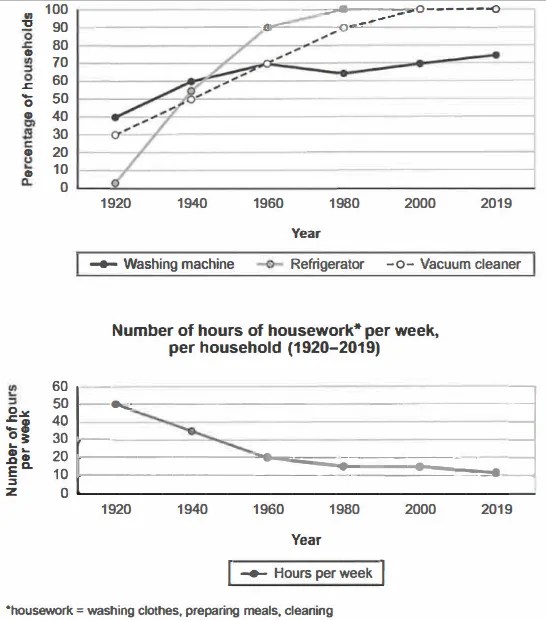
The charts below show the changes in ownership of electrical appliances and amount of time spent doing housework in households in one country between 1920 and 2019.
Summarise the information by selecting and reporting the main features, and make comparisons where relevant.
Percentage of households with electrical appliances (1920-2019)
Student answer (Band 4.5)
"The line chart illustrates the changes in ownership of electrical appliances between 1920 and 2019.Overall,the vaccum cleaner had the highest value accounted for 90% and the washing machine was the lowest accounted for 70%.Looking at the details,vaccum cleaner recorded the highest figure approximately 100%in 1920.This was followed by refrigerator,which stood at 90%in 1920.Meanwhile,Washing machine accounted for 70% in 2000.The vaccum cleaner 30%decreased and then increased to 100%in 2019.
Another line chart shows different number of hours of housework per week,per household between 1920 to 2019.Overall,the number of hours of housework per week value accounted for 50and the the number of hours accounted for10was the lowest.
Looking at the details,it recorded the highest figure 50in 1920.Morever it was accounted for
40 in 1940.However the number of hours was accounted for 30in 1960.
This number of hours was followed by 20 in 1980.Meanwhile,the number of hours was
accounted for 10 in 2000."
AI examiner evaluation
| Criterion | Band |
|---|---|
| Task Achievement / Task Response | 4.0 |
| Coherence and Cohesion | 4.5 |
| Lexical Resource | 5.0 |
| Grammatical Range and Accuracy | 5.0 |
| Overall | 4.5 |
Task Achievement / Task Response: Band 4.0
The response identifies both charts and attempts to give an overview, but the main features are frequently misreported, so the task is addressed only minimally. For example, the vacuum cleaner did not reach approximately 100% in 1920; it began at 30% and rose to 100% by 2000. The refrigerator started at about 2%, not 90%, and the washing machine was not the lowest at 70% in the overall comparison. The housework figures are also shifted: they fell from 50 hours in 1920 to 35 in 1940 and 20 in 1960, rather than 40 and 30 respectively. The account omits the final 2019 figure and gives no clear comparison of the appliance trends. Focus on accurate starting and ending points and the overall patterns.
Coherence and Cohesion: Band 4.5
There is a basic attempt to organise the response into two sections, one for appliance ownership and one for housework, and phrases such as “Looking at the details” signal a move from overview to data. However, progression within each section is difficult to follow: appliance figures are presented out of chronological order, and the housework sequence becomes incomplete and ends at 2000. Linking expressions such as “This was followed by” and “Meanwhile” do not always clarify which series or year is being discussed. Paragraphing is also weakened by the abrupt final line and uneven spacing. Arrange each chart’s figures chronologically, use a separate paragraph for the overview and details, and make references explicit by naming the appliance or year.
Lexical Resource: Band 5.0
The response uses a small set of task-related terms, including “ownership,” “electrical appliances,” “highest figure,” and “hours of housework per week.” This gives it some relevant vocabulary, but repetition of “accounted for” and “number of hours” makes the description imprecise and unnatural. Several spelling errors are noticeable, including “vaccum” and “Morever,” while phrases such as “the highest value accounted for 90%” do not express the intended comparison clearly. Use more precise reporting verbs and trend language, such as “stood at,” “rose to,” “declined,” and “remained stable.” Check spelling carefully and vary repeated phrases so that each figure is clearly linked to its category.
Grammatical Range and Accuracy: Band 5.0
The response attempts some sentence variety through sequencing and contrast, for example, “This was followed by…” and “However…,” but most sentences rely on simple patterns and the more extended constructions are often faulty. Missing spaces after full stops and around figures make sentence boundaries unclear. There are also errors in articles and sentence construction, as in “the the number of hours accounted for10was the lowest,” and the opening overview joins several ideas without clear punctuation. Some phrases lack a complete or well-formed clause, particularly the unfinished “Morever it was accounted for” before the next line. Practise writing complete sentences with a clear subject and verb, and use consistent punctuation and spacing when reporting years and percentages.
See this exact question answered at other band scores. The same prompt compared across bands.
Browse more IELTS Writing model answers or get your own writing scored by the same AI examiner.