Band 6.5 IELTS Writing Task 1 Model Answer
Overall Band Score: 6.5 · Cambridge IELTS 16 · 2026-11-16
IELTS Writing Task 1 question
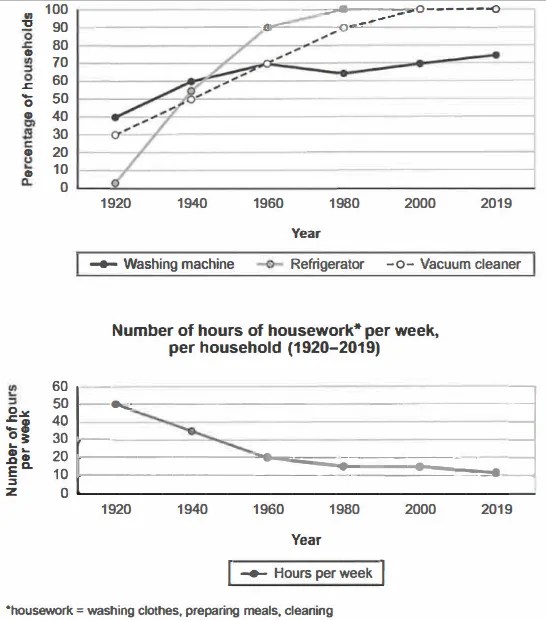
The charts below show the changes in ownership of electrical appliances and amount of time spent doing housework in households in one country between 1920 and 2019.
Summarise the information by selecting and reporting the main features, and make comparisons where relevant.
Percentage of households with electrical appliances (1920-2019)
Student answer (Band 6.5)
The provided figure illustrates the differences in electrical equipment ownership, and the number of hours doing house chores from 1920 to 2019 in a country.
Overall, eventually, refrigerators and vacuum cleaners were in every household except washing machines. the number of hours of usage has a downward trend.
In 1920, less than 5% of households had refrigerators, while three out of ten houses had vacuum cleaners and more than one-third of homes had washing machines. However, ownership of refrigerators were rapidly increased and it was common in every house by 1980 and continue to remained unchanged. vacuum cleaners took two more decades be common in every home and held their position. However, washing machines were the most popular electrical appliances in 1920. the ownership gradually increased to 70% in 1960, which was the same as vacuum cleaners at the time, before reducing to approximately to 65% in 1980. Then, ownership gradually increased roughly to 75% in 2019.
In 1920, there were 50 hours spent using electrical appliances. It sharply decreased to 20 hours by 1960, and gradually reduced close to 10 hours by the year 2019.
AI examiner evaluation
| Criterion | Band |
|---|---|
| Task Achievement / Task Response | 7.0 |
| Coherence and Cohesion | 6.5 |
| Lexical Resource | 6.5 |
| Grammatical Range and Accuracy | 5.5 |
| Overall | 6.5 |
Task Achievement / Task Response: Band 7.0
The response covers both charts and identifies the main overall patterns: appliance ownership generally rose, while weekly housework time fell. It supports this with relevant comparisons, including refrigerators reaching full household coverage by 1980 and vacuum cleaners doing so by 2000, as well as the washing-machine dip around 1980. Most reported figures align with the chart. However, the overview says refrigerators and vacuum cleaners were in every household “except washing machines,” which is imprecise because washing-machine ownership also rose to 75%; clarify that only the first two reached 100%. The final paragraph incorrectly describes the hours as time spent “using electrical appliances”: the chart measures housework, not appliance use. Correcting this distinction and making the overview more precise would strengthen an otherwise well-selected account.
Coherence and Cohesion: Band 6.5
The response has a clear overall structure: an introduction, an overview, a paragraph on appliance ownership, and a final paragraph on housework hours. The sequence within the appliance paragraph is generally logical, and linking words such as “while,” “before,” and “then” help show comparisons and change over time. Some cohesion is less controlled, however. Repeated “However” does not always signal a genuine contrast, and the final paragraph feels detached from the earlier discussion rather than integrated as a second chart trend. The overview’s reference to “the number of hours of usage” is also unclear, making the relationship to the housework chart harder to follow. Use more precise references and vary transitions to make progression smoother.
Lexical Resource: Band 6.5
There is an adequate range for describing trends and comparisons, including “gradually increased,” “rapidly increased,” “downward trend,” and “remained unchanged.” These choices communicate the broad patterns, and the response uses relevant terms such as “ownership” and “households.” Some wording is imprecise or awkward for this chart, particularly “electrical equipment,” “house chores,” and “hours spent using electrical appliances”; the last phrase mislabels the measure as appliance use rather than housework time. There is also repetition of “ownership” and “common in every home.” More precise chart vocabulary and natural collocations would improve flexibility and accuracy. For example, describe appliances as “owned by households” and say that housework time “fell” or “declined.”
Grammatical Range and Accuracy: Band 5.5
The response attempts a mix of simple and complex sentences, including clauses with “while,” “before,” and “which,” and the main trends remain understandable. However, errors in verb forms, agreement, articles, and sentence boundaries are frequent enough to limit accuracy. Examples include “ownership of refrigerators were rapidly increased,” “continue to remained unchanged,” and the fragment-like lowercase starts after full stops in “the number” and “vacuum cleaners.” The phrase “before reducing to approximately to 65%” also has an unnecessary repeated preposition. Aim to check subject–verb agreement and use consistent past-tense forms for historical data; for example, “refrigerator ownership rose rapidly and remained unchanged.” Careful proofreading of capitalization and sentence construction would improve control.
See this exact question answered at other band scores. The same prompt compared across bands.
Browse more IELTS Writing model answers or get your own writing scored by the same AI examiner.