Band 5.0 IELTS Writing Task 1 Model Answer
Overall Band Score: 5.0 · Cambridge IELTS 16 · 2026-11-16
IELTS Writing Task 1 question
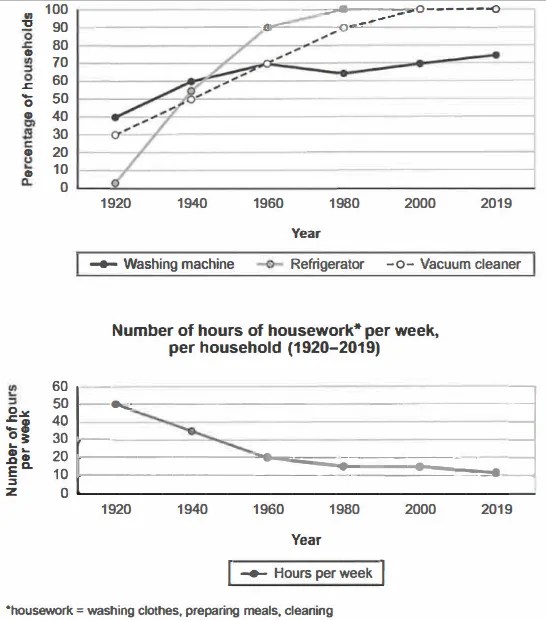
The charts below show the changes in ownership of electrical appliances and amount of time spent doing housework in households in one country between 1920 and 2019.
Summarise the information by selecting and reporting the main features, and make comparisons where relevant.
Percentage of households with electrical appliances (1920-2019)
Student answer (Band 5.0)
The given charts illustrate the transfer of ownership of power appliances and the number of time spent doing housework in houshold in one country from 1920 to 2019.
Overall, it is clear from the first chart that refrigerator and vacuum cleaner were the mostly used appliances, while the other chart indicates a drawback of the number of hours of hours per week per houshold.
According to the fisrt chart, refrigerator starts from 0% in 1920, and increses dramatically at the propotion of 100% in 2019, while vacuum cleaner starts from 40% in 1920 and had a significant rose of 100% in 2019. However washing machine had a fluctuation throughout the period, starts at 3
AI examiner evaluation
| Criterion | Band |
|---|---|
| Task Achievement / Task Response | 4.0 |
| Coherence and Cohesion | 5.0 |
| Lexical Resource | 5.5 |
| Grammatical Range and Accuracy | 5.0 |
| Overall | 5.0 |
Task Achievement / Task Response: Band 4.0
The response identifies the broad topic and attempts an overview, but it reports only a small part of the data and does not complete the comparison. The overview claim that refrigerators and vacuum cleaners were the “mostly used” appliances is not accurate across the whole period: washing machines had higher ownership than refrigerators in 1920 and 1940. Some figures are also misread: refrigerators began at about 2%, not 0%, and vacuum cleaners at about 30%, not 40%. The final sentence is cut off after “starts at 3,” and the hours-of-housework trend is not described at all. The response is also 36 words below the required minimum. To improve, give a complete overview and select key figures for all three appliances and housework.
Coherence and Cohesion: Band 5.0
There is a basic attempt to organise the response into an introduction, an overview and a detail paragraph, and sequencing phrases such as “Overall” and “According to the first chart” help signal the purpose of each section. However, the progression is incomplete: the final paragraph stops mid-sentence, and the second chart is not discussed, so the reader cannot follow a full account of the task. The overview also combines two different claims without clearly explaining the comparison. Use separate, complete paragraphs for the overview and the main details, and group related trends together. Linking expressions should connect accurate, finished points rather than introduce information that is left undeveloped.
Lexical Resource: Band 5.5
The response uses some task-related vocabulary, including “ownership,” “appliances,” “fluctuation” and “throughout the period,” so the topic is generally recognisable. However, the range is limited and several word choices or collocations are inaccurate, such as “transfer of ownership,” “a drawback of the number of hours,” and “a significant rose.” Spelling errors—including “houshold,” “fisrt” and “increses”—also make the writing less controlled. Aim for precise chart language such as “the proportion of households owning,” “fell steadily,” and “reached 100%.” Check spelling and choose verbs that describe trends naturally; this will make the information clearer and more appropriate for an academic report.
Grammatical Range and Accuracy: Band 5.0
The response attempts some complex sentence forms, particularly with “while” and “However,” and the opening sentence communicates the general subject. However, grammatical control is inconsistent. For example, “refrigerator and vacuum cleaner were” lacks plural articles or plural nouns, while “washing machine had a fluctuation throughout the period, starts at…” shifts awkwardly between past tense and an incomplete clause. The phrase “the number of time spent” also has an incorrect noun form and structure. Most sentences are understandable, but errors and the unfinished final sentence interfere with clarity. Use consistent past-tense reporting, check singular and plural forms, and make sure each sentence has a complete main clause.
See this exact question answered at other band scores. The same prompt compared across bands.
Browse more IELTS Writing model answers or get your own writing scored by the same AI examiner.