Band 5.0 IELTS Writing Task 1 Model Answer
Overall Band Score: 5.0 · Cambridge IELTS 16 · 2026-11-17
IELTS Writing Task 1 question
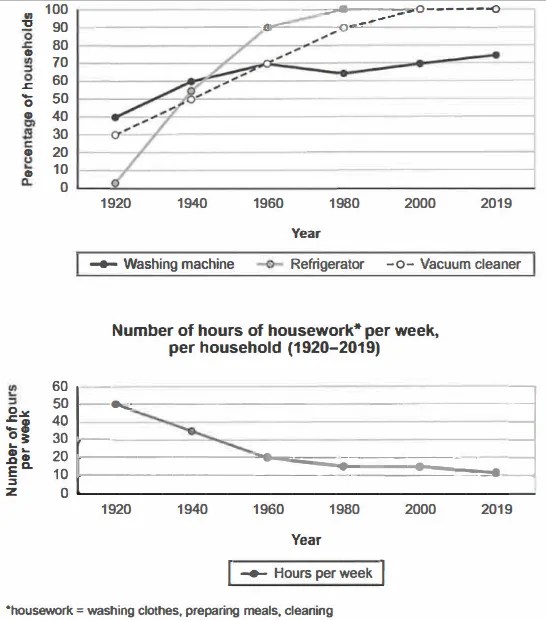
The charts below show the changes in ownership of electrical appliances and amount of time spent doing housework in households in one country between 1920 and 2019.
Summarise the information by selecting and reporting the main features, and make comparisons where relevant.
Percentage of households with electrical appliances (1920-2019)
Student answer (Band 5.0)
This line graph is illustrating the percentage of households with electric appliances between the year from 1920 to 2019 and time spent during housework.
The use of refrigerator in 1920 was 0% but it started increasing and with dramatic increase its usage reached to 90% in 1960 and in 1980 its reached at its peak to 100% and maintain this percentage till 2000.
Washing machine and vacuum cleaner started from 40% and 0% and they also maintain their usage till 1940 to nearly 50%. In 1960 washing machine intersect at same percentage approximately 70% but usage of washing machine start declining and reached nearly 65% in 1980 and with little rise in 2000 it ends at approximately 75% in 2019.But vacuum cleaner maintain its level and intersect with refrigerator and maintain its usage to 100% by the end of 2019.
AI examiner evaluation
| Criterion | Band |
|---|---|
| Task Achievement / Task Response | 3.5 |
| Coherence and Cohesion | 5.0 |
| Lexical Resource | 5.5 |
| Grammatical Range and Accuracy | 5.0 |
| Overall | 5.0 |
Task Achievement / Task Response: Band 3.5
You identify the general subject and report several relevant appliance trends, including refrigerators rising to 100% and vacuum cleaners reaching full ownership by the end. However, the response does not provide a clear overview of the main features, and the second chart—housework hours falling from 50 to 11—is omitted entirely. Some figures are inaccurate: refrigerators were about 2%, not 0%, in 1920, and vacuum cleaners began at 30%, not 0%. The description of washing-machine ownership is also unclear, particularly the claim that it “maintain[s]” usage until 1940. The response is 10 words below the required minimum. To improve, cover both charts, give a concise overview, and check each starting value and major change against the graph.
Coherence and Cohesion: Band 5.0
The response has a basic sequence: it introduces the graph, describes refrigerators, and then discusses washing machines and vacuum cleaners. This gives the reader some organisation, and time references such as “in 1960” and “by the end of 2019” help locate information. However, there is no distinct overview or paragraphing to guide the reader through the main trends, and the account moves between two appliance series within the same sentence. Linking is limited, with repeated use of “and” and “but”; some connections are also unclear, as in “maintain their usage till 1940 to nearly 50%.” Organise the response into an introduction, an overview, and focused detail paragraphs, and use clearer comparisons between series.
Lexical Resource: Band 5.5
You use relevant vocabulary for describing trends, including “increasing,” “dramatic increase,” “declining,” “peak,” and “percentage.” These choices show an attempt to vary the language rather than relying only on basic terms. However, several expressions are imprecise or unnatural, such as “maintain their usage,” “intersect at same percentage,” and “reached at its peak.” “Usage” is also repeated where the chart measures household ownership, and “electric appliances” is less precise than “electrical appliances.” Aim for accurate collocations and use terms that describe the data directly, such as ownership, proportion, rose, fell, and levelled off. This will make the report clearer and more natural.
Grammatical Range and Accuracy: Band 5.0
You attempt both simple and longer sentences, including a sequence of changes linked with “but” and “and.” The main meaning is usually recoverable, but errors occur frequently in sentence construction and verb forms. For example, “in 1980 its reached at its peak” has an incorrect subject form and verb pattern, while “washing machine start declining” does not maintain the past tense used for the historical data. Articles and plurals are also inconsistent in phrases such as “use of refrigerator” and “washing machine and vacuum cleaner.” Punctuation is weak, with missing spaces after full stops and long sentences that need clearer boundaries. Practise accurate past-tense reporting and divide complex descriptions into controlled sentences.
See this exact question answered at other band scores. The same prompt compared across bands.
Browse more IELTS Writing model answers or get your own writing scored by the same AI examiner.