Band 5.5 IELTS Writing Task 1 Model Answer
Overall Band Score: 5.5 · Cambridge IELTS 16 · 2026-11-18
IELTS Writing Task 1 question
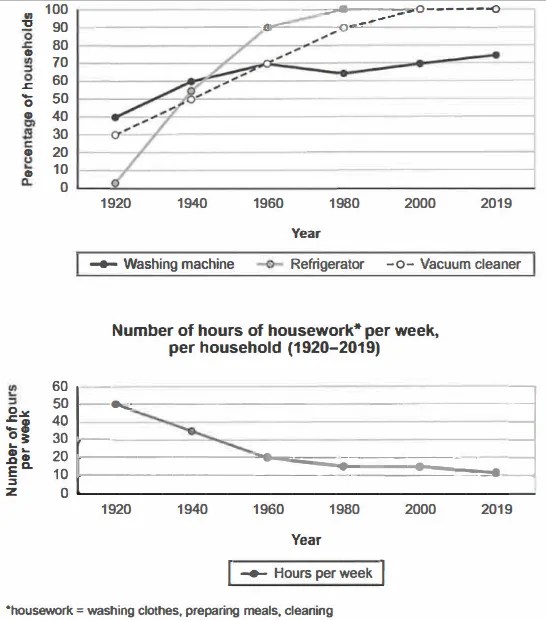
The charts below show the changes in ownership of electrical appliances and amount of time spent doing housework in households in one country between 1920 and 2019.
Summarise the information by selecting and reporting the main features, and make comparisons where relevant.
Percentage of households with electrical appliances (1920-2019)
Student answer (Band 5.5)
The two line graph illustrates the proportion of households who owned electrical applicance and amount of hours spent on housework.
Overall, the use of refrigerator increased over the entire period of time whereas washing machine show large fluctuation. Vacuum cleaner show gradual climb. The average number of hour spent on housework decline .
The household who used refrigerator increased from 0% to 100% in betweeen year 1920 and 1980 and it remains stable. Wahing machine shows increased from 1920 to 1960 with percentage of 40%, 50% and 70% respectively and decline down in between 1960 to 1980. In the year 2000 and 2019 washing machine climb up. Last one, Vacuum cleaner showed shows same level of gradual increase from 1920 to 2019 without any fluctuation.
Subsequently, the numbe rof people spent time on housework is higher upto 50% in the year 1920 and it declines during the entire period of time.
.
AI examiner evaluation
| Criterion | Band |
|---|---|
| Task Achievement / Task Response | 6.0 |
| Coherence and Cohesion | 6.0 |
| Lexical Resource | 5.5 |
| Grammatical Range and Accuracy | 5.0 |
| Overall | 5.5 |
Task Achievement / Task Response: Band 6.0
You identify the main overall patterns: refrigerator ownership reaches full coverage and then levels off, while housework time declines. You also report the broad rise in vacuum-cleaner ownership and the washing-machine dip followed by recovery. However, some details are inaccurate or unclear: refrigerator ownership starts at about 2%, not 0%, and washing-machine ownership is about 60% in 1940, not 50%. The overview says washing machines show “large fluctuation,” although the series mainly rises with one modest fall. The housework figures are described as percentages, even though they represent hours per week. More precise comparisons and a clearer account of the key figures would make the summary more complete and accurate.
Coherence and Cohesion: Band 6.0
The response has a recognisable structure: an introduction, an overview, and paragraphs describing the appliance trends and housework. This gives the reader a coherent overall route through the information. Some links and references, however, are mechanical or unclear. “Overall” and “Subsequently” signal stages, but “Last one” is informal and does not clearly connect the vacuum-cleaner point to the preceding comparison. The appliance details are also crowded into one paragraph, while the final housework point is very brief. Grouping the three appliance series together with clearer comparisons, then giving the housework trend its own developed paragraph, would improve progression and cohesion.
Lexical Resource: Band 5.5
You use relevant chart vocabulary such as “proportion,” “increased,” “decline,” “stable,” and “gradual increase,” so the main trends are generally understandable. However, several word choices and collocations are imprecise or repetitive: “use of refrigerator” and “household who used refrigerator” refer to ownership, while “washing machine shows increased” is not a natural way to describe a data trend. “Large fluctuation” overstates the washing-machine pattern, which has one modest dip. There are also spelling errors, including “applicance,” “betweeen,” “Wahing,” and “numbe.” Use accurate terms consistently, such as “ownership,” “the proportion of households,” and “hours of housework per week,” and check spelling before submitting.
Grammatical Range and Accuracy: Band 5.0
You attempt both simple and more extended sentence forms, and the overall meaning can usually be followed. However, some errors in agreement, articles, plurals, and sentence construction remain. For example, “washing machine show” and “Vacuum cleaner show” need singular verb agreement, while “the average number of hour” requires a plural noun. The opening also needs parallel structure: “the proportion of households who owned electrical appliances and the number of hours spent on housework.” In “it remains stable,” the pronoun’s reference is not fully clear. Build accuracy by checking subject–verb agreement and noun forms, and use a wider range of controlled comparisons, such as “while” and “whereas,” rather than relying mainly on short trend statements.
See this exact question answered at other band scores. The same prompt compared across bands.
Browse more IELTS Writing model answers or get your own writing scored by the same AI examiner.