Band 5.5 IELTS Writing Task 1 Model Answer
Overall Band Score: 5.5 · Cambridge IELTS 16 · 2026-11-18
IELTS Writing Task 1 question
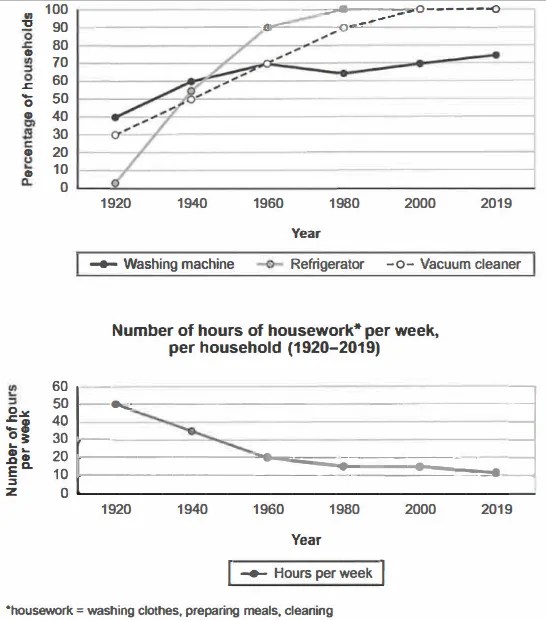
The charts below show the changes in ownership of electrical appliances and amount of time spent doing housework in households in one country between 1920 and 2019.
Summarise the information by selecting and reporting the main features, and make comparisons where relevant.
Percentage of households with electrical appliances (1920-2019)
Student answer (Band 5.5)
The chart illustrates the changes in the proportion of ownership of electrical appliances and the number of hours per week spent doing household chores in a single country between 1920 and 2019.
Overall, it is noticeable that all the home appliances noticablly increased; however, the refrigerator hit a high at the end of the period, while the vacuum cleaner gradually increased, whereas the washing machine saw some fluctuations and showed less of an increase and the number of house work dropped over the period of time.
Firstly, the refrigerator started from zero and, over the period of time, gradually increased and in 1980 hit a high of 100% and remained the same for the rest of the years
Secondly, the washing machine started from 30% and hit a high of 100% in year 2000.
AI examiner evaluation
| Criterion | Band |
|---|---|
| Task Achievement / Task Response | 5.0 |
| Coherence and Cohesion | 5.5 |
| Lexical Resource | 6.0 |
| Grammatical Range and Accuracy | 6.0 |
| Overall | 5.5 |
Task Achievement / Task Response: Band 5.0
You identify the overall rise in appliance ownership and the decline in housework, and you correctly note that refrigerators reached 100% by 1980 and stayed there. However, the report covers the data only partially: it gives no figures or trend for vacuum cleaners or housework, despite mentioning the latter in the overview. Several washing-machine details are inaccurate: ownership was about 40% in 1920, not 30%, and it never reached 100%; it ended at about 75%. The refrigerator began at about 2%, rather than zero. The response is also 16 words below the required minimum, leaving important comparisons undeveloped. Include the main figures for all four series and describe the key contrasts.
Coherence and Cohesion: Band 5.5
The response has a recognisable structure, with an introduction, an overview and two detail paragraphs, and signposting such as “Overall,” “Firstly” and “Secondly” helps show the intended sequence. However, the progression is incomplete: the final paragraph stops after the washing-machine figures, while the vacuum-cleaner and housework trends are not developed. The overview also combines several comparisons in a long sentence, making the relationships between trends less clear. To improve, organise the details by appliance trends and then housework, and use clear comparisons between the series. Ensure each paragraph develops its stated focus rather than ending before the chart’s main information has been covered.
Lexical Resource: Band 6.0
You use an adequate range of task-related vocabulary, including “proportion,” “ownership,” “fluctuations” and “gradually increased,” and the meaning is generally clear. There are, however, some imprecise or awkward choices: “hit a high” is less suitable for describing a line reaching a maximum, and “house work” is not conventionally written as one word. “Noticablly” is misspelled, and “the number of hours per week spent doing household chores” could be expressed more concisely as “weekly housework hours.” Avoid repeating broad phrases such as “over the period of time”; use precise trend language and figures to make comparisons more informative.
Grammatical Range and Accuracy: Band 6.0
You show a mix of simple and more complex sentence forms. For example, the overview uses a contrast with “however” and “whereas,” and the opening sentence clearly introduces both measures. Some grammatical and punctuation issues remain, though they do not usually prevent understanding. The sentence beginning “Overall” is long and joins several contrasting ideas without clear punctuation, while the final detail sentence lacks a full stop. In “in year 2000,” the article is missing; write “in the year 2000” or simply “in 2000.” Aim to control longer comparison sentences by separating the trends into shorter clauses, and check articles and sentence-ending punctuation.
See this exact question answered at other band scores. The same prompt compared across bands.
Browse more IELTS Writing model answers or get your own writing scored by the same AI examiner.