Band 5.5 IELTS Writing Task 1 Model Answer
Overall Band Score: 5.5 · Cambridge IELTS 16 · 2026-11-18
IELTS Writing Task 1 question
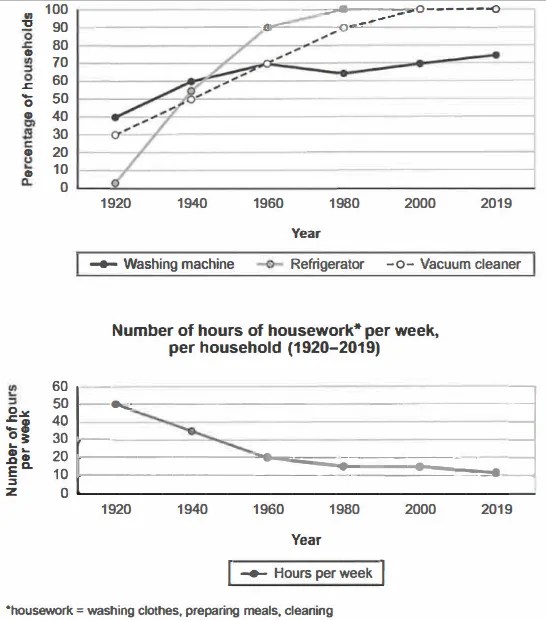
The charts below show the changes in ownership of electrical appliances and amount of time spent doing housework in households in one country between 1920 and 2019.
Summarise the information by selecting and reporting the main features, and make comparisons where relevant.
Percentage of households with electrical appliances (1920-2019)
Student answer (Band 5.5)
The line graphs compare the changes of the proportion of households with electrical appliance and the number of hours of housework per week, per household for a particular time. Overall, it is evident that all the figures showed an upward trend, although the rate of growth varied considerabely. Refrigerator and vacuum cleaner remained the highest position throughout the period, whereas the time of housework per houldhold declined over the period.
In 1920, refrigerator used no electricity, but it increased sharply and rose to approximately 55% in1940. the figure rose from 1940 to 1980, before remained stable at 100%. Vacuum cleaner started to use electricity from 30%. The figure grew significantly and remaind same with refrigerator at 100% in 2000. In terms of washing machine, in 1920 the figure was 40% and it rose slowly before decreased in1960. The figure was just over 70% in 2019.
In 1920, every household took 50 hours per week, the figure decreased modarately between 1920 and 1960 before decliced steadily. In 2019, it was 10 hours.
AI examiner evaluation
| Criterion | Band |
|---|---|
| Task Achievement / Task Response | 5.5 |
| Coherence and Cohesion | 5.5 |
| Lexical Resource | 5.5 |
| Grammatical Range and Accuracy | 5.0 |
| Overall | 5.5 |
Task Achievement / Task Response: Band 5.5
You identify the broad contrast between rising appliance ownership and falling housework time, and include several relevant figures, such as refrigerators reaching 100% by 1980 and housework falling to about 10 hours in 2019. However, the overview is not fully accurate: “all the figures showed an upward trend” conflicts with the clear decline in housework and the washing-machine dip around 1980. The claim that refrigerators and vacuum cleaners “remained the highest position throughout” is also inaccurate, since neither was highest at every point. Some details are unclear or misreported: the refrigerator began at about 2%, not zero, and washing-machine ownership fell after 1960, not before it. A more precise overview and accurate comparisons would make the response more complete and better supported.
Coherence and Cohesion: Band 5.5
The response has a recognisable structure: an introduction and overview are followed by appliance details and then housework figures. This gives the reader a basic route through the information. However, progression within the body paragraphs is sometimes difficult to follow because comparisons and time periods are not consistently expressed. For example, the washing-machine account says it “rose slowly before decreased in1960,” which leaves the sequence unclear, while the refrigerator description jumps from 1940 to 1980 without clearly reporting the intervening trend. Linking phrases such as “In terms of” and “Overall” are used, but connections between individual data points are limited or awkward. Grouping the appliance trends more clearly and using accurate time markers would improve cohesion.
Lexical Resource: Band 5.5
You use some relevant task vocabulary, including “proportion,” “increased sharply,” “rose,” and “declined,” so the main trends are generally understandable. However, the range is limited and several word choices or collocations are inaccurate, which sometimes makes the meaning awkward: “the highest position,” “refrigerator used no electricity,” and “every household took 50 hours” do not describe the chart naturally. There are also noticeable spelling errors, including “considerabely,” “houldhold,” “remaind,” “modarately,” and “decliced.” Aim to use precise chart language consistently—for example, describe the percentage of households that owned an appliance, rather than saying the appliance “used electricity.” Proofreading spelling and word forms would also make the report clearer.
Grammatical Range and Accuracy: Band 5.0
You attempt a mixture of simple sentences and longer clauses, including “although the rate of growth varied considerably” and “before remained stable at 100%.” However, control is uneven, and errors in verb forms, articles, and sentence construction occur often enough to make some statements difficult to interpret. Examples include “before remained stable,” which needs a suitable verb form, and “the figure … before decreased,” where the clause is not grammatically complete. The sentence beginning “In 1920, refrigerator used no electricity” also has an article and structure problem. Tense use is not always controlled when describing past changes. Practise forming accurate past-tense comparisons and checking each clause for a clear subject and correctly formed verb.
See this exact question answered at other band scores. The same prompt compared across bands.
Browse more IELTS Writing model answers or get your own writing scored by the same AI examiner.