Band 5.0 IELTS Writing Task 1 Model Answer
Overall Band Score: 5.0 · Cambridge IELTS 16 · 2026-11-18
IELTS Writing Task 1 question
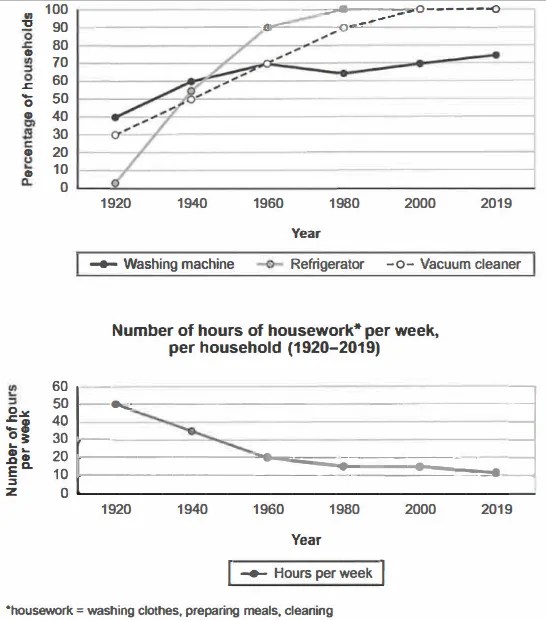
The charts below show the changes in ownership of electrical appliances and amount of time spent doing housework in households in one country between 1920 and 2019.
Summarise the information by selecting and reporting the main features, and make comparisons where relevant.
Percentage of households with electrical appliances (1920-2019)
Student answer (Band 5.0)
The given picture illustrates the changes in ownerships of elecrical appliances and the time spent doing housework in households in a single country between 1920 and 2019.
The diagram shows the proportion of households with electrical appliances. Moreover, it also describes number of hours of housework per week and per household. In 2019, vaccume cleaner juped and continue to its peak point. On the other hand, hours per week of housework gradually decreasing.
In 1920, the percentage of households was very low, while the number of hours of housework per week at its maximum. At first, washing machine use 40 percent and it increases gradully. Refrigerator is the machine that had no useage at start, but it would be rapidly increase through 0 percent to 100 percent.
However, number of hours of house work per week was 50 in 1920. In housework, it includes washing clothes, preparing meals and cleaning. These hours gradually slow down with passage of time and become zero in 2019.
AI examiner evaluation
| Criterion | Band |
|---|---|
| Task Achievement / Task Response | 5.5 |
| Coherence and Cohesion | 5.0 |
| Lexical Resource | 5.0 |
| Grammatical Range and Accuracy | 5.0 |
| Overall | 5.0 |
Task Achievement / Task Response: Band 5.5
You identify the two subjects and give a broad contrast: appliance ownership rises while housework time falls. Some relevant figures are included, such as washing machines at 40% in 1920 and housework at 50 hours. However, the account only partially reports the main features, and several statements are inaccurate or unclear. Refrigerators were at about 2%, not zero, in 1920, and housework fell to about 11 hours in 2019 rather than zero. The claim that vacuum-cleaner ownership “jumped” to its peak is not supported by a specific comparison. Include a clear overview of the major trends and compare the appliances’ different paths, including refrigerators reaching full ownership by 1980 and washing machines fluctuating slightly.
Coherence and Cohesion: Band 5.0
The response has some basic organisation: it introduces the charts, then discusses appliance ownership and housework in separate paragraphs. However, the progression is not consistently clear, and ideas are sometimes repeated or placed together without a useful link. For example, the opening repeats that the diagram shows appliance ownership and housework hours, while “In 1920” appears in two separate paragraphs. Connectors such as “Moreover,” “On the other hand,” and “However” are used, but the relationships they signal are not always precise. A clearer sequence would be an introduction, an overview of the main trends, then focused comparisons of the appliance figures and housework hours, with references that make each comparison easy to follow.
Lexical Resource: Band 5.0
You use some relevant task vocabulary, including “proportion,” “percentage,” “peak point,” and “gradually,” so the topic is generally recognisable. However, the range is limited and several word choices or collocations are inaccurate, which sometimes makes the meaning difficult to follow. For example, “ownerships” is not the natural form here, “vacuum cleaner jumped” is an imprecise description, and “hours gradually slow down” does not clearly describe a decrease. There are also noticeable spelling errors, including “elecrical,” “vaccume,” “gradully,” and “useage.” Use precise trend language such as “rose,” “remained stable,” and “declined,” and check spelling and the natural pairing of nouns and verbs.
Grammatical Range and Accuracy: Band 5.0
The response includes simple sentences and attempts to combine ideas, but the range of structures is limited and errors occur frequently. Examples include “the number of hours … at its maximum,” which is not a complete sentence, and “washing machine use 40 percent,” where the verb form is missing. In “it would be rapidly increase,” the verb construction is faulty; “hours … gradually slow down” also has an unclear grammatical relationship between the subject and verb. Articles and plural forms are inconsistent, as in “number of hours” and “ownerships.” These errors can make some statements hard to interpret. Practise accurate past-tense descriptions of chart data and build longer sentences around a clear subject and verb, checking agreement and articles.
See this exact question answered at other band scores. The same prompt compared across bands.
Browse more IELTS Writing model answers or get your own writing scored by the same AI examiner.