Band 5.5 IELTS Writing Task 1 Model Answer
Overall Band Score: 5.5 · Cambridge IELTS 16 · 2026-11-18
IELTS Writing Task 1 question
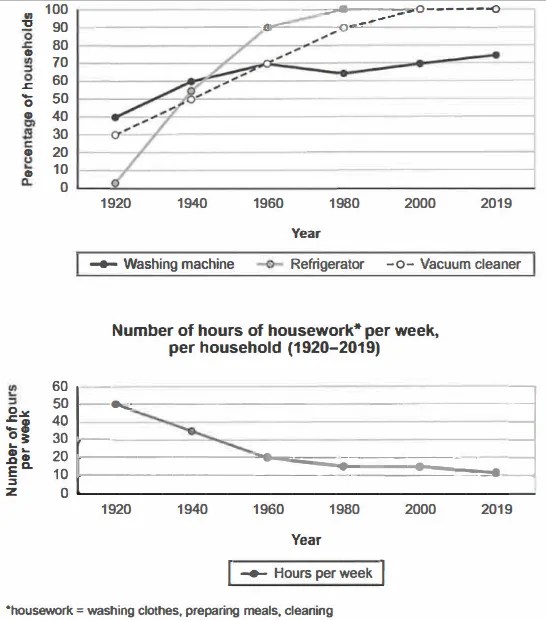
The charts below show the changes in ownership of electrical appliances and amount of time spent doing housework in households in one country between 1920 and 2019.
Summarise the information by selecting and reporting the main features, and make comparisons where relevant.
Percentage of households with electrical appliances (1920-2019)
Student answer (Band 5.5)
The line charts illustrate the percentage of households with electrical applicance and number of hours of housework per week, per household over the periods of 99 years. Overall, refrigetator had the highest percentage of household, while washing machine showed the lowest trend. The number of hours per week of houseworks accounted highest in 1920 and the hours decreased significantly over the period.
In 1920, washing machine stood at 40%, followed by 60% in 1940. The use of washing machine recorded at 70% in 1960. It then decreased gradually at 64% in 1980. After that it remained stable with approximately 72% in 2000 and 2019.
In terms of refrigerator, it started at 0% in 1920, and then it increased sharply at 55% in 1940, followed by 90% in 1960. After that, it climb at 100% in 1980,
AI examiner evaluation
| Criterion | Band |
|---|---|
| Task Achievement / Task Response | 4.0 |
| Coherence and Cohesion | 5.5 |
| Lexical Resource | 6.0 |
| Grammatical Range and Accuracy | 5.5 |
| Overall | 5.5 |
Task Achievement / Task Response: Band 4.0
The response identifies the broad contrast that appliance ownership rose while housework time fell, and it gives several relevant figures for washing machines and refrigerators. However, it addresses the task only partially: the overview incorrectly says refrigerators had the highest ownership while washing machines showed the lowest trend, despite the vacuum cleaner also reaching 100% and washing-machine ownership generally rising. The account stops partway through the refrigerator trend and omits the vacuum-cleaner series and nearly all details about housework hours. The response also contains 136 words, below the required 150. To make the summary complete, report the main trends for all four series and include key end-point comparisons, without needing to list every value.
Coherence and Cohesion: Band 5.5
The response has a recognisable structure: an opening overview is followed by paragraphs on washing machines and refrigerators. Sequencing within the washing-machine paragraph is clear, using “In 1920,” “It then,” and “After that” to guide the reader through the years. However, the final paragraph ends abruptly after the 1980 figure, so the report has no complete progression or conclusion covering the remaining data. The overview also does not prepare the reader for the selective detail that follows, and the housework series is not integrated. Use a paragraph for the overall trends, then organise the appliance and housework details in a balanced way, with clear transitions between them.
Lexical Resource: Band 6.0
There is an adequate range of task-related vocabulary, including “percentage,” “increased sharply,” “decreased significantly,” and “remained stable.” These expressions help communicate changes over time, and the meaning is generally understandable. However, some word choices and collocations are inaccurate or awkward, such as “washing machine showed the lowest trend,” “percentage of household,” and “hours of houseworks accounted highest.” Spelling errors in “applicance” and “refrigetator” also reduce accuracy. Choose precise terms for ownership levels and trends—for example, say that ownership “was lowest” or “rose to” a figure—and check spelling and singular/plural forms carefully.
Grammatical Range and Accuracy: Band 5.5
The response uses a mix of simple and more developed sentence forms, including “It then decreased gradually…” and “After that, it remained stable…”. Most of the intended meaning can be followed, but some grammatical errors remain. For example, “it climb at 100%” has an incorrect verb form, and “In 1920, washing machine stood at 40%” needs an article or plural noun. The sentence “The number of hours per week of houseworks accounted highest” also has an unclear grammatical construction. The final sentence is incomplete, ending with a comma after “1980.” Practise accurate past-tense reporting, articles, and complete sentence boundaries while retaining the range of structures already attempted.
See this exact question answered at other band scores. The same prompt compared across bands.
Browse more IELTS Writing model answers or get your own writing scored by the same AI examiner.