Band 5.0 IELTS Writing Task 1 Model Answer
Overall Band Score: 5.0 · Cambridge IELTS 16 · 2026-11-18
IELTS Writing Task 1 question
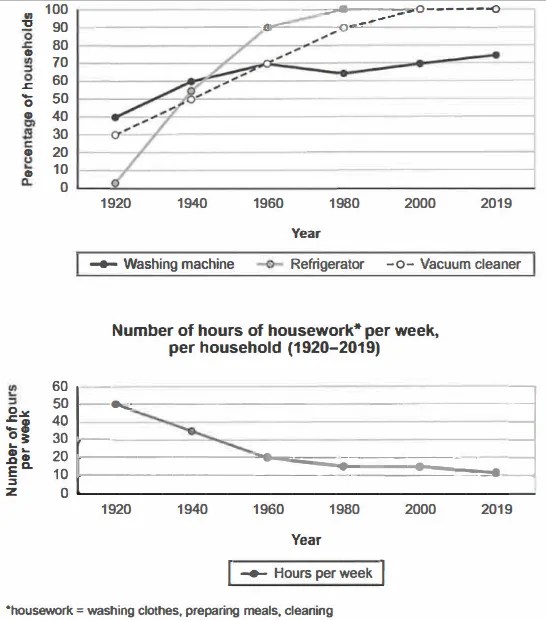
The charts below show the changes in ownership of electrical appliances and amount of time spent doing housework in households in one country between 1920 and 2019.
Summarise the information by selecting and reporting the main features, and make comparisons where relevant.
Percentage of households with electrical appliances (1920-2019)
Student answer (Band 5.0)
The two line graphs demonstrate the proportion in ownership of electrical appliances such as washing machine, refrigerator and vacuum cleaner. Also, it illustrates the number of hours of various houseworky per residents weekly between 1920 and 2019.
Overall, most of the electrical appliances were dramatically increased over the period years. While, the number of hours of housework were at peaked and fell steadily throughout the given years.
In detail, the data of refrigerator started at zero then rise abruptly at exact 90% in 1960, whereas increased steadily at 100 which recorded as the highest peaked percentage. In addition, washing machineand vacuum cleaner were gradually climbed from 30% to 40% respecctively, and reached the same at 70% in 1960. While, washing machine slightly fell at approximately 60% but then increased just over a three quarters, vacuum sharply rise to 100% precisely. In contrast, the number of hours
AI examiner evaluation
| Criterion | Band |
|---|---|
| Task Achievement / Task Response | 5.0 |
| Coherence and Cohesion | 5.0 |
| Lexical Resource | 5.5 |
| Grammatical Range and Accuracy | 5.0 |
| Overall | 5.0 |
Task Achievement / Task Response: Band 5.0
You identify the two broad trends: appliance ownership generally rose, while weekly housework time declined. You also include some relevant comparisons, such as refrigerators reaching 100% and washing-machine ownership dipping before rising. However, the report is only partial: the housework graph is introduced but not described, and the final sentence breaks off at “In contrast, the number of hours”. Some figures are also inaccurate or unclear: refrigerators began at about 2%, not zero, and reached about 90% in 1960; the washing-machine and vacuum-cleaner figures in 1920 were 40% and 30%, respectively. The response is four words below the required minimum. Cover both graphs with a complete overview and key figures, checking each comparison against the chart.
Coherence and Cohesion: Band 5.0
There is a basic paragraph structure, with an introduction, an overview and a detail paragraph, and the overview attempts to summarise the main trends. However, progression is limited because the detail paragraph moves between appliances without a clear sequence, and the housework comparison is left unfinished. Linking words such as “While,” “In addition,” and “In contrast” are used, but some are awkwardly placed or do not connect complete ideas; for example, “While, washing machine slightly fell…” is not a complete, well-linked sentence. Organise the details by graph or by time period, use clear comparisons, and ensure every paragraph and sentence is complete.
Lexical Resource: Band 5.5
You use some task-relevant vocabulary, including “proportion,” “ownership,” “steadily,” and “approximately,” and the reader can generally identify the appliances and trends being discussed. However, several word choices and collocations are inaccurate or unnatural, such as “houseworky,” “at peaked,” “highest peaked percentage,” and “sharply rise.” Spelling and spacing problems, including “respecctively” and “washing machineand,” also reduce clarity. The range is sufficient to attempt a report, but errors sometimes make the description difficult to follow. Prefer precise chart language such as “the figure for,” “peaked at,” “rose sharply,” and “declined,” and check spelling and word forms carefully.
Grammatical Range and Accuracy: Band 5.0
The response attempts some complex sentence forms, including clauses introduced by “whereas” and “while,” but these are often faulty or incomplete. For example, “While, the number of hours of housework were at peaked and fell steadily” has an incorrect clause structure and subject–verb agreement, while “In contrast, the number of hours” is unfinished. There are also errors in articles and number, as in “such as washing machine,” and in verb forms, as in “were gradually climbed.” These frequent problems sometimes obscure the intended relationships between data. Build accurate simple sentences first, then add subordinate clauses; check agreement, verb forms, articles and sentence completion.
See this exact question answered at other band scores. The same prompt compared across bands.
Browse more IELTS Writing model answers or get your own writing scored by the same AI examiner.