Band 7.0 IELTS Writing Task 1 Model Answer
Overall Band Score: 7.0 · Cambridge IELTS 16 · 2026-11-18
IELTS Writing Task 1 question
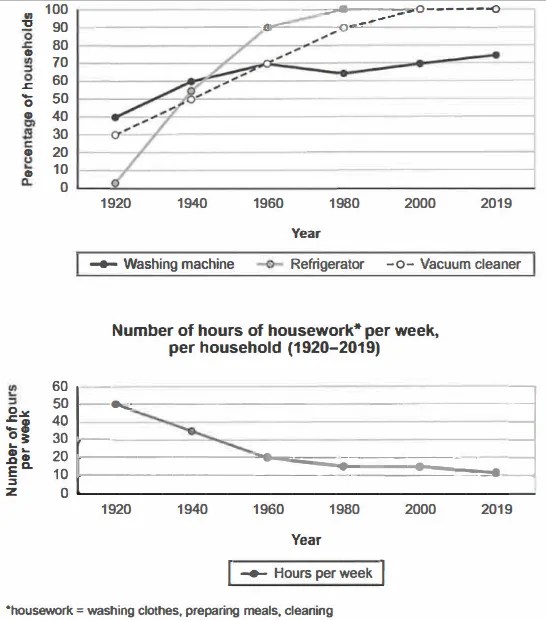
The charts below show the changes in ownership of electrical appliances and amount of time spent doing housework in households in one country between 1920 and 2019.
Summarise the information by selecting and reporting the main features, and make comparisons where relevant.
Percentage of households with electrical appliances (1920-2019)
Student answer (Band 7.0)
The line graphs below show the changes in the percentage of households owning electrical appliances and the number of hours spent doing housework in one country between 1920 and 2019. Overall, the ownership of refrigerators, and vacuum cleaners surged, while the number of hours spent doing housework per week decreased substantially.
The percentage of houses owning refrigerators hiked from 0% in 1920 to 90% in 1960. From 1980, refrigerators became universal. Similarly, vacuum cleaners saw a steady increase, with about 30% of households owning one, in 1920, and in 2000, they became universally owned. On the other hand, about 40% of the households owned a washing machine in 1920, and steadily increased till 1960, before experiencing a decrease in ownership in 1980. As compared to other appliances, washing machine did not became universal
Turning to the number of hours spent doing household chores per week, the hours plummeted from 50 hours in 1920 to 20 hours in 1960. After 1960, the hours spent on housework kept decreasing steadily, and reached 10 hours per week in 2019.
AI examiner evaluation
| Criterion | Band |
|---|---|
| Task Achievement / Task Response | 7.0 |
| Coherence and Cohesion | 7.5 |
| Lexical Resource | 7.0 |
| Grammatical Range and Accuracy | 6.5 |
| Overall | 7.0 |
Task Achievement / Task Response: Band 7.0
The response gives a clear overview of the main patterns: refrigerator and vacuum-cleaner ownership rose markedly, while housework time fell. It also selects relevant comparisons, including refrigerators reaching universal ownership by 1980 and vacuum cleaners doing so by 2000, and correctly notes the washing-machine dip in 1980. Most figures are consistent with the chart, although the refrigerator figure is reported as 0% rather than approximately 2%, and the final housework figure is given as 10 rather than about 11 hours. The washing-machine trend is less fully reported: its later recovery to 75% in 2019 is omitted. Including that endpoint and making the overview cover all three appliances would make the account more complete and precise.
Coherence and Cohesion: Band 7.5
The information is organised in a clear sequence: an introduction and overview are followed by appliance comparisons and then the housework data. Linking expressions such as “Similarly,” “On the other hand,” and “Turning to” help signal relationships and the shift between graphs. The progression is easy to follow, and the paragraphing separates the two main topics appropriately. Some connections could be made more precise: “As compared to other appliances” introduces the washing-machine point, but the comparison is not developed, and the sentence ending “did not became universal” feels unfinished. A clearer final comparison, including the washing machine’s 2019 level, would strengthen the flow and give the appliance paragraph a more complete ending.
Lexical Resource: Band 7.0
There is a useful range of vocabulary for describing trends, including “surged,” “steady increase,” “decrease,” and “plummeted,” alongside relevant terms such as “universal” and “ownership.” This allows the writer to avoid relying only on basic verbs like “go up” and “go down.” Some choices are less natural or precise in an academic report: “hiked” is not the best collocation for a percentage, “houses owning” is less accurate than “households owning,” and “universally owned” is awkward when describing appliance ownership. “Kept decreasing steadily” also repeats the same trend idea. More conventional chart language and careful collocation would make the vocabulary more consistently controlled.
Grammatical Range and Accuracy: Band 6.5
The response uses a mix of simple and complex structures, including a relative clause in “the number of hours spent doing housework per week decreased substantially” and a time clause in “before experiencing a decrease in ownership in 1980.” Most sentences communicate the intended trends clearly. However, some errors remain in verb forms and sentence construction: “washing machine did not became universal” should use “become,” and the final washing-machine statement lacks a full stop. The phrase “and steadily increased till 1960” also has an unclear subject, since the percentage, rather than the washing machine, increased. These issues do not prevent understanding, but more consistent control of agreement, verb forms, and complete sentence boundaries is needed for stronger accuracy.
See this exact question answered at other band scores. The same prompt compared across bands.
Browse more IELTS Writing model answers or get your own writing scored by the same AI examiner.