Band 5.5 IELTS Writing Task 1 Model Answer
Overall Band Score: 5.5 · Cambridge IELTS 16 · 2026-11-18
IELTS Writing Task 1 question
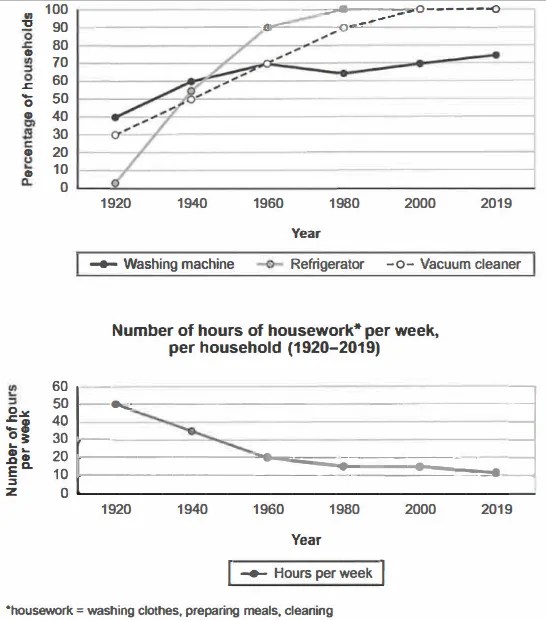
The charts below show the changes in ownership of electrical appliances and amount of time spent doing housework in households in one country between 1920 and 2019.
Summarise the information by selecting and reporting the main features, and make comparisons where relevant.
Percentage of households with electrical appliances (1920-2019)
Student answer (Band 5.5)
The line chart shows the changes in ownership of electrical appliances and amount of time spent in doing household work in country during the 1920 to 2019. The data is being calibrated in proportion.
In an overview, it is clear that refrigerator and vacuum cleaner followed the rising trend whereas washing machine showed fluctuation all over period.
To commence with, washing machine and vacuum stood at 40 and 30 percent in 1920 and increasing in all the years reached to maximum extent in 2000 and followed till 2019 while cleaner lifted till 1960 at 70 percent and showed a decrement in 1980 at 65 and further increased in next decades reaching 74 in the recent given year.
Additionally, refrigerator started from zero and followed the rising trend till 1960 holding 80 percent of the value and arrive at 100 percent in 1980 and so on. Number of hours started decreasing in 1920 from 50 hours and arrive at 15 hours in 1980 and remained constant for the next two decades and further droped to 11 hours in 2019.
AI examiner evaluation
| Criterion | Band |
|---|---|
| Task Achievement / Task Response | 5.5 |
| Coherence and Cohesion | 5.5 |
| Lexical Resource | 5.5 |
| Grammatical Range and Accuracy | 5.0 |
| Overall | 5.5 |
Task Achievement / Task Response: Band 5.5
You identify the broad contrast between rising appliance ownership and falling housework time, and include several relevant figures. However, some key details are inaccurate: washing-machine ownership did not rise continuously to a maximum in 2000; it fell from about 70% in 1960 to 65% in 1980, then increased. The refrigerator reached about 90% in 1960, not 80%, and began at roughly 2%, rather than zero. The overview also says the washing-machine trend fluctuated, but does not clearly summarise the major overall pattern that refrigerators and vacuum cleaners reached full household coverage while housework time declined substantially. More accurate comparisons and a clearer overview would make the response more complete and better supported.
Coherence and Cohesion: Band 5.5
The response has a recognisable structure: an introduction, an overview, and two detail sections. This gives the reader a basic route through the information, and transitions such as “In an overview” and “Additionally” signal the stages of the report. However, progression within the detail paragraphs is not consistently clear. The sentence beginning “To commence with” combines washing-machine and vacuum-cleaner figures, then shifts to “cleaner,” making it difficult to tell which appliance is being described. Some linking phrases, including “and so on,” are vague and do not explain the data relationship. Grouping the three appliance trends together with clear comparisons, then describing housework hours separately, would create a more logical progression.
Lexical Resource: Band 5.5
You use some task-relevant vocabulary, including “ownership,” “rising trend,” “remained constant,” and “decreasing,” so the main subject is generally understandable. There is also an attempt to vary expressions rather than repeat the same verb throughout. However, several choices are inaccurate or unnatural, such as “the data is being calibrated in proportion,” “reached to maximum extent,” and “holding 80 percent of the value.” “Cleaner” is also imprecise when referring to a vacuum cleaner, and “decrement” is an awkward choice for a chart description. These word-choice and collocation problems sometimes make the intended meaning less clear. Use standard trend language and name each appliance consistently.
Grammatical Range and Accuracy: Band 5.0
You attempt both simple and longer sentences, including clauses linked with “whereas” and “while,” but control is uneven. Errors in articles and sentence structure appear in the opening, for example “in country” and “in the 1920 to 2019.” Verb forms are also frequently inaccurate: “washing machine and vacuum … increasing,” “refrigerator … arrive,” and “hours started decreasing … and arrive” do not maintain correct tense or agreement. Some sentences contain several ideas joined together without clear grammatical boundaries, which makes them harder to follow. Practise writing shorter, complete comparisons first, then combine them using accurate past-tense forms and appropriate articles.
See this exact question answered at other band scores. The same prompt compared across bands.
Browse more IELTS Writing model answers or get your own writing scored by the same AI examiner.