Band 6.0 IELTS Writing Task 1 Model Answer
Overall Band Score: 6.0 · Cambridge IELTS 16 · 2026-11-18
IELTS Writing Task 1 question
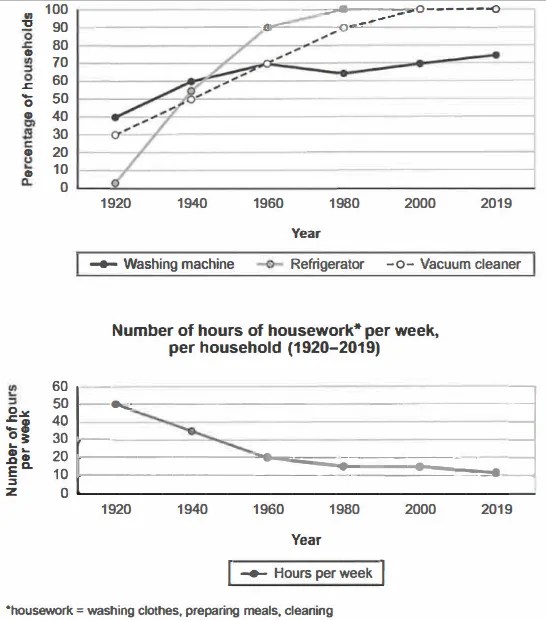
The charts below show the changes in ownership of electrical appliances and amount of time spent doing housework in households in one country between 1920 and 2019.
Summarise the information by selecting and reporting the main features, and make comparisons where relevant.
Percentage of households with electrical appliances (1920-2019)
Student answer (Band 6.0)
The given charts illustrate the statistical data of particular country about the development of the possesion of hybrid appliances and time that is utilized in domestictasks in family between 1920 to 2019.
Overall, there is rapid increase in use of refrigerato in between 1920 to 1960, whereas a steady increase in washing machine and linear rise in vacuum cleaner upto seven decades. The total hours of housework per week decreses considerably freom 1920 to 1960.
Commencing with the first, refrigerator there is dramatic climb in from zero to 90% from 1920 to 1960 and washing machine or vacuum cleaner have approximately same behviour with increase of 30% from 40 from 1920 to 1960, but vacuum cleaner has 10% rise more than washing machines. Moreover, same pattern are followed by refrgerator and vacuum cleaner throughout the remaining till 2019, while usage of washing machine shows a little variation between roughly 60% to 75% till 2019.
Another chart demonstrates the number of hours spend on housechores per week there is a significant fell in number of hours from 50 to 20 and in between 1920 to 1960, after that a minor decrease is observed.
AI examiner evaluation
| Criterion | Band |
|---|---|
| Task Achievement / Task Response | 6.5 |
| Coherence and Cohesion | 6.5 |
| Lexical Resource | 5.5 |
| Grammatical Range and Accuracy | 5.5 |
| Overall | 6.0 |
Task Achievement / Task Response: Band 6.5
You identify the main overall patterns: appliance ownership generally rose, while weekly housework time fell, and you include relevant figures such as refrigerators reaching 90% by 1960 and housework dropping from 50 to 20 hours. This gives the response a clear, relevant summary. However, some comparisons are inaccurate or unclear: washing machines rose from 40% to about 70% between 1920 and 1960, not by 30% “from 40,” and vacuum cleaners rose from 30% to 70%, so the claim that both increased by 30% is misleading. The overview also says the housework decline was from 1920 to 1960 but does not capture the later fall to 11 hours. To strengthen the report, describe the full period and distinguish the appliance trends more precisely, including the refrigerator and vacuum cleaner reaching full ownership.
Coherence and Cohesion: Band 6.5
The response has a recognisable structure: an introduction, an overview, a paragraph on appliance ownership and a final paragraph on housework. Sequencing the appliance discussion before the hours chart is logical, and phrases such as “Overall” and “Moreover” help signal relationships. However, some links are mechanical or do not make the comparison clear. For example, “washing machine or vacuum cleaner have approximately same behaviour” is difficult to follow, and “same pattern are followed” does not specify which years or figures are being compared. The final paragraph is also brief and ends without summarising the later trend. Use clearer topic sentences and connect each comparison to its time period so the progression is more consistently easy to follow.
Lexical Resource: Band 5.5
You attempt a range of task-appropriate vocabulary, including “dramatic climb,” “steady increase,” “variation” and “significant fall.” These choices show an effort to describe trends rather than simply list figures. However, inaccurate spelling and word choice are noticeable, including “possesion,” “domestictasks,” “refrigerato,” “decreses” and “freom.” Some collocations are also unnatural: “development of the possession” and “time that is utilized in domestic tasks” are less direct than standard chart-reporting language. “Hybrid appliances” is not an accurate label for the items shown. Aim for precise, conventional terms such as “ownership of household appliances” and “hours spent on housework,” and check spelling and word forms carefully.
Grammatical Range and Accuracy: Band 5.5
You attempt both simple and more complex sentence forms, including clauses introduced by “whereas” and “while,” and the overall meaning is usually recoverable. However, some sentence structures are incomplete or awkwardly joined. For instance, “Another chart demonstrates the number of hours spend on housechores per week there is a significant fell” combines two clauses without a clear grammatical connection. There are also errors in articles, agreement and verb forms, as in “there is rapid increase,” “same pattern are followed,” and “hours spend.” Prepositions and time expressions need attention too: “in between 1920 to 1960” should use a consistent construction such as “between 1920 and 1960.” Build accuracy by separating long clauses and checking each sentence’s subject, verb and linking structure.
See this exact question answered at other band scores. The same prompt compared across bands.
Browse more IELTS Writing model answers or get your own writing scored by the same AI examiner.