Band 5.0 IELTS Writing Task 1 Model Answer
Overall Band Score: 5.0 · Cambridge IELTS 16 · 2026-11-19
IELTS Writing Task 1 question
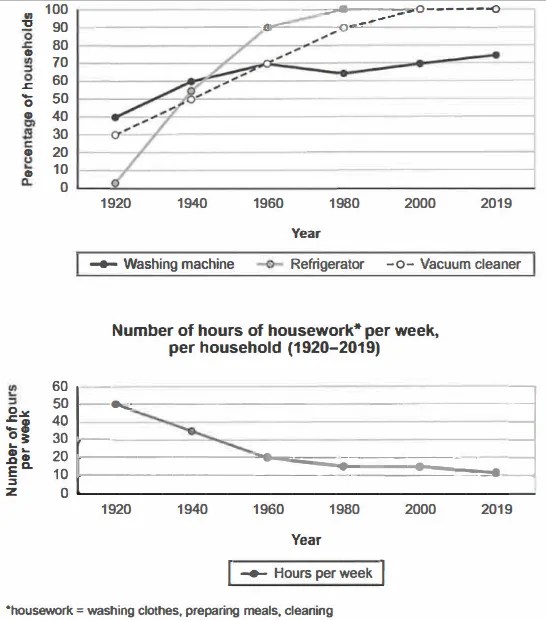
The charts below show the changes in ownership of electrical appliances and amount of time spent doing housework in households in one country between 1920 and 2019.
Summarise the information by selecting and reporting the main features, and make comparisons where relevant.
Percentage of households with electrical appliances (1920-2019)
Student answer (Band 5.0)
The given diagrams illustrate the changes in ownership of electrical appliances and amount of time spent doing housework in households in one country from 1920 to 2019.
Overall, three applainces are shown in the graph including washing machine, refrigerator, and vacuum cleaner, while the ownership of all three electrical appliances increased over the period. Refriferator and vacuum cleaner became more common, while the number of hours spent on housework decreased significantly.
In 1920,around 40% of household owned a washing machine, compared with 305 for vacuum cleaner. However no household had refrigrator. By 1940 the figures for washing machine, refrigerator and vacuum cleaner had risen to approximately 60% 55% and 50%. In 2019, allmost 100% of households, vacuum cleaner and rafigerator, whereas washing machine ownership stood at 80%.
Secondly, households per week in 2019 50 hours and in 1940 was lower 35 hours, while in the year of 1960 and the hours is 20, in contrast in the period of 2000 15 hours. Finally, the number dropped to approximately 10 hours per week in 2019.
AI examiner evaluation
| Criterion | Band |
|---|---|
| Task Achievement / Task Response | 5.5 |
| Coherence and Cohesion | 5.0 |
| Lexical Resource | 5.0 |
| Grammatical Range and Accuracy | 5.0 |
| Overall | 5.0 |
Task Achievement / Task Response: Band 5.5
You identify the overall contrast: appliance ownership generally rose, while time spent on housework fell. You also report several relevant figures, including the 1940 appliance percentages and the decline in housework to about 10 hours by 2019. However, coverage is partial and some key details are inaccurate or unclear. The chart shows refrigerators at about 2% in 1920, not none, and in 2019 refrigerators and vacuum cleaners reached 100%, while washing machines were about 75%, not 80%. The housework figures are also presented in a confusing order, with 2019 and 1940 reversed in the sentence beginning “Secondly”. Include the major trends more systematically and compare the series accurately.
Coherence and Cohesion: Band 5.0
The response has a basic paragraph structure, moving from an introduction and overview to appliance figures and then housework. The overview gives the reader a useful sense of the main trends. However, progression within the body is difficult to follow, especially in “households per week in 2019 50 hours and in 1940 was lower 35 hours”, where the time sequence and comparison are unclear. “Secondly” and “Finally” do not create a reliable structure, and the appliance and housework details are not linked clearly. Organise the body into two focused paragraphs, one for appliance ownership and one for housework, and report each series in chronological order. Use clear comparison phrases and references so readers can follow which figures belong to which year.
Lexical Resource: Band 5.0
You use some relevant task vocabulary, including “ownership”, “increased”, “decreased significantly” and “approximately”, and the main subject remains understandable. However, the range is limited and several spelling errors affect the accuracy and polish of the report: “applainces”, “Refriferator”, “refrigrator” and “rafigerator”. Some expressions are also imprecise or unnatural, such as “allmost 100% of households, vacuum cleaner and rafigerator” and “households per week”. Choose precise chart language, for example, “the proportion of households owning…” and “hours of housework per household”. Check spelling carefully and avoid repeating general words when a specific trend verb or comparison would be clearer.
Grammatical Range and Accuracy: Band 5.0
You attempt both simple and more complex sentences, including a contrast with “while” and “whereas”, but control is inconsistent. Errors in agreement and sentence construction occur in “40% of household owned” and “in 1940 was lower 35 hours”. The sentence “In 2019, allmost 100% of households, vacuum cleaner and rafigerator” is incomplete, while “in the year of 1960 and the hours is 20” has faulty structure and tense. Punctuation is also inconsistent, as in “1920,around”. These problems sometimes make the data difficult to interpret. Practise complete subject–verb–object sentences, maintain past-tense reporting, and use parallel forms when listing years and figures; then proofread articles, plurals and punctuation.
See this exact question answered at other band scores. The same prompt compared across bands.
Browse more IELTS Writing model answers or get your own writing scored by the same AI examiner.