Band 6.0 IELTS Writing Task 1 Model Answer
Overall Band Score: 6.0 · Cambridge IELTS 16 · 2026-11-19
IELTS Writing Task 1 question
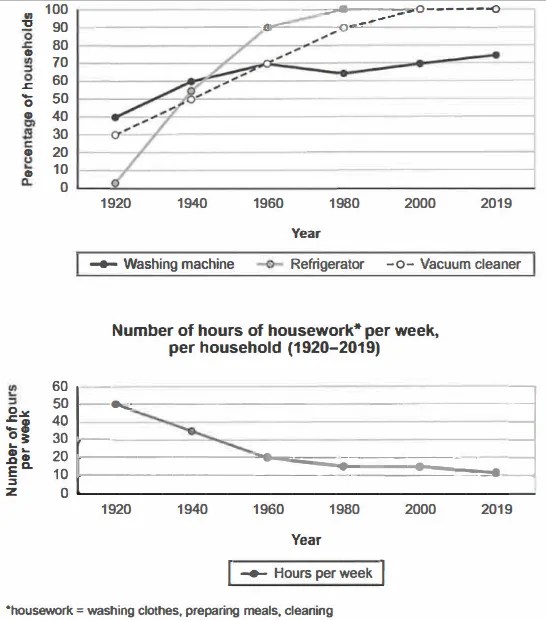
The charts below show the changes in ownership of electrical appliances and amount of time spent doing housework in households in one country between 1920 and 2019.
Summarise the information by selecting and reporting the main features, and make comparisons where relevant.
Percentage of households with electrical appliances (1920-2019)
Student answer (Band 6.0)
The charts illustrate the changes in owning electrical machines and amount of time households doing housework in a country from 1920 to 2019.
Overall, the first chart shows that, the ownership of electrical appliances increasing day by day over years. On the other hand, number of house work per week by households are decreasing day by day over years.
To begin with, washing machine started increasing with 40% of appliances in 1920 with the highest percentage. In 1960 it decreased slightly from 70% to approximately 65%. Again it started increasing in 1980 at reached almost 75% in 2019. Refrigerator was at the lowest point in 1920 with 0%. Until 1980 it reached at the peak with 100% and stayed steady until 2019. Vacuum cleaner started with 30% in 1920 and reached at its peak in 2000 with 100% and it was steady until 2019.
Turning to housework per week by per households. In 1920, It was 50% with highest percentage and started sharply decreasing. By 1980, it was approximately 15% and reached at bottom by 2019 with 10%.
AI examiner evaluation
| Criterion | Band |
|---|---|
| Task Achievement / Task Response | 6.5 |
| Coherence and Cohesion | 6.5 |
| Lexical Resource | 5.5 |
| Grammatical Range and Accuracy | 5.5 |
| Overall | 6.0 |
Task Achievement / Task Response: Band 6.5
You identify the main overall contrast: appliance ownership generally rose, while time spent on housework fell. You also report several key endpoints and trends, including refrigerators reaching 100% by 1980 and vacuum cleaners reaching full ownership by 2000. Some details, however, are inaccurate or unclear: washing-machine ownership rose from 40% to 70% by 1960, then dipped to about 65% in 1980; your account reverses the timing of that dip and says it reached 75% in 1980. The refrigerator began at about 2%, not 0%, and housework is measured in hours, not percentages. The overview also overgeneralises the steady rise, since washing-machine ownership fluctuated. More precise comparisons and accurate units would strengthen the summary.
Coherence and Cohesion: Band 6.5
The response has a clear overall shape: an introduction, a brief overview, a paragraph on appliance ownership and a final paragraph on housework. This makes the main categories easy to follow, and transitions such as “To begin with” and “Turning to” help signal the shift between them. However, some linking is mechanical, and the appliance paragraph would be clearer if it followed a consistent order and compared the series directly. The sentence “In 1960 it decreased slightly from 70% to approximately 65%” is confusing because the decline occurs after 1960, while “Again it started increasing in 1980” does not clearly identify the relevant period. Use clearer time references and connect related comparisons within sentences.
Lexical Resource: Band 5.5
You use enough task-related vocabulary to communicate the main trends, including “increasing,” “decreasing,” “reached,” “peak” and “steady.” However, the range is limited and several expressions are repetitive or imprecise. “Electrical machines” is less suitable than “electrical appliances,” while “increasing day by day over years” is not a natural way to describe changes across the chart period. “House work” is usually written as one word, and “number of housework” does not express the measure accurately. There are also collocation problems in phrases such as “reached at the peak” and “at bottom.” More precise trend vocabulary and natural combinations would improve clarity and flexibility.
Grammatical Range and Accuracy: Band 5.5
You attempt both simple and more extended sentence forms, and the overall meaning is generally understandable. However, some grammatical errors recur in sentence construction, agreement, articles and punctuation. For example, “amount of time households doing housework” is missing a verb or a suitable preposition, and “the ownership … increasing” needs a finite verb such as “increased.” In “number of house work per week by households are decreasing,” the subject and verb do not agree. Capitalisation and punctuation are also inconsistent, as in “In 1920, It was.” Aim to produce complete, controlled sentences, and check subject–verb agreement and verb forms. Greater accuracy in these areas would make the comparisons easier to follow.
See this exact question answered at other band scores. The same prompt compared across bands.
Browse more IELTS Writing model answers or get your own writing scored by the same AI examiner.