Band 6.0 IELTS Writing Task 1 Model Answer
Overall Band Score: 6.0 · Cambridge IELTS 16 · 2026-11-19
IELTS Writing Task 1 question
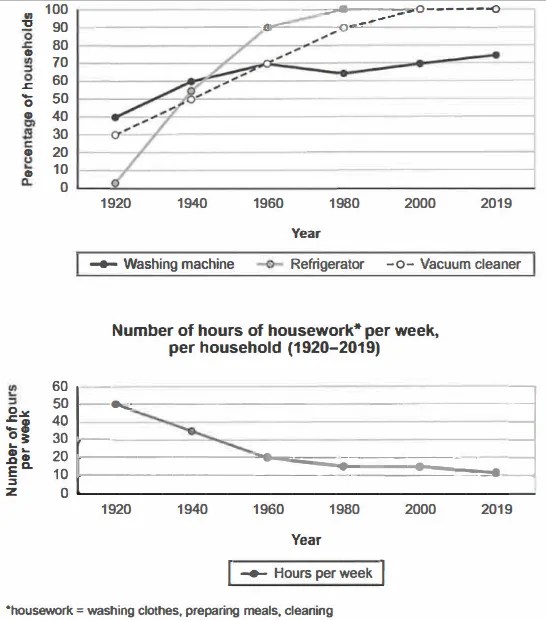
The charts below show the changes in ownership of electrical appliances and amount of time spent doing housework in households in one country between 1920 and 2019.
Summarise the information by selecting and reporting the main features, and make comparisons where relevant.
Percentage of households with electrical appliances (1920-2019)
Student answer (Band 6.0)
THE GRAPH ILUSTRATE THE PERCENTAGE OF HOUSEHOLDS WITH ELECTRICAL APPLIANCES AND THE NUMBER OF HOURS OF HOUSEWORK PER WEEK SINCE 1920 UNTIL 2019 IN ONE COUNTRY .
OVERALL, THE MOST NOTICEABLE FEATURES IS THAT THE PERCENTAGE OF HOUSEHOLD IN ALL OF WASHING MACHINE , REFRIGERATOR AND VOCUUM CLEANER INCREASED DURING THE YEARS , WHILE THE NUMBER OF HOUSEWORKERS SIGNIFICANTLY DECREASED.
LOOKING AT THE DETAILS THE REFRIGERATORIN 1920 WAS ON THE BOTTOM WITH 0% OF HOUSEHOLDS AND THEN INCREASED DRAMATICLLY IN 55% IN 1940 AFTER THAT IT CONTINUED TO ROSE UNTIL 90% IN 1960 AND AS IT'S SHOWED IT CLIMBED STEADY IN 1980 AND IT REMAIN STABLE UNTIL 2019WHILE THE VACUUM CLEANER ROSE DRAMATICLLY FROM 30% IN1920 TO 90% IN 1980 AND CONTINUED TO 100% IN 2000 THEN RAMAIN STABEL, AS WE CAN SEE WASHING MACHINES THERE WAS SOME WITNESSED PERIOD OF INSTABILITY , IT'S INCREASED FROM 40% TO A COMMOUN POINT WITH THE VACCUM CLEANER WHICH IS 70% AT THE YEAR OF W1960 AND QAFTER THAT FALL TO 62% IN 1980 AND AGAIN ROSE TO 70% IN 2000 FOLLOWING THIS ROSE GRADUALLY TO 75% IN 2019.
TURNING TO THE NUMBER OF HOURS OF HOUSEWORK WE CAN SEE CLEARLLY THE DECEASE STARTING FROM 50 HOURS IN 1920 AND HIT THE BOTTOM IN 2019 WITH 10 HOURES PER WEEK .
AI examiner evaluation
| Criterion | Band |
|---|---|
| Task Achievement / Task Response | 7.0 |
| Coherence and Cohesion | 6.5 |
| Lexical Resource | 5.5 |
| Grammatical Range and Accuracy | 5.0 |
| Overall | 6.0 |
Task Achievement / Task Response: Band 7.0
You cover both charts and provide a clear overview: appliance ownership generally rose, while time spent on housework fell. The response also selects useful comparisons, including the refrigerator’s rapid rise and the vacuum cleaner reaching full ownership by 2000. Most reported figures match the chart, but the refrigerator starts at about 2%, not 0%, and the washing-machine figure for 1980 is about 65%, rather than 62%. The housework measure is hours per household, not the “number of houseworkers,” and its final value is about 11 hours. These are small inaccuracies within an otherwise relevant, well-supported summary. To strengthen the report further, describe the housework trend with an intermediate figure as well as its endpoints.
Coherence and Cohesion: Band 6.5
The response has a recognisable structure: an introduction, an overview, a paragraph describing appliance ownership, and a final paragraph on housework. This gives the reader a logical route through both visuals, and phrases such as “Looking at the details” and “Turning to” signal transitions. However, the long appliance paragraph combines several series in one sentence, making comparisons difficult to follow; the many uses of “and,” “after that,” and “while” create a mechanical flow. Some references, such as “it” and “as it’s showed,” are unclear. Use shorter sentences and group the appliance trends more deliberately, then connect the housework paragraph with a concise comparison to the overall rise in ownership.
Lexical Resource: Band 5.5
You use relevant chart vocabulary, including “increased,” “stable,” “gradually,” and “dramatically,” and you attempt to vary the language used to describe trends. However, inaccurate spelling and word choice are frequent enough to make the writing less fluent: “vocuum,” “dramaticlly,” “ramain stabel,” and “decease” obscure otherwise clear points. Some expressions are also unnatural or imprecise, such as “common point” for the shared 70% figure and “number of houseworkers” for hours of housework. Aim for accurate, conventional collocations and check spelling carefully. A more controlled range of terms such as “rose sharply,” “levelled off,” and “declined” would make the comparisons clearer and more appropriate to an academic report.
Grammatical Range and Accuracy: Band 5.0
You attempt complex sentences to describe changes over time, but these are often faulty or run together, as in the long sentence beginning “Looking at the details the refrigerator…” and continuing through several appliance trends. Errors in agreement and verb forms also recur: “the most noticeable features is,” “it remain stable,” and “it’s increased.” Articles and sentence boundaries need attention, too; for example, the opening would be clearer as “The graph illustrates…” and the final paragraph needs a complete, well-punctuated sentence. These problems sometimes make relationships between figures difficult to follow. Practise writing one main trend per sentence, using past tense consistently for historical data, and checking subject–verb agreement and punctuation before submitting.
See this exact question answered at other band scores. The same prompt compared across bands.
Browse more IELTS Writing model answers or get your own writing scored by the same AI examiner.