Band 6.0 IELTS Writing Task 1 Model Answer
Overall Band Score: 6.0 · Cambridge IELTS 16 · 2026-11-19
IELTS Writing Task 1 question
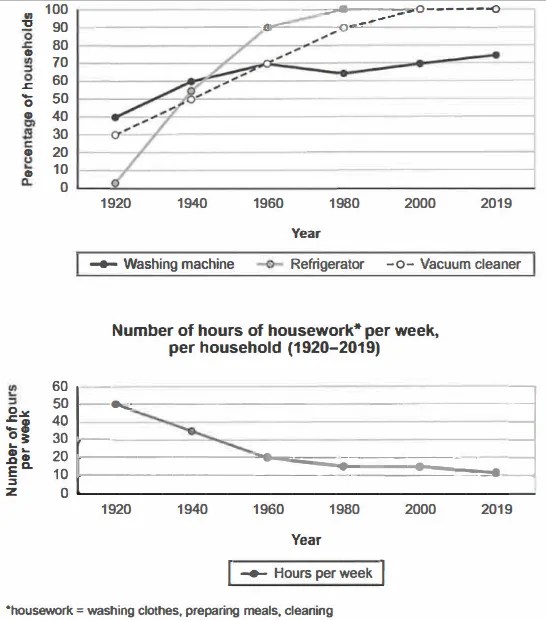
The charts below show the changes in ownership of electrical appliances and amount of time spent doing housework in households in one country between 1920 and 2019.
Summarise the information by selecting and reporting the main features, and make comparisons where relevant.
Percentage of households with electrical appliances (1920-2019)
Student answer (Band 6.0)
The two line graph illustrate changes in time and money spenty on home appliances and doing housework in one country work from 1920 to 2019.
Overall, the spending time had reduce drastically through out the decade. On the other hand , the using of home appliances increased significantly in last 99 years.
Intially, the hours per week was near 50 in 1920 and gradually decrease to 20 in 1960. Then, it slightly went down to almost 15 hours in 1980 and next 20 years it remained the same. In 2019, it end up with almost 11 hours per week.
On the other hand, Refrigerator had almost 1% in 1920, it jumped upto 54% in 1940 and continue rised till 1980 and remained consistent in next 39 years and finished with 100%. Furthermore, Vacuum cleaner rose from 30% in 1920 to 90% in 1980, 10% lower than refrigerator. In 2000 and 2019 both were sharing same percentage. Washing machine were flactuated during the whole years and theie peak was in 2019 the percentage was upto 62%.
AI examiner evaluation
| Criterion | Band |
|---|---|
| Task Achievement / Task Response | 6.5 |
| Coherence and Cohesion | 6.5 |
| Lexical Resource | 5.5 |
| Grammatical Range and Accuracy | 5.0 |
| Overall | 6.0 |
Task Achievement / Task Response: Band 6.5
You cover both charts and identify their main contrast: appliance ownership generally rose while weekly housework time fell. The housework figures are reported accurately, including the decline from about 50 hours to 20 by 1960 and the later plateau around 15. You also describe the refrigerator and vacuum-cleaner trends with useful comparisons. However, the washing-machine account contains a major factual error: it peaks at about 75% in 2019, not 62%, and its movement is not simply fluctuating throughout. The overview could also be more precise by noting that refrigerators reached full ownership by 1980 and vacuum cleaners by 2000. This gives the response a clear, relevant account, but some selected features are less fully or accurately reported.
Coherence and Cohesion: Band 6.5
The response has a recognisable structure: an introduction, an overview, and separate discussion of housework and appliance ownership. This makes the main information reasonably easy to follow, and transitions such as “On the other hand” and “Furthermore” help signal relationships. However, the repeated use of “On the other hand” is not always appropriate, since the appliance details are not all direct contrasts, and the final paragraph moves between refrigerator, vacuum cleaner and washing machine without a clear organising pattern. Some references are also unclear, as in “both were sharing same percentage,” where the reader must infer which appliances are meant. Grouping the appliance trends more systematically and using more precise linking and referencing would make progression smoother.
Lexical Resource: Band 5.5
You use some relevant task vocabulary, including “percentage,” “remained the same,” “gradually,” and “jumped,” so the main trends can generally be understood. However, the range and control are limited by repeated general wording such as “increased” and “went down,” as well as inaccurate or awkward expressions: “spending time” does not describe the chart, and “the using of home appliances” is not a natural collocation. Spelling errors such as “Intially,” “flactuated,” and “theie” are noticeable, while “peak” is used inaccurately for the washing-machine figure. Aim for precise trend language and check spelling and word forms; this would make the description more fluent and exact.
Grammatical Range and Accuracy: Band 5.0
You attempt both simple and more extended sentence forms, and the sequence of past-tense descriptions is generally understandable. However, grammatical errors occur often enough to make some sentences awkward or unclear. For example, “The two line graph illustrate” has errors in number and subject–verb agreement, while “the hours per week was” and “Washing machine were” also show agreement problems. Verb forms are frequently inaccurate in phrases such as “had reduce,” “gradually decrease,” and “continue rised.” Articles and sentence boundaries also need attention, particularly in “Refrigerator had almost 1% in 1920, it jumped…” where two clauses are joined with a comma. Practise accurate past-tense reporting and check agreement and clause punctuation.
See this exact question answered at other band scores. The same prompt compared across bands.
Browse more IELTS Writing model answers or get your own writing scored by the same AI examiner.