Band 6.0 IELTS Writing Task 1 Model Answer
Overall Band Score: 6.0 · Cambridge IELTS 16 · 2026-11-19
IELTS Writing Task 1 question
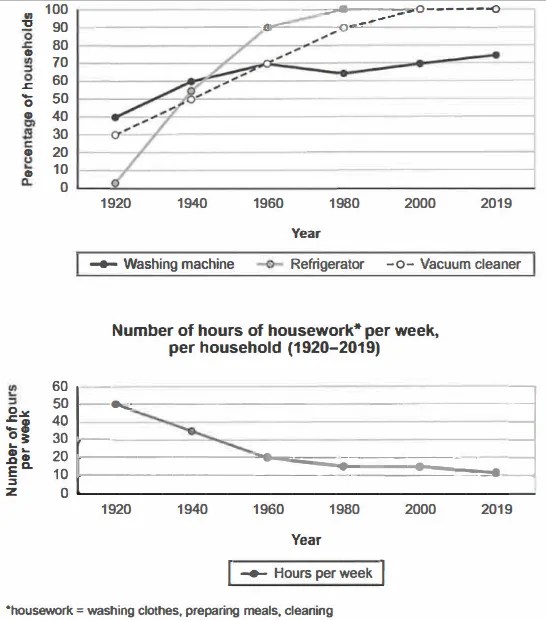
The charts below show the changes in ownership of electrical appliances and amount of time spent doing housework in households in one country between 1920 and 2019.
Summarise the information by selecting and reporting the main features, and make comparisons where relevant.
Percentage of households with electrical appliances (1920-2019)
Student answer (Band 6.0)
The line graphs illustrate the variations in possesion of electrical devices and the average time spent doing chores in house in a country from 1920 to 2019.
Overall, the frequently utilized electronics is washing machine over the period of years. The increased changing trend is observed in the utilization of refigerator in a period of 100 years. However, a declining pattern is noticed in the number of hours spent doing housework between 1920 and 2019.
The surging trend is observed in the utilization of refrigerator and vacum cleaner over the period of 100 years. The proportion of refrigerator rose from 0% in 1920 to 100% in 2000s. Similar trend is observed in the use of vacum cleaner spiking to 100% in 2000s from 30% in 1920. However, the utilization of wasing machine faces a slight dip in 1980 falling to less than 70% after rising to 70% in 1960 rising again to around 80%
AI examiner evaluation
| Criterion | Band |
|---|---|
| Task Achievement / Task Response | 5.5 |
| Coherence and Cohesion | 6.0 |
| Lexical Resource | 6.0 |
| Grammatical Range and Accuracy | 5.5 |
| Overall | 6.0 |
Task Achievement / Task Response: Band 5.5
You identify the broad patterns: appliance ownership generally rises, while time spent on housework falls. You also include relevant comparisons, such as refrigerators reaching full ownership and washing-machine ownership dipping around 1980. However, some figures are inaccurate: refrigerators were at about 2%, not 0%, in 1920, and reached 100% by 1980 rather than in the 2000s. The overview’s claim that washing machines were the most frequently owned appliance throughout is not supported, since refrigerators and vacuum cleaners reached 100%. Most importantly, the housework figures are not reported beyond the overview, leaving one of the two charts largely undescribed. Develop this section and give a clearer, accurate overview of the main contrasts.
Coherence and Cohesion: Band 6.0
The response has a recognisable structure, moving from an introduction to an overview and then to details about appliance ownership. Linking words such as “Overall,” “However,” and “Similar trend” help signal relationships between points. The progression is nevertheless incomplete: the final paragraph focuses on appliances and does not develop the housework chart, so the two sets of information are not balanced. Some connections are also awkward or repetitive, particularly the repeated use of “trend” and “over the period of 100 years.” Organise the details into clearer groups—for example, one paragraph on appliance ownership and another on housework—and use references that make comparisons between the charts explicit.
Lexical Resource: Band 6.0
You use a reasonable range of task-related vocabulary, including “proportion,” “declining pattern,” “utilization,” and “slight dip,” and the intended meaning is generally understandable. There are, however, several spelling errors, including “possesion,” “refigerator,” “vacum,” and “wasing.” Some expressions are also unnatural or imprecise: “frequently utilized electronics” is not a clear way to describe ownership, and “in 2000s” is an awkward time reference. Repeated reliance on “trend” and “utilization” limits variety. Prefer precise chart language such as “the percentage of households owning…” and use verbs like “rose,” “fell,” “levelled off,” and “reached” to describe changes accurately.
Grammatical Range and Accuracy: Band 5.5
You attempt both simple and more complex sentence forms, including the contrast introduced by “However” and the comparison beginning “Similar trend is observed…”. The main ideas can usually be followed, but some grammatical errors reduce clarity. For example, “doing chores in house” is missing an article, and “the frequently utilized electronics is washing machine” has problems with agreement and article use. The final sentence is also difficult to follow because several changes are joined together without clear punctuation or a complete structure. Practise forming concise sentences with a clear subject and verb, and check articles, agreement, and punctuation when describing several stages of a trend.
See this exact question answered at other band scores. The same prompt compared across bands.
Browse more IELTS Writing model answers or get your own writing scored by the same AI examiner.