Band 6.5 IELTS Writing Task 1 Model Answer
Overall Band Score: 6.5 · Cambridge IELTS 16 · 2026-11-19
IELTS Writing Task 1 question
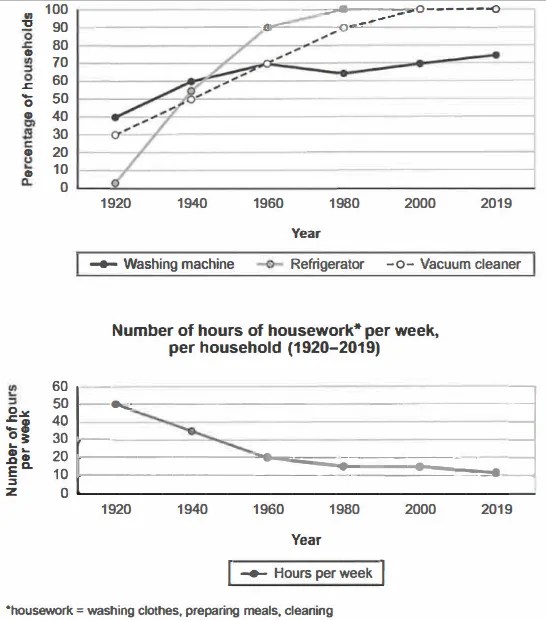
The charts below show the changes in ownership of electrical appliances and amount of time spent doing housework in households in one country between 1920 and 2019.
Summarise the information by selecting and reporting the main features, and make comparisons where relevant.
Percentage of households with electrical appliances (1920-2019)
Student answer (Band 6.5)
The line graphs gives information about the variation in possession of wasing machines, refrigerators and vacum cleaners and average time spent doing house chores in a country from 1920 to 2019.
Overall, the most utilized electronic device is the wasing machine in a period of 100 years. The use of refrigerator become the essential neccessity in the second half of the century. However, the decreasing trend of hours spent per week on housework is observed between 1920 and 2019.
The use of refrigerator spiked dramaticaly from 0% in 1920 to 100% in the 2000s. A similar trend is noticed for vacum cleaners rising from 30% in 1920 to 100% in the 2000s. However, washing machine utilization increased from 40% in 1920 to 70% in 1960 followed by a slight dip of around 10% in 1980, then rising back to nearly 80% in 2019.
Moreover, the declining trend in washing clothes, preparing meals and cleaning is observed in past 100 years. It declined from around 50 hours per week in 1920 to less than 10 hours per week in 2019.
AI examiner evaluation
| Criterion | Band |
|---|---|
| Task Achievement / Task Response | 7.0 |
| Coherence and Cohesion | 7.0 |
| Lexical Resource | 6.0 |
| Grammatical Range and Accuracy | 6.0 |
| Overall | 6.5 |
Task Achievement / Task Response: Band 7.0
You cover both charts and provide a clear overview: appliance ownership generally rose, while weekly housework time fell. The response also selects useful comparisons, including the refrigerator’s rapid rise, the vacuum cleaner’s increase, and the washing machine’s temporary decline. Most figures are broadly aligned with the chart, but a few details are inaccurate or over-generalised: refrigerator ownership starts at about 2%, not 0%, and reaches 100% by 1980 rather than in the 2000s. The washing machine rises to about 75% in 2019, not nearly 80%, and housework falls to around 11 hours, not below 10. The claim that washing machines were the most utilized device throughout is also not supported, since refrigerators and vacuum cleaners reach higher levels later. More precise comparisons would strengthen the report.
Coherence and Cohesion: Band 7.0
The response has a clear four-part structure: introduction, overview, appliance details, and housework figures. Its progression is easy to follow, and linking expressions such as “Overall,” “However,” and “Moreover” help signal shifts between trends. The appliance paragraph groups the three devices effectively, while the final paragraph addresses the second chart. Some connections could be more precise: “Moreover” does not quite express the relationship between the appliance trends and the decline in housework, and “the most utilized electronic device” in the overview is not clearly reconciled with the later figures. Use comparisons that explicitly connect the series, and make sure references such as “it” clearly identify the trend or measure being discussed.
Lexical Resource: Band 6.0
You use a reasonable range of task-related vocabulary, including “spiked,” “declining trend,” “slight dip,” and “utilization,” so the main trends are generally understandable. There are, however, several spelling errors—“wasing,” “vacum,” and “neccessity”—and some word choices or collocations are awkward. “Most utilized electronic device” is not a natural way to describe household ownership, while “house chores” is less suitable for a formal chart summary than “housework.” “The use of refrigerator” also needs a more natural expression. Aim for accurate, conventional language for describing proportions and trends, and proofread spelling carefully; these improvements would make your otherwise relevant vocabulary more precise and controlled.
Grammatical Range and Accuracy: Band 6.0
You attempt a mix of simple and more complex structures, including “followed by a slight dip” and the contrast introduced by “However.” The overall meaning remains clear, but some grammatical errors occur. The opening has subject–verb disagreement in “The line graphs gives,” and “The use of refrigerator become” has an incorrect verb form and lacks an article. In “It declined from around 50 hours,” the pronoun’s reference is unclear because the preceding subject is a list of activities rather than the amount of time. There are also missing articles in phrases such as “in a period of 100 years” and “in past 100 years.” Check agreement, tense consistency, and article use, and vary sentence patterns while keeping each sentence’s subject explicit.
See this exact question answered at other band scores. The same prompt compared across bands.
Browse more IELTS Writing model answers or get your own writing scored by the same AI examiner.