Band 6.5 IELTS Writing Task 1 Model Answer
Overall Band Score: 6.5 · Cambridge IELTS 16 · 2026-11-19
IELTS Writing Task 1 question
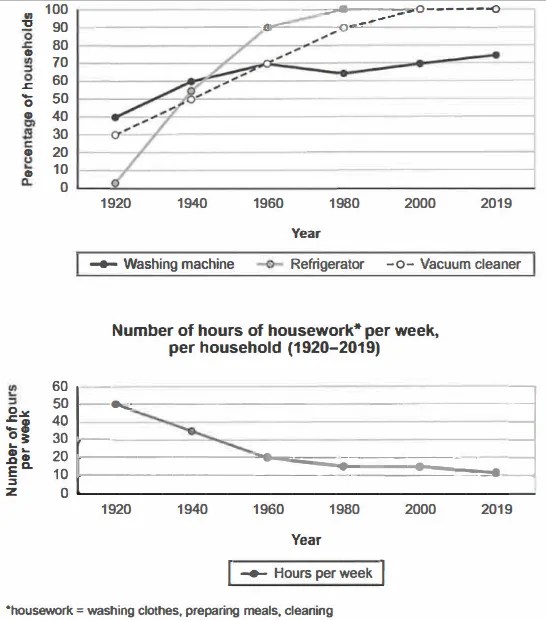
The charts below show the changes in ownership of electrical appliances and amount of time spent doing housework in households in one country between 1920 and 2019.
Summarise the information by selecting and reporting the main features, and make comparisons where relevant.
Percentage of households with electrical appliances (1920-2019)
Student answer (Band 6.5)
These line charts illustrate the comparison of percentages of households using electric appliances and the number of hours it reduced the household work per week from the year 1920 to 2019.
Overall, most of the people did not had any refrigerator in the start, but towards the end almost all people owned it, alongside the vacuum cleaner. The number of hours of household work were also substantially reduced by the end due to the availability of these electric appliances.
Many of the households did not had any refrigerator in 1920, while vacuum cleaner and washing machine were owned by 30% and 40% of households respectively. The number of refrigerators surged in 1940 reaching almost to more than half of the households to the percentage of 52% a little above vaccum cleaner. Washing machines also increased and reached to 70% of households same as vaccum in this year with a little dip in 1980 and then again becoming stable and ending with almost 72% people owning it by the end of the 2019. In 1980 refrigerators reached almost all the homes, while vacuum cleaners were almost present in 90% of homes. In 2000, almost all the homes had vacuum.
In 1920, almost 50 hours of work per week was required to do the house chores such as washing clothes, preparing meals and cleaning. These hours plunged over these years reaching to 20% in 1960, and then amost became 15% and remaing stable and closing at 10 hours of work per week.
AI examiner evaluation
| Criterion | Band |
|---|---|
| Task Achievement / Task Response | 7.0 |
| Coherence and Cohesion | 6.5 |
| Lexical Resource | 6.0 |
| Grammatical Range and Accuracy | 5.5 |
| Overall | 6.5 |
Task Achievement / Task Response: Band 7.0
You cover both charts and provide a clear overview: appliance ownership generally rose, while weekly housework time fell. The main trends and several useful comparisons are reported, including refrigerators reaching full ownership by 1980 and vacuum cleaners doing so by 2000. Most figures are close to the chart, though the washing-machine account is imprecise: it reached about 70% in 1960, dipped to 65% in 1980, then rose to 75% in 2019, rather than ending at about 72%. The 1940 refrigerator figure is also closer to 55% than 52%. Your explanation that reduced housework was “due to” appliances goes beyond what the charts establish; describe the parallel trends without claiming a cause. More precise reporting would strengthen an otherwise well-selected account.
Coherence and Cohesion: Band 6.5
The response has a clear overall structure: an introduction, an overview, and separate discussion of appliance ownership and housework hours. Information generally progresses chronologically, and links such as “Overall,” “while,” and “In 2000” help the reader follow comparisons. This meets the lower-band expectation of a coherent arrangement and shows some of the flexibility associated with stronger cohesion. However, the appliance paragraph moves between appliances and years in a way that occasionally makes comparisons difficult to track, and “these years” is a vague reference. Grouping the appliance trends more systematically—for example, refrigerators and vacuum cleaners together, then washing machines—would improve progression. A few long sentences also combine several stages, so clearer sentence boundaries would make the sequence easier to follow.
Lexical Resource: Band 6.0
You use an adequate range of task-related vocabulary, including “surged,” “substantially reduced,” “reached,” and “stable,” and the meaning is generally clear. There are also attempts at more specific phrasing, such as “a little dip” and “almost all the homes.” However, some choices are imprecise or informal for an academic report: “people owning it” should refer to households, and “number of refrigerators” does not accurately describe a percentage of households. “Household work” and “house chores” are repeated where “housework” would be more natural. Spelling errors such as “vaccum,” “amost,” and “remaing” are noticeable, though they do not prevent understanding. Aim for consistent chart terminology and more precise collocations to make the vocabulary more controlled.
Grammatical Range and Accuracy: Band 5.5
You attempt a mix of simple and complex sentences, including clauses with “while” and “reaching,” and the overall meaning remains understandable. However, some errors in verb forms, agreement, and sentence construction limit accuracy. For example, “most of the people did not had” should be “most households did not have,” and “the number of hours … were” should be “the number … was.” The sentence beginning “The number of refrigerators surged …” is awkwardly constructed and would be clearer as “Refrigerator ownership rose to about 55% in 1940.” In “reaching to 20%,” the preposition is unnecessary, and hours should not be expressed as a percentage. There is also a run-on sequence in the washing-machine description. Check subject–verb agreement and build shorter, controlled sentences around each comparison.
See this exact question answered at other band scores. The same prompt compared across bands.
Browse more IELTS Writing model answers or get your own writing scored by the same AI examiner.