Band 6.0 IELTS Writing Task 1 Model Answer
Overall Band Score: 6.0 · Cambridge IELTS 16 · 2026-11-19
IELTS Writing Task 1 question
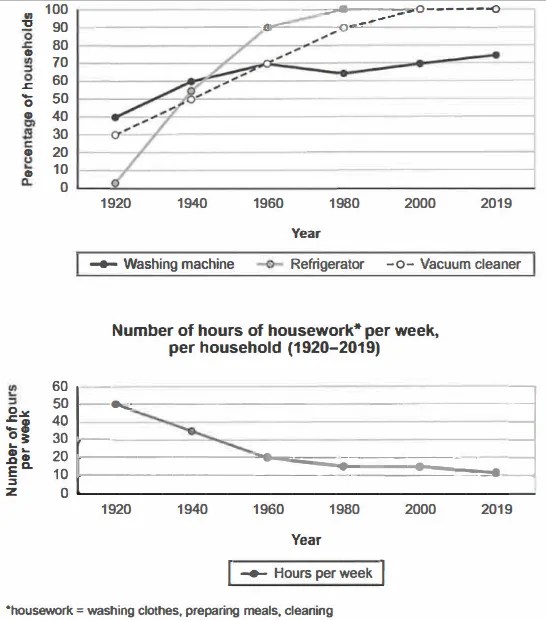
The charts below show the changes in ownership of electrical appliances and amount of time spent doing housework in households in one country between 1920 and 2019.
Summarise the information by selecting and reporting the main features, and make comparisons where relevant.
Percentage of households with electrical appliances (1920-2019)
Student answer (Band 6.0)
The line charts illustrate the proportions of the changes in ownership of electrical appliances, and how much time was spent per week on doing housework in homes in a country from 1920 and 2019.
Overall, the share for refrigerator and vacuum cleaner reached an universal level, found in every households by 2000, whereas the proportion for washing machine fluctuated. On the other hand, the total number of hours of housework fell steadily.
In 1920, the ownership of refrigerator was just around 1%, the lowest owned electrical appliances in the household. It rose dramatically, overtaking the share of vacuum cleaner by 1940, and washing machine in between 1940 and 196, and reached at 100% by 1980. Compared with vacuum cleaner; it started at 30% and rose to 70% by 1960, leveling with the share of washing machine before reaching at 100% in 2000. In contrast, washing machine stood at 40% in the initial period, the highest among the catagory, it's share fluctuated modestly and stood at over 70% by the end of the period.
As for the number of hours spent on doing housework, it was 50 hours a week in 1920. This was followed by a sharp decrease, reaching at 20 hourse per week, more than halved of its initial time. It stood at just over 10 hours a week in 2019.
AI examiner evaluation
| Criterion | Band |
|---|---|
| Task Achievement / Task Response | 6.5 |
| Coherence and Cohesion | 6.0 |
| Lexical Resource | 6.5 |
| Grammatical Range and Accuracy | 5.5 |
| Overall | 6.0 |
Task Achievement / Task Response: Band 6.5
You cover both charts and provide a clear overview: refrigerator and vacuum-cleaner ownership became universal, while washing-machine ownership fluctuated and housework time declined. Most key figures and comparisons are accurately selected, including the refrigerator reaching 100% in 1980 and vacuum cleaners doing so by 2000. The account is not fully precise in places: the refrigerator overtook washing-machine ownership between 1940 and 1960, not simply “in between 1940 and 196”; the year is incomplete, and the final washing-machine figure is about 75%, rather than merely “over 70%.” The housework trend is reported, but the plateau at 15 hours from 1980 to 2000 is omitted. More exact reporting of these stages would make the coverage more complete and developed.
Coherence and Cohesion: Band 6.0
The response has a coherent overall arrangement: an introduction, a summary of the main trends, a paragraph comparing appliance ownership, and a final paragraph on housework. This makes the information easy to follow. Linking expressions such as “Overall,” “On the other hand,” “Compared with,” and “In contrast” help signal comparisons, although some transitions are slightly mechanical or do not connect the comparison smoothly. For example, the long appliance paragraph moves between refrigerator, vacuum cleaner, and washing machine in a way that makes the sequence of comparisons harder to track. The final paragraph also gives only a brief account of the housework figures. Grouping the appliance trends more systematically and showing the 1980–2000 plateau before the final decline would strengthen progression and cohesion.
Lexical Resource: Band 6.5
You use an adequate range of task-related vocabulary, including “proportions,” “ownership,” “overtaking,” “fluctuated,” and “sharp decrease.” These choices communicate the main trends, and some less common terms show an attempt to describe changes precisely. However, several collocations and word forms are inaccurate or awkward, such as “the lowest owned electrical appliances,” “reached at 100%,” and “an universal level.” There are also spelling errors in “catagory” and “hourse,” and “the share for refrigerator” is less natural than a phrase referring to refrigerator ownership. These issues do not prevent understanding, but more accurate collocations and careful proofreading would make the description more fluent and precise.
Grammatical Range and Accuracy: Band 5.5
You attempt a mix of simple and complex sentences, including clauses with “whereas,” “before,” and “as.” The overall meaning is generally clear, but some grammatical errors remain. For example, “every households” has a number-agreement error, and “the share for refrigerator and vacuum cleaner reached an universal level” has problems with articles and sentence construction. The sentence beginning “Compared with vacuum cleaner; it started…” uses punctuation incorrectly and leaves the comparison unclear. There are also awkward verb patterns in “reached at 100%” and “more than halved of its initial time.” Aim to form comparisons with complete, parallel clauses, check articles and singular/plural agreement, and use standard verb patterns. This would improve accuracy while preserving your range of sentence structures.
See this exact question answered at other band scores. The same prompt compared across bands.
Browse more IELTS Writing model answers or get your own writing scored by the same AI examiner.