Band 6.0 IELTS Writing Task 1 Model Answer
Overall Band Score: 6.0 · Cambridge IELTS 16 · 2026-11-19
IELTS Writing Task 1 question
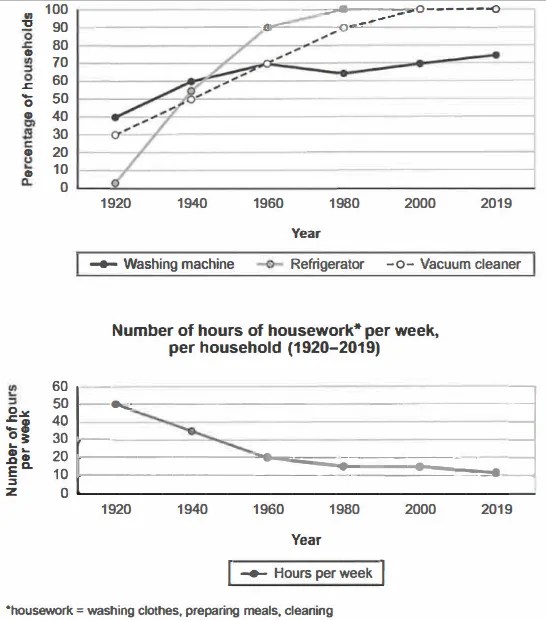
The charts below show the changes in ownership of electrical appliances and amount of time spent doing housework in households in one country between 1920 and 2019.
Summarise the information by selecting and reporting the main features, and make comparisons where relevant.
Percentage of households with electrical appliances (1920-2019)
Student answer (Band 6.0)
The two charts illustrates the diverses in ownership of electrical machines and the time spent doing housework in households in one century between 1920 and 2019.
Firstly, we will talk about the percentage of households during this century. Washing machine started it with about fourty percent then had a significant rising ended in 1960 around sixty percent, after that it had a flactuated situation till 2000, after that it had grown up just over sixty percent by 2019. Furthemore, in 1920 refrigerator approximately had not have any households but in a short time it had increased dramatically untill it had a one hundred percent in 1980, it remained stable over the remaining time of the century. Vacuum cleaner had the midest place at the beggining of this era. It had an incredible jumping statement from 1920 to 2000 when it had a full percent of households.
Secondly, number of hours of housework weekly in the same period. We can notice that the main idea is that hours had declined over those years, while it started around fifty hours in 1920 it had broken down rapidly to just over ten hours in 1980. Furthermore, it had a stability stage till the end of the century when it ended about just ten hours.
In conclusion, we can see the relation between the percentage of households and the hours of housework per week, so wee can say when the percentage rose the hours decreased directly.
AI examiner evaluation
| Criterion | Band |
|---|---|
| Task Achievement / Task Response | 6.0 |
| Coherence and Cohesion | 6.5 |
| Lexical Resource | 5.5 |
| Grammatical Range and Accuracy | 5.0 |
| Overall | 6.0 |
Task Achievement / Task Response: Band 6.0
You cover both charts and identify the main overall patterns: appliance ownership generally increased, while weekly housework declined. Several figures are reported accurately, including refrigerators reaching 100% by 1980 and vacuum cleaners reaching full ownership by 2000. However, some details are inaccurate or unclear: washing-machine ownership rose from about 40% to 70% by 1960, not around 60%, and the later figure is about 75%, rather than merely “just over sixty percent.” Housework fell to about 15 hours by 1980 and stayed there until 2000; it did not fall to just over ten hours at that point. The final relationship is a reasonable summary, but the overview would be stronger if it clearly highlighted the appliances that reached saturation and the washing machine’s slight fluctuations.
Coherence and Cohesion: Band 6.5
The response has a clear overall arrangement: appliance ownership is discussed first, housework hours second, followed by a conclusion. This makes the two chart topics easy to follow, and sequencing phrases such as “Firstly” and “Secondly” help signal the shift. The progression within the appliance paragraph is less controlled, however: repeated “after that” makes the account sound mechanical, and the washing-machine trend is difficult to follow because its rise, dip and later increase are not clearly separated. The conclusion repeats the broad relationship rather than adding a concise overview. To strengthen cohesion, group the appliance trends by their key patterns and use more precise links such as “by contrast,” “thereafter” and “while,” with clear references to the relevant series.
Lexical Resource: Band 5.5
You attempt a range of trend vocabulary, including “increased dramatically,” “remained stable” and “declined,” which is appropriate for describing charts. However, several inaccurate word choices and collocations reduce precision: “diverses” does not express differences, “electrical machines” is less suitable than “appliances,” and “incredible jumping statement” is not a natural way to describe a sharp rise. There are also noticeable spelling errors, including “fourty,” “flactuated,” “Furthemore” and “beggining.” Some phrases, such as “full percent of households,” are understandable but imprecise. Build a reliable set of chart-description expressions and check spelling and collocations carefully; this will make your descriptions clearer and more natural.
Grammatical Range and Accuracy: Band 5.0
You use both simple statements and longer sentences with time clauses, for example, “while it started around fifty hours in 1920…” This shows an attempt to vary sentence structure, and the main trends remain understandable. However, some grammatical errors recur. The opening has subject–verb disagreement in “The two charts illustrates,” and “refrigerator approximately had not have any households” has an incorrect verb construction. Articles and sentence structure are also problematic in “it had a one hundred percent” and “when it had a full percent of households.” The final sentence contains an unclear construction after “so.” Aim for accurate, direct sentences, checking agreement, verb forms and articles; then use complex clauses only where you can control their structure.
See this exact question answered at other band scores. The same prompt compared across bands.
Browse more IELTS Writing model answers or get your own writing scored by the same AI examiner.