Band 5.0 IELTS Writing Task 1 Model Answer
Overall Band Score: 5.0 · Cambridge IELTS 16 · 2026-11-20
IELTS Writing Task 1 question
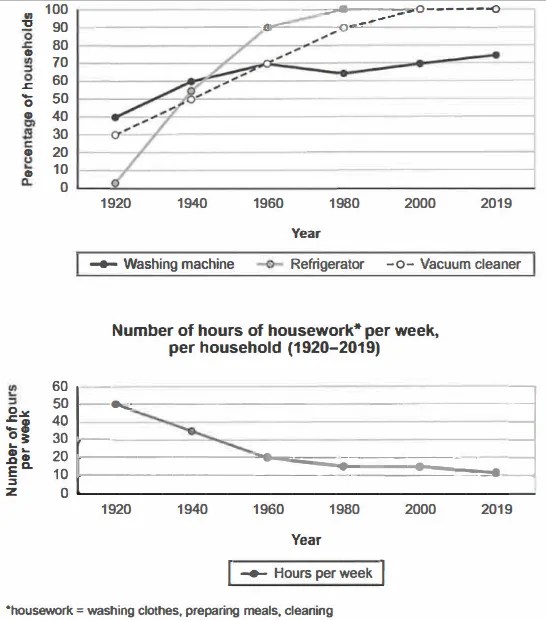
The charts below show the changes in ownership of electrical appliances and amount of time spent doing housework in households in one country between 1920 and 2019.
Summarise the information by selecting and reporting the main features, and make comparisons where relevant.
Percentage of households with electrical appliances (1920-2019)
Student answer (Band 5.0)
The following charts illustrate fluctuations in ownership of electrical gadgets and amount of time spent doing housework in households in one country between 1920 and 2019.Overall, all three appliances became more commom over the period. Refrigerator and vacuum cleaner reached almost 100%,while washing machine remained lower.In 1920, around 40% of household had a washing machine and 30% had a vacuum cleaner, while almost no household had a refrigerator. There was a sharp increase in all three appliances between 1920 and 1960. By 1960, the refrigerator and vacuum cleaner had risen to around 90%, while the washing machine had risen to about 70%. After 1960, the figures for refrigerator and vacuum cleaner continued to rise slightly and reached 100% by 2000, where they remained stable. In contrast, the percentage for washing machine remained stab
AI examiner evaluation
| Criterion | Band |
|---|---|
| Task Achievement / Task Response | 3.5 |
| Coherence and Cohesion | 5.0 |
| Lexical Resource | 6.0 |
| Grammatical Range and Accuracy | 5.5 |
| Overall | 5.0 |
Task Achievement / Task Response: Band 3.5
You identify the broad pattern that appliance ownership increased and correctly report several key figures, including washing machines at about 40% and vacuum cleaners at 30% in 1920, and washing machines at around 70% in 1960. However, the response is incomplete: it ends mid-sentence at “remained stab” and does not describe the housework-hours trend at all, despite this being a major part of the task. The claim that refrigerators and vacuum cleaners were both around 90% by 1960 is inaccurate: the refrigerator was about 90%, but the vacuum cleaner was about 70%. The response also falls 32 words short of the 150-word minimum. Include both charts’ main trends and finish the comparison.
Coherence and Cohesion: Band 5.0
The information is presented in a generally understandable order: you give an overview, describe the starting figures, and then move to changes after 1960. Linking expressions such as “Overall,” “while,” “By 1960,” and “In contrast” help show comparisons and sequence. However, the response is too brief to develop a complete progression, and the final sentence is cut off, leaving the washing-machine trend unfinished. The housework data is also absent, so the two charts are not connected or compared. Separate the overview and detailed comparisons into clear paragraphs, and use a concluding comparison that covers both appliance ownership and housework hours.
Lexical Resource: Band 6.0
You use a suitable range of task-related vocabulary, including “ownership,” “sharp increase,” “reached,” “remained stable,” and “in contrast.” These choices communicate trends and comparisons clearly, and the meaning is generally easy to follow. Some wording is less precise or natural: “electrical gadgets” is informal for this chart, while “became more commom” contains a spelling error and “almost no household” is an awkward singular construction. Prefer “electrical appliances,” “became more common,” and “almost no households owned a refrigerator.” The phrase “figures for refrigerator and vacuum cleaner” would also be clearer as “the proportions of households owning refrigerators and vacuum cleaners.” More precise trend vocabulary would help you describe the missing housework series.
Grammatical Range and Accuracy: Band 5.5
You produce several clear sentences and use a mix of simple and more complex structures, including the contrast in “In 1920 …, while …” and the time clause “where they remained stable.” Most of the intended meaning is understandable. Some grammatical control is still uneven: “40% of household had” needs a plural noun and verb (“households had”), and “the figures for refrigerator and vacuum cleaner” needs plural forms or articles. The opening also runs directly into “Overall” without a space or clear sentence separation. Finally, the unfinished “remained stab” prevents the last sentence from being grammatically complete. Check agreement, articles and plurals, and proofread sentence boundaries before submitting.
See this exact question answered at other band scores. The same prompt compared across bands.
Browse more IELTS Writing model answers or get your own writing scored by the same AI examiner.