Band 6.5 IELTS Writing Task 1 Model Answer
Overall Band Score: 6.5 · Cambridge IELTS 16 · 2026-11-20
IELTS Writing Task 1 question
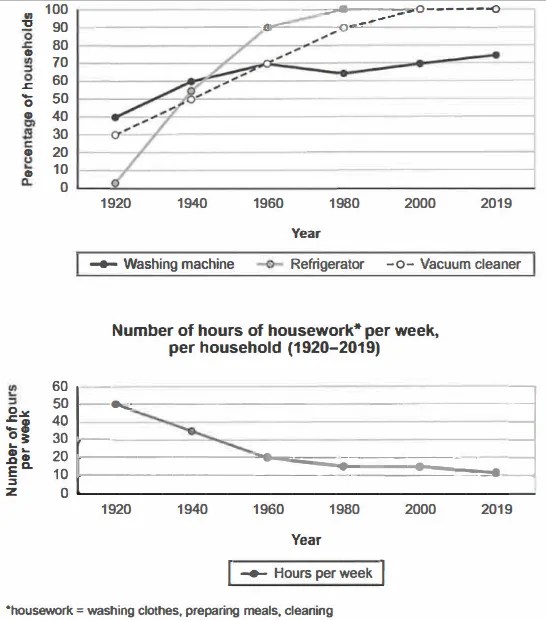
The charts below show the changes in ownership of electrical appliances and amount of time spent doing housework in households in one country between 1920 and 2019.
Summarise the information by selecting and reporting the main features, and make comparisons where relevant.
Percentage of households with electrical appliances (1920-2019)
Student answer (Band 6.5)
The charts demonstrate the changes in ownership of three different electrical appliances and how much time to spend doing housework in households from 1920 to 2019.
Overall, the ownership of all three electrical appliances increased over the period while people started to sped less time on household activities.
In 1920 , there were no people who owned a refrigerator but over the years the ownership of a refrigerator increased steadily and in 1980 every household had their own refrigerator and this figure stayed constent until the end of the period. The ownership of vacuum cleaner also increased gradually until 2000, rising from 30% to 100% and rest of the period it remained stable. However, the ownership of washing machine fluctuated over the time as it increased from 40% to 70% by 1960 ,then slightly went down before reaching its peak ownership by 2019 which was nearly 75% .
In 1920, people spent 50 hours per week due to their housework but this number sharply decreased over the time by reaching 20 hours in 1960. Then this figure further went down to nearly 10 hours per week at the end of the period.
AI examiner evaluation
| Criterion | Band |
|---|---|
| Task Achievement / Task Response | 7.0 |
| Coherence and Cohesion | 7.0 |
| Lexical Resource | 6.0 |
| Grammatical Range and Accuracy | 6.0 |
| Overall | 6.5 |
Task Achievement / Task Response: Band 7.0
You cover both charts and provide a clear overview: appliance ownership generally rose, while time spent on housework fell. The main trends are supported with relevant figures, including the refrigerator reaching 100% in 1980 and the vacuum cleaner reaching full ownership by 2000. The washing-machine account also captures its rise, dip and later recovery. However, “there were no people who owned a refrigerator” is inaccurate: the chart shows about 2% in 1920. The housework description gives the 1960 figure and endpoint but omits the plateau at 15 hours in 1980 and 2000. More precise reporting of these details would make the coverage more consistently complete.
Coherence and Cohesion: Band 7.0
The response is organised effectively into an introduction, an overview and two detail paragraphs, with the appliance trends grouped together and housework discussed separately. This gives the reader a clear progression through the information. Linking expressions such as “Overall,” “However,” and “Then” help signal contrast and sequence. Some connections are less smooth, particularly “and rest of the period it remained stable,” where the relationship between the clauses is not clearly marked, and the final paragraph could compare the intermediate years more explicitly. Use a wider range of accurate linking structures and clearer references to the figures to make the progression more flexible and polished.
Lexical Resource: Band 6.0
Your vocabulary is adequate for describing trends, with useful terms such as “increased steadily,” “fluctuated,” “decreased,” and “remained stable.” These allow you to report the main movements without obscuring meaning. However, some choices are imprecise or awkward: “ownership of a refrigerator increased” would be clearer as “the proportion of households with a refrigerator rose,” and “peak ownership” is less natural than “highest level.” There are also spelling errors in “constent” and “sped,” and “household activities” is broader than the chart’s specific measure of housework. Aim for accurate collocations and check spelling, while varying the repeated use of “increased” and “figure.”
Grammatical Range and Accuracy: Band 6.0
You use a mix of simple and complex sentences, including clauses with “while,” “as,” and “before,” and the overall meaning remains clear. Some grammatical errors persist, however. In the overview, “people started to sped less time” has an incorrect verb form; use “started to spend less time.” The phrase “how much time to spend doing housework” needs a grammatical construction such as “how much time households spent doing housework.” There are also punctuation and sentence-boundary issues, for example the missing space before the comma in “1920 ,” and the run-on connection in “and rest of the period it remained stable.” Review verb forms, clause construction and punctuation to improve accuracy.
See this exact question answered at other band scores. The same prompt compared across bands.
Browse more IELTS Writing model answers or get your own writing scored by the same AI examiner.