Band 5.5 IELTS Writing Task 1 Model Answer
Overall Band Score: 5.5 · Cambridge IELTS 16 · 2026-11-20
IELTS Writing Task 1 question
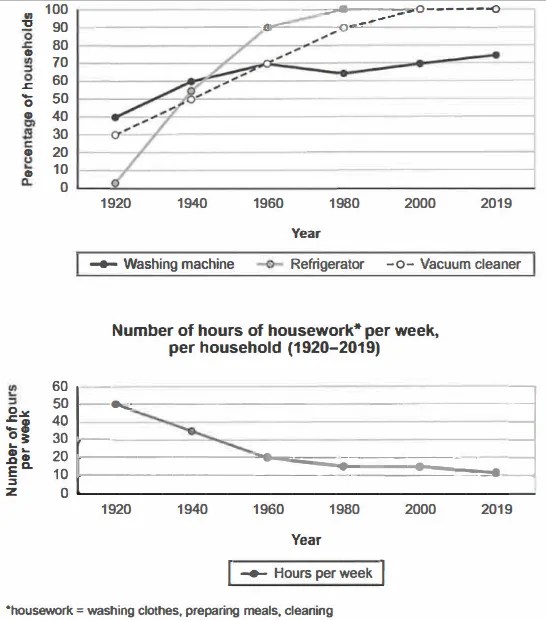
The charts below show the changes in ownership of electrical appliances and amount of time spent doing housework in households in one country between 1920 and 2019.
Summarise the information by selecting and reporting the main features, and make comparisons where relevant.
Percentage of households with electrical appliances (1920-2019)
Student answer (Band 5.5)
First line graph illustrates the percentage in ownership of households with electrical appliances while the second line graph shows the amount of time spent doing housework in households in one country between 1920 and 2019.
Overall, all the figures in the first line graph are significantly rosen. As the percentage of Refrigerator and Vacuum remained the same through out the years. Washing machine accounted for lowest proportion while in the second line graph the number of hours spent in households doing housework descrease steadily.
In 1920, the number of Refrigerator and Vacuum cleaner was 0% and 30% which rose steadily to 55% and 60% respectively. The percentage of both Refrigerator and Vacuum was rose to 90% and 70% in 1960 and both reached to 100% in 2000 and remained the same in 2019.
In contrast, the number of time spent doing housework in 1920 was 50% which falled slightly to 35% in 1940 and 20% in 1960 and until 1980 the number of hours per week remained the same in 2000 and 2019 which was 10%.
AI examiner evaluation
| Criterion | Band |
|---|---|
| Task Achievement / Task Response | 5.5 |
| Coherence and Cohesion | 5.5 |
| Lexical Resource | 5.5 |
| Grammatical Range and Accuracy | 5.0 |
| Overall | 5.5 |
Task Achievement / Task Response: Band 5.5
You identify the two charts and give a broad overview, noting the general rise in appliance ownership and the fall in housework time. However, the overview contains a major contradiction: refrigerator and vacuum-cleaner ownership did not remain unchanged, but rose substantially. Several details are also inaccurate or incomplete: refrigerators were about 2% in 1920, not 0%, and vacuum-cleaner ownership was about 50% in 1940, not 60%. You also say both appliances reached 100% in 2000, although the refrigerator had reached that level by 1980. The washing-machine trend is barely reported, and the housework figure was about 11 hours in 2019. More accurate selection and comparison of the main trends would make the summary more complete.
Coherence and Cohesion: Band 5.5
The response has a recognisable structure, with an introduction, an overview and separate paragraphs for appliance ownership and housework. This helps the reader follow the broad topic. However, progression is weakened by the overview’s inaccurate claim that refrigerator and vacuum ownership remained the same, which conflicts with the later account of increases. The appliance paragraph also combines several years and figures in a way that makes comparisons difficult to track. Linking phrases such as “Overall” and “In contrast” are useful, but the latter introduces only the housework trend and does not clearly connect it to the appliance data. Organise the details by clear trends and use accurate references to years and categories so the relationships between figures are easier to follow.
Lexical Resource: Band 5.5
You use some relevant task vocabulary, including “percentage,” “proportion,” “steadily” and “remained the same,” and the reader can generally understand the intended trends. However, several word choices and collocations are inaccurate or awkward, such as “percentage in ownership,” “the number of Refrigerator and Vacuum cleaner,” and “number of time spent.” “Rosen,” “descrease” and “falled” also show errors in word form or spelling, while capitalising appliance names is unnecessary. These issues make the description less precise, especially when reporting comparisons. Aim for standard chart language such as “the proportion of households owning…” and “hours spent on housework,” and check spelling and collocations before finishing.
Grammatical Range and Accuracy: Band 5.0
You attempt both simple and more complex sentences, including a contrast introduced by “while” and a time clause beginning “until 1980.” However, errors occur frequently and sometimes make relationships between ideas unclear. For example, “As the percentage of Refrigerator and Vacuum remained the same through out the years” is an incomplete clause, and “both reached to 100%” has an incorrect verb pattern. In “the number of hours … was 50%,” the sentence structure and unit do not fit the intended meaning; the chart reports hours, not a percentage. The final sentence also has an unclear construction around “remained the same in 2000 and 2019.” Practise complete clauses, consistent past-tense reporting, and clear subject–verb structures.
See this exact question answered at other band scores. The same prompt compared across bands.
Browse more IELTS Writing model answers or get your own writing scored by the same AI examiner.