Band 5.5 IELTS Writing Task 1 Model Answer
Overall Band Score: 5.5 · Cambridge IELTS 16 · 2026-11-20
IELTS Writing Task 1 question
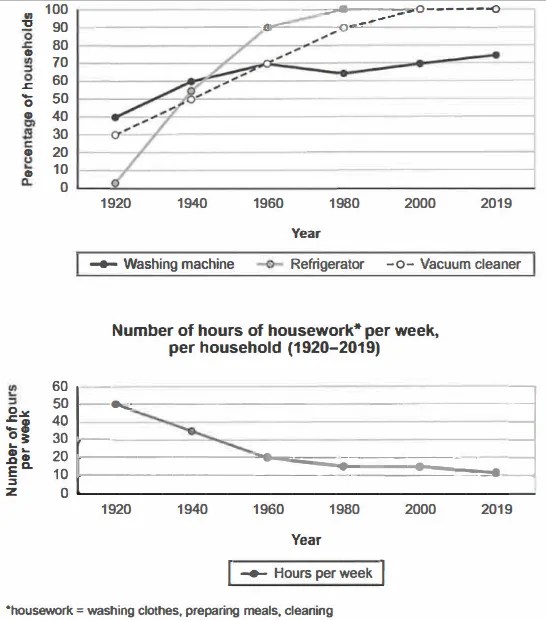
The charts below show the changes in ownership of electrical appliances and amount of time spent doing housework in households in one country between 1920 and 2019.
Summarise the information by selecting and reporting the main features, and make comparisons where relevant.
Percentage of households with electrical appliances (1920-2019)
Student answer (Band 5.5)
This line graphs illustarte the changes in owning an appliances and the time spent doing house work in household in one country between 1920 and 2019. Overall, thier was a dramaticaly change in Refrigerator and vacuum cleaner, while washing machine also rose gradually.
In 1920 no one know about refrigerator but in 20 years it went up to almost 55% thier was sharply increase in 1960 and it became 90%, At 1980 to [redacted phone]% of people use it. After that Vacuum cleaner was 30% nevertheless it jump from 50% in 1940 to 70% in 1960, it became a 100% in 2000 and then never go down. Thier was 40% of washing machine user in 1960 which slightly rose with time bit in 1980 it decline from 70%. In 2019 more then 70% people use it.
It take 50 hour in week in 1920 for housewrok, but it reduce with the time and in 1960 it take 20 hour per week it go down slightly and in 2019 it take only 10 hours.
AI examiner evaluation
| Criterion | Band |
|---|---|
| Task Achievement / Task Response | 6.0 |
| Coherence and Cohesion | 6.0 |
| Lexical Resource | 5.5 |
| Grammatical Range and Accuracy | 5.0 |
| Overall | 5.5 |
Task Achievement / Task Response: Band 6.0
You cover both charts and provide an overview, noting that refrigerator and vacuum-cleaner ownership rose while housework time fell. Several key figures are reported accurately, including refrigerators reaching 100% by 1980 and housework declining from 50 to about 10 hours. However, some details are unclear or inaccurate: “no one” owned a refrigerator in 1920, although the chart shows about 2%, and the washing-machine figures are confused. The 40% figure belongs to 1920, not 1960; ownership was about 70% in 1960, dipped to 65% in 1980, then rose to 75% in 2019. The overview could also identify the broad contrast more precisely: refrigerators and vacuum cleaners reached full ownership, while washing machines did not.
Coherence and Cohesion: Band 6.0
The response has a recognisable structure: an introduction and overview are followed by appliance details and then housework figures. This gives the reader a generally coherent route through the information. However, the appliance paragraph combines several trends in long, loosely connected sentences, and transitions such as “After that” and “nevertheless” do not always show the intended relationship clearly. The washing-machine information is especially difficult to follow because the years and figures are presented out of sequence. Use separate, logically ordered comparisons—for example, group refrigerator and vacuum-cleaner growth, then describe the washing-machine dip and recovery. Clearer sentence boundaries and more precise referencing would make the progression easier to follow.
Lexical Resource: Band 5.5
You use relevant chart vocabulary, including “rose,” “decline,” “sharply increase,” and “hours per week,” and the main trends are usually understandable. However, word choice and collocation are often inaccurate or repetitive. Phrases such as “owning an appliances,” “no one know about refrigerator,” and “it take 50 hour in week” do not express the data naturally. There are also noticeable spelling errors, including “illustarte,” “thier,” “dramaticaly,” and “housewrok.” Aim for precise reporting language such as “the proportion of households with…” and “housework took…”; check spelling and use the correct form of appliance names. This would make the description more fluent and exact.
Grammatical Range and Accuracy: Band 5.0
You attempt both simple and more complex sentence forms, and the overall meaning can generally be followed. However, errors in sentence structure, tense, agreement, articles, and punctuation are frequent enough to make some statements difficult to interpret. For example, “This line graphs illustrate” has subject–verb disagreement, while “it went up” and “it became 90%” use unclear pronoun reference. The sentence beginning “After that Vacuum cleaner…” joins several separate ideas without effective punctuation, and “It take 50 hour in week” lacks correct tense and article/plural forms. Practise writing shorter, complete sentences with a clear subject and verb, and use past-tense forms consistently when describing the historical data. More accurate sentence control is needed alongside your attempts at longer structures.
See this exact question answered at other band scores. The same prompt compared across bands.
Browse more IELTS Writing model answers or get your own writing scored by the same AI examiner.