Band 5.5 IELTS Writing Task 1 Model Answer
Overall Band Score: 5.5 · Cambridge IELTS 16 · 2026-11-21
IELTS Writing Task 1 question
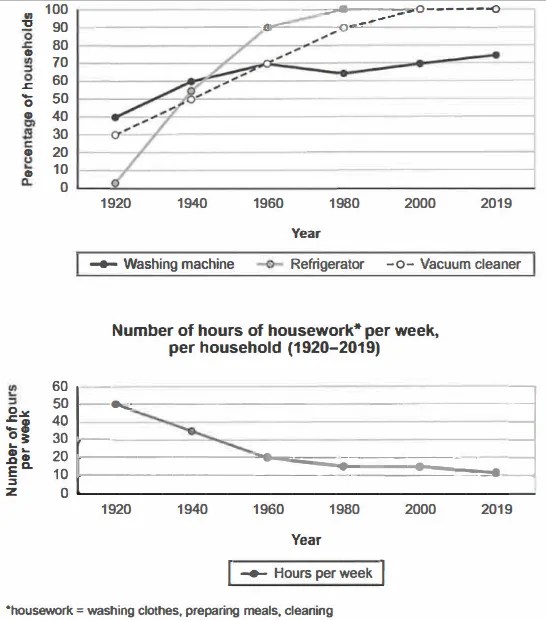
The charts below show the changes in ownership of electrical appliances and amount of time spent doing housework in households in one country between 1920 and 2019.
Summarise the information by selecting and reporting the main features, and make comparisons where relevant.
Percentage of households with electrical appliances (1920-2019)
Student answer (Band 5.5)
The line charts provides key information about the changes between the percentage of households with electrical appliances and the time spended doing housework in households in one country between 1920 and 2019. The units are measured in percentage.
Overall, it is clear from the graph that the differnts between charts is the percentage of households with electrical appliances is rising up over the years, and the number of hours of housework is falling down. In addition, the percentage of household with electrical appliances increased substantially over the years. Whereas the number of hours of housework decreased substantially over the period.
According to what is shown, the share of families with electrical devises, first the washing machine rised from 40 to 70 between 1920 and 1960 and falled from 70 to 65 between 1960 and 1980 and increased to 75 between 1980 and 2019. Secondly refrigerator rised from 0 to 100 between 1920 and 1980, however it fixed in 100 from 1980 to 2019, also the same thing with vacuum cleaner it rised rapidly from 30 to 100 between 1920 and 2000 and fixed in 100 until 2019.
In terms of number of hours of housework per week deceased over all the period , from 50 to 10 between 1920 and 2019.
AI examiner evaluation
| Criterion | Band |
|---|---|
| Task Achievement / Task Response | 6.0 |
| Coherence and Cohesion | 5.5 |
| Lexical Resource | 5.0 |
| Grammatical Range and Accuracy | 5.0 |
| Overall | 5.5 |
Task Achievement / Task Response: Band 6.0
You cover both charts and identify their main contrast: appliance ownership generally rose while housework time fell. You also report several useful figures, including washing machines rising from 40% to 70% before dipping to 65%, and refrigerators reaching 100% by 1980. Some details, however, are inaccurate or insufficiently developed. Refrigerator ownership was about 2%, not 0%, in 1920, and housework fell from 50 to 11 hours, rather than 10. The overview repeats the same general trend without highlighting that refrigerators and vacuum cleaners eventually reached full household ownership, while washing machines remained lower and fluctuated. A more precise overview and accurate endpoint figures would make the key features clearer and more complete.
Coherence and Cohesion: Band 5.5
The response has a recognisable structure: an introduction, an overview, a paragraph on appliance ownership and a final sentence about housework. This gives the reader a basic route through the information. However, progression within the appliance paragraph is weakened by the sequence markers “first” and “Secondly” and the long sentence joining several trends with commas and “however.” The overview also repeats the rise in appliance ownership and fall in housework rather than adding a distinct comparison. The final housework detail is separated into a very short paragraph, so it feels under-integrated. Grouping the appliance trends in a clearer sequence and linking the two charts through direct comparisons would improve cohesion.
Lexical Resource: Band 5.0
You use relevant chart vocabulary such as “percentage,” “share,” “increased,” “decreased” and “per week,” so the topic is generally clear. However, the range is limited and several word-choice, collocation and spelling errors make the description less natural: “time spended,” “the differnts between charts,” “electrical devises,” “rised,” “falled” and “fixed in 100.” Repetition of “increased substantially” and “decreased substantially” also limits precision. Choose standard trend language and check spelling and word forms carefully. For example, describe a figure as “remained at 100%” rather than “fixed in 100,” and use “ownership” or “proportion of households” to avoid repeating “percentage of households.”
Grammatical Range and Accuracy: Band 5.0
You attempt both simple and more complex sentences, including a contrast with “Whereas” and a clause introduced by “however.” Nevertheless, control is inconsistent, and some sentence structures are faulty or difficult to follow. The opening “The line charts provides” has a subject–verb agreement error, while “the differnts between charts is” has an unclear grammatical construction. In “the washing machine rised … and falled,” the verb forms are also incorrect; these are grammatical form errors in addition to spelling issues. Several clauses are joined with commas, as in the appliance paragraph, creating run-on sentences. Use shorter, complete sentences, maintain past-tense forms consistently, and check agreement and punctuation.
See this exact question answered at other band scores. The same prompt compared across bands.
Browse more IELTS Writing model answers or get your own writing scored by the same AI examiner.