Band 6.0 IELTS Writing Task 1 Model Answer
Overall Band Score: 6.0 · Cambridge IELTS 16 · 2026-11-21
IELTS Writing Task 1 question
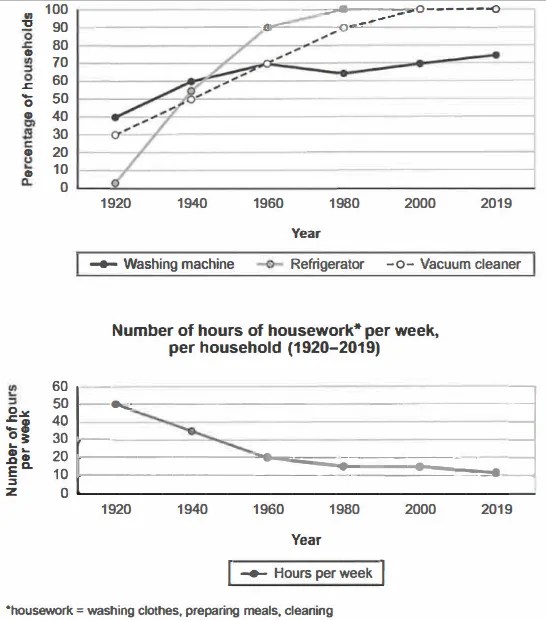
The charts below show the changes in ownership of electrical appliances and amount of time spent doing housework in households in one country between 1920 and 2019.
Summarise the information by selecting and reporting the main features, and make comparisons where relevant.
Percentage of households with electrical appliances (1920-2019)
Student answer (Band 6.0)
The line graph illustrates fluctuations in electrical appliances ownership and amount of time spent in doing housechores in one particular country over a century from 1920 to 2019.
Overall, it is evident that refrigerator became popular in later half period in1960 from 90% reaching approximately 100% in 1980 and maintining this figure till 2019.On the other hand, washing machine continues to rise till 1960 to 70% before it witnessed slight dip and then again reaching almost 70% in 2019. Whereas, vaccums cleaner continues to gain momentum from 30% in 1920 to 100% in 2000 and maintained this position till 2019.
Time spent in house hold chores witnessed decline througout years from peak rate 50hours per week in 1920 and is reduced to 10 hours per week by the end of 2019.
AI examiner evaluation
| Criterion | Band |
|---|---|
| Task Achievement / Task Response | 5.5 |
| Coherence and Cohesion | 6.0 |
| Lexical Resource | 6.0 |
| Grammatical Range and Accuracy | 5.5 |
| Overall | 6.0 |
Task Achievement / Task Response: Band 5.5
You identify the main overall patterns: appliance ownership generally increased, while weekly housework time fell. Several figures are also reported accurately, including refrigerators reaching about 100% by 1980 and vacuum cleaners reaching 100% by 2000. However, the account is incomplete: it omits the refrigerator’s very low starting point and the housework figures for the middle years, and it gives the final housework figure as 10 rather than approximately 11 hours. The washing-machine description is also unclear: it says the figure reaches “almost 70% in 2019,” although it is about 75%. The response is 131 words, below the required 150, which limits the detail and comparisons provided. Include more key stages and precise comparisons to address the task more fully.
Coherence and Cohesion: Band 6.0
The response has a clear basic structure, moving from an introduction to an overview and then to the housework trend. “Overall” signals the summary, and “On the other hand” helps distinguish trends. However, most appliance details are crowded into one long overview sentence, while the housework trend is isolated in a short final paragraph; grouping the appliance series together and giving the housework data its own developed paragraph would improve progression. Some linking is awkward or incomplete, particularly “Whereas, vaccums cleaner…” and the abrupt shift to “Time spent…”. Use cohesive devices to show comparisons between series, and ensure each paragraph develops a clear, connected set of information.
Lexical Resource: Band 6.0
You use a reasonable range of task-related vocabulary, including “fluctuations,” “maintaining,” “slight dip,” and “decline,” and the main trends remain understandable. There are, however, several inaccurate or unnatural choices that reduce precision. “Housechores” and “house hold chores” are inconsistent, while “gain momentum” is not a natural way to describe a rising percentage. “Peak rate” is also unsuitable for the number of hours, and “refrigerator became popular” describes popularity rather than household ownership. Spelling errors such as “vaccums,” “maintining,” and “througout” are noticeable. Aim for precise chart language such as “the proportion of households owning…” and check spelling and collocations before submitting.
Grammatical Range and Accuracy: Band 5.5
You attempt a mix of sentence forms, including a complex opening sentence and clauses describing changes over time. The overall meaning is generally clear, but some grammatical errors affect accuracy. For example, “refrigerator became popular” needs an article, and “in later half period in1960” has an incomplete and unclear time phrase. In “washing machine continues to rise till 1960 to 70% before it witnessed…,” the tense shifts awkwardly between present and past, and the sentence structure makes the sequence difficult to follow. The final sentence also combines “witnessed decline” with “is reduced,” creating inconsistent tense and form. Use past tense consistently for the historical data, and check articles, sentence boundaries, and punctuation.
See this exact question answered at other band scores. The same prompt compared across bands.
Browse more IELTS Writing model answers or get your own writing scored by the same AI examiner.