Band 6.0 IELTS Writing Task 1 Model Answer
Overall Band Score: 6.0 · Cambridge IELTS 16 · 2026-11-21
IELTS Writing Task 1 question
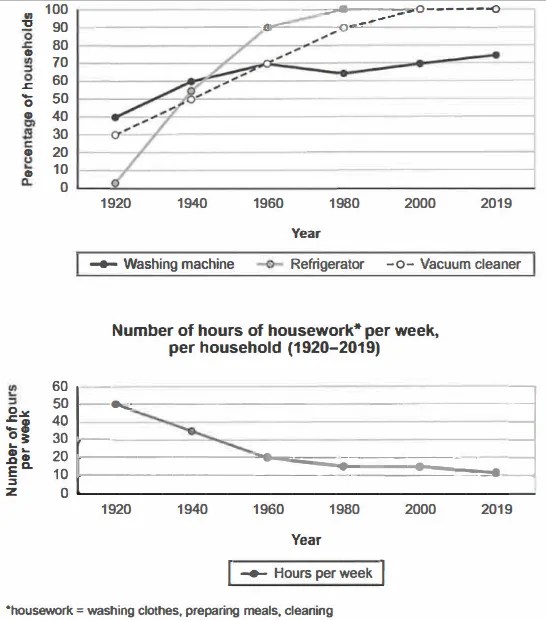
The charts below show the changes in ownership of electrical appliances and amount of time spent doing housework in households in one country between 1920 and 2019.
Summarise the information by selecting and reporting the main features, and make comparisons where relevant.
Percentage of households with electrical appliances (1920-2019)
Student answer (Band 6.0)
The charts illustrate percentage alteration of house owners having electrical appliances and variation in number of time utilize doing washing clothes, preparing meals , cleaning in a house from 1920 to 2019.
overall, the proportion of usage in washing machine, refrigerator and vacuum cleaner are increased for each of them with in a time period, however, the number of hours used in application of these devices are greatly reduced during such specific period.
In 1920, the percentage of utilization of refrigerator is almost zero conversely it dominate at the end of mention era with 100%. While, washing machine and vacuum cleaner is about 30% and 40% respectively, washing machine was increased with little fluctuation to 75% but Vacuum cleaner was jump up to 100% at end of time period.
The duration of using things are vary like these are almost 50% in 1920 whereas, it reach to almost 10% in 2019. These variation show progressive decrease in the numer.
AI examiner evaluation
| Criterion | Band |
|---|---|
| Task Achievement / Task Response | 6.5 |
| Coherence and Cohesion | 6.5 |
| Lexical Resource | 5.5 |
| Grammatical Range and Accuracy | 5.0 |
| Overall | 6.0 |
Task Achievement / Task Response: Band 6.5
You identify the broad contrast between rising appliance ownership and falling housework time, and you include useful start- and end-point figures. The refrigerator’s rise from almost zero to 100% and the vacuum cleaner’s increase to 100% are relevant features. However, some details are inaccurate: in 1920, washing machines were at about 40% and vacuum cleaners at 30%, but these are reversed in your account. The washing-machine trend also includes a dip around 1980, which is not captured by saying it increased with “little fluctuation.” The overview says all appliance proportions increased, but should note that refrigerators and vacuum cleaners reached saturation while washing-machine ownership remained lower. The housework figures are hours, not percentages. More accurate comparisons across the period would make the summary more complete.
Coherence and Cohesion: Band 6.5
The response has a recognisable structure: an introduction, an overview, and paragraphs describing appliance ownership and housework time. This gives the reader a basic progression from the overall trends to selected details. Linking expressions such as “however” and “whereas” also show an attempt to compare information. At times, though, the connections are unclear or mechanically placed. For example, “While, washing machine and vacuum cleaner…” is not a complete contrast with the preceding sentence, and “These variation” does not clearly identify which figures it refers to. Grouping the appliance trends more systematically, then describing the hours trend in a separate, clearly developed paragraph, would improve the flow and make comparisons easier to follow.
Lexical Resource: Band 5.5
You attempt a range of task-related vocabulary, including “proportion,” “fluctuation,” “duration,” and “progressive decrease.” However, several choices are inaccurate or unnatural and sometimes obscure the intended meaning. “Percentage alteration of house owners” does not describe appliance ownership, while “number of time utilize” and “percentage of utilization” are awkward formulations. “The refrigerator… it dominate” also uses an unsuitable verb for the trend. These issues show that the vocabulary range is still limited in effective control, despite some attempts at less common terms. Prefer precise chart language and familiar collocations, such as “the proportion of households owning,” “rose to,” and “the number of hours spent on housework.” Check word forms and spelling, including “number.”
Grammatical Range and Accuracy: Band 5.0
There are attempts to combine ideas using contrast and time clauses, but control of sentence structure is uneven, and errors occur in basic as well as more complex forms. For example, “washing machine and vacuum cleaner is” has a subject–verb agreement problem, and “it reach” should use a past-tense verb. The sentence beginning “While” is a fragment, and the final sentence, “These variation show…,” has a number-agreement error. Articles and plurals are also inconsistent, as in “the number of hours” and references to appliance types. These errors sometimes make relationships between ideas difficult to interpret. Build accuracy with clear simple sentences first, then add subordinate clauses and check agreement, tense, articles, and punctuation.
See this exact question answered at other band scores. The same prompt compared across bands.
Browse more IELTS Writing model answers or get your own writing scored by the same AI examiner.