Band 6.5 IELTS Writing Task 1 Model Answer
Overall Band Score: 6.5 · Cambridge IELTS 16 · 2026-11-22
IELTS Writing Task 1 question
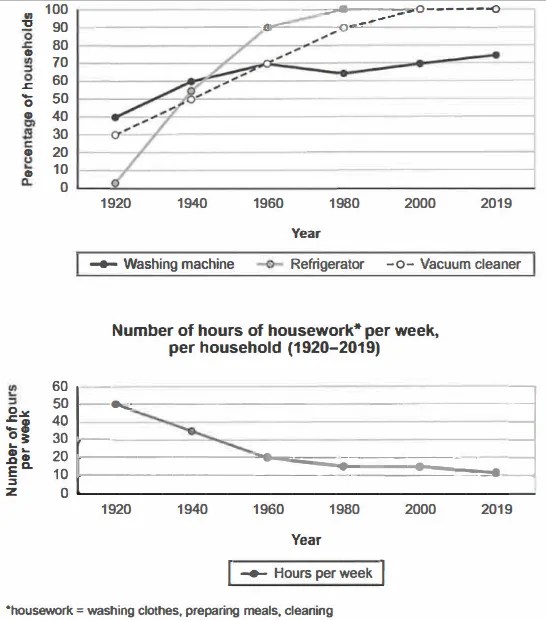
The charts below show the changes in ownership of electrical appliances and amount of time spent doing housework in households in one country between 1920 and 2019.
Summarise the information by selecting and reporting the main features, and make comparisons where relevant.
Percentage of households with electrical appliances (1920-2019)
Student answer (Band 6.5)
The charts illustrates percentange of households with three different electrical appliances and amount of time spent doing housework in households in one country from 1920 to 2019.
Overall, the percentage of household with three different appliance has increased over the time. Only percentage for washing machine has been fluctuated a little. Beside this, the amount of time spent doing housework has declined throughout the period.
In 1920, 30% households owned vacuum cleaner , this figure increased steadily to 90% households by 1980, then it plummeted to 100% in 2000 and then remained steady till 2019. Similarly, ownernship of refrigerator started with nearly 1% household the increased dramactically to 90% by 1980, then it incresed to 100% and stabilised after 1980.In contrast, washing machine were owned by 40% of households in 1920, this owernship increased to 70% households in 1960, then it decline sligthly to approximately 65%, and again figure inclined to 70% in 2000, and by 2019 nearly 75% household owned washing machine.
The amount of time spent doing housework stared with 50 hours in 1920 and declined to nearly 10 hours by 2019.
AI examiner evaluation
| Criterion | Band |
|---|---|
| Task Achievement / Task Response | 7.0 |
| Coherence and Cohesion | 6.5 |
| Lexical Resource | 6.0 |
| Grammatical Range and Accuracy | 5.5 |
| Overall | 6.5 |
Task Achievement / Task Response: Band 7.0
You identify the main overall patterns: appliance ownership generally rose, while time spent on housework fell. You also select relevant details for all three appliances and the housework measure. However, some figures and descriptions are inaccurate: vacuum-cleaner ownership rose from 90% in 1980 to 100% in 2000, so it did not “plummet”; refrigerator ownership reached 90% in 1960, not 1980; and housework fell to about 11 hours by 2019, rather than “nearly 10.” The overview also says washing-machine ownership “has been fluctuated,” although the intended point—that it changed less consistently—is useful. More precise reporting of the refrigerator timeline and the housework figures would make the account more fully supported.
Coherence and Cohesion: Band 6.5
The response has a clear overall structure: an introduction, a summary of the main trends, a paragraph on appliance ownership, and a final sentence on housework. This makes the information easy to follow, and linking expressions such as “Overall,” “Similarly,” and “In contrast” help signal relationships. However, the appliance paragraph contains several long, joined clauses, making comparisons harder to process; for example, the washing-machine sentence strings together multiple stages with commas. Some transitions are also not fully logical, as “then it plummeted to 100%” contradicts the preceding rise. The housework trend is separated into a very brief final paragraph and could be developed alongside the appliance comparisons. More controlled sentence grouping and clearer links between stages would strengthen progression.
Lexical Resource: Band 6.0
You use a reasonable range of task-related vocabulary, including “increased steadily,” “declined,” “stabilised,” and “ownership,” and the reader can generally understand the trends you intend to describe. There are, however, several spelling errors, such as “percentange,” “dramactically,” “incresed,” and “sligthly,” alongside inaccurate or awkward choices. “Plummeted” means a sharp fall, so it is unsuitable for a rise to 100%; “figure inclined” is also unnatural in this context. Repeated use of “increased” and “household” limits flexibility. Aim for accurate trend verbs and natural collocations, such as “the proportion of households owning…” and “rose to,” while checking spelling carefully.
Grammatical Range and Accuracy: Band 5.5
You attempt both simple and more complex sentences, including clauses linked with “while,” “then,” and “and,” and the main meaning is usually recoverable. However, errors in agreement, articles, plurals, and sentence boundaries occur across the response. For example, “The charts illustrates” should have a plural verb, while “percentage of household” needs a plural noun and an article or possessive construction. In “washing machine were owned,” the subject and verb do not agree. Several sentences join independent clauses with commas, particularly the long washing-machine account, and “the increased” lacks a clear grammatical construction. Use shorter, accurately punctuated sentences and check subject–verb agreement and noun forms; this would improve control while retaining your attempts at complex structures.
See this exact question answered at other band scores. The same prompt compared across bands.
Browse more IELTS Writing model answers or get your own writing scored by the same AI examiner.