Band 5.0 IELTS Writing Task 1 Model Answer
Overall Band Score: 5.0 · Cambridge IELTS 16 · 2026-11-22
IELTS Writing Task 1 question
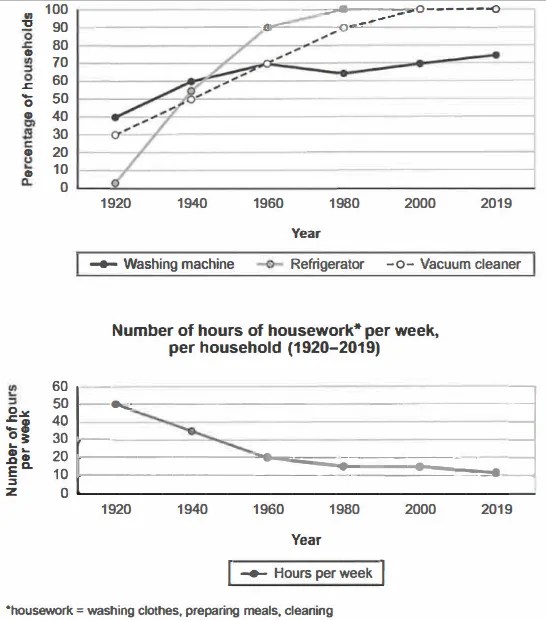
The charts below show the changes in ownership of electrical appliances and amount of time spent doing housework in households in one country between 1920 and 2019.
Summarise the information by selecting and reporting the main features, and make comparisons where relevant.
Percentage of households with electrical appliances (1920-2019)
Student answer (Band 5.0)
Th line graphs demonstrates, proportions of families who owns electrical equipments, and how much these appliances effect the housework between 1920 to 2019.
Overall, at the start the washing machine was the most common thing comparitively, which were present in multiple homes, moreover this trend was followed by the vacuum cleaner. However the refrigerator was less popular in early stages but it demands increases with the passage of time as a result the burden and time of different work in homes were reduced.
Initially, the refrigerator was the most popular appliance in 1920 and own by around 40 families, there demands were increased upto 1960 but the popularity fallen in 1980 and then little hike after 1980 to 2019. The vacuum cleaner was the second most demanding object, in 1920 30 homes have it. After that there needs increases drammatically then washing machines and reached upto 100 houses that held the vaccum cleaner. Between 2000 to 2019 there sales remained same.
Refrigerator was the less known thing in 1920 only one house have the refrigerator, after 1920 the need of refrigerator was elevated then washing machine and vaccum cleaner which gave us figure of 100 homes have refrigerators then for 2 decades there presence remained same in homes. These equipments reduced the house work burden of hours per week, so after 1920 the numbers of hours for work reduced which was 50 and then in 1980 it was upto 12 hours per week in 2019 it came to 10 hours per week.
AI examiner evaluation
| Criterion | Band |
|---|---|
| Task Achievement / Task Response | 5.0 |
| Coherence and Cohesion | 4.5 |
| Lexical Resource | 5.0 |
| Grammatical Range and Accuracy | 5.0 |
| Overall | 5.0 |
Task Achievement / Task Response: Band 5.0
You identify the broad relationship between appliance ownership and declining housework, and you include figures for several years. However, the account only partially reports the chart accurately. The opening overview incorrectly says washing machines were most common at the start: they were more common than vacuum cleaners, but the key contrast is that refrigerators rose sharply to full ownership while housework fell. More seriously, you call the refrigerator the most popular appliance in 1920 and say around 40 households owned it; this figure belongs to washing machines, while refrigerators were at about 2%. You also mix up the refrigerator and vacuum-cleaner trends in the body. To improve, select the main trends accurately and compare the series using the correct labels and values.
Coherence and Cohesion: Band 4.5
The response has an introduction, an overview and body paragraphs, so there is an attempt to organise the information. However, progression is difficult to follow because the appliance descriptions are repeatedly confused: the paragraph beginning “Initially, the refrigerator…” actually describes washing machines, while the next paragraph shifts between vacuum cleaners and refrigerators. Connectors such as “After that,” “then” and “as a result” are used, but they do not consistently clarify which series or time period is being discussed. The final paragraph also combines appliance ownership with housework figures without a clear comparison. Group the three appliance trends together accurately, then describe the decline in housework, using clear references such as “this figure” only when the referent is unmistakable.
Lexical Resource: Band 5.0
You attempt a range of vocabulary, including “proportions,” “popularity,” “dramatically” and “burden,” and the general topic is usually recognisable. However, word choice and spelling errors are frequent enough to make some statements difficult to interpret. Phrases such as “it demands increases,” “second most demanding object” and “their sales remained same” are not natural ways to describe household ownership. There are also repeated spelling errors, including “comparitively,” “drammatically” and “vaccum.” Use precise chart language and check spelling: for example, describe the “percentage of households owning” an appliance, and say that ownership “rose,” “fell” or “levelled off.”
Grammatical Range and Accuracy: Band 5.0
You attempt both simple and longer sentences, including clauses linked with “however,” “after that” and “as a result.” Nevertheless, control is inconsistent, and frequent errors sometimes make relationships between ideas unclear. Examples include “families who owns,” “the refrigerator was … own by,” and “30 homes have it,” where agreement, verb form or tense is faulty. Articles and plurals are also unreliable in phrases such as “the house work burden of hours” and “100 houses.” Several long sentences run ideas together, particularly the final sentence about housework, making the timeline hard to follow. Practise accurate past-tense reporting and subject–verb agreement, and divide complex comparisons into shorter, correctly punctuated sentences.
See this exact question answered at other band scores. The same prompt compared across bands.
Browse more IELTS Writing model answers or get your own writing scored by the same AI examiner.