Band 5.5 IELTS Writing Task 1 Model Answer
Overall Band Score: 5.5 · Cambridge IELTS 16 · 2026-11-23
IELTS Writing Task 1 question
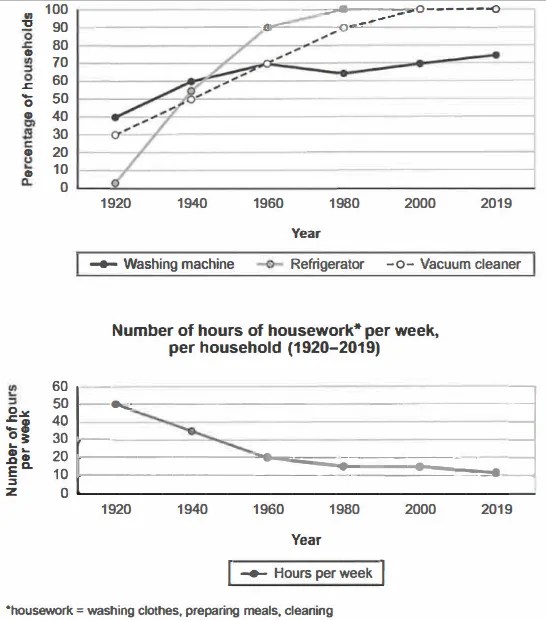
The charts below show the changes in ownership of electrical appliances and amount of time spent doing housework in households in one country between 1920 and 2019.
Summarise the information by selecting and reporting the main features, and make comparisons where relevant.
Percentage of households with electrical appliances (1920-2019)
Student answer (Band 5.5)
The two line graphs illustrates the variations in ownership of electrical appliances and peroid of time spent doing homwork in households in a country from 1920 and 2019.
Overall, it can be clearly seen that, the highest proportion is refrigerator and vacuum cleaner, while the lowest is washing machine, in contrast the number of hours of housework per week is on the peek in the beginning.
Firstly, washing machine in 1920, the ratio was 40% it slightly increased to 70% in 1960, gradually reduced upto around 65% after that it inhanced to round about 73% in 2019. Refrigerator was very low in the commence in 1920, it dramatically climbed to 90% in 1960, furthermore, it rose to 100% after that it remained the same. Vacuum cleaner in 1920 it was 30%, it surged to 95% in 2000, and than remained the same, any way it increased overall.
Housework in 1920 it was 50% it decline to 30% in 1960, in addition washing clothes, preparing meals, cleaning in number slowly dipped to 10% with the passage of time.
AI examiner evaluation
| Criterion | Band |
|---|---|
| Task Achievement / Task Response | 5.5 |
| Coherence and Cohesion | 6.0 |
| Lexical Resource | 5.5 |
| Grammatical Range and Accuracy | 5.0 |
| Overall | 5.5 |
Task Achievement / Task Response: Band 5.5
You identify the main overall contrast: appliance ownership generally rose, while time spent on housework fell. You also report several relevant figures, including washing machines at 40% in 1920 and about 70% in 1960, and refrigerators reaching 100%. However, the overview is unclear and partly inaccurate: calling refrigerators and vacuum cleaners the “highest” and washing machines the “lowest” does not describe the full period, and the washing machine was not consistently the lowest. Some details are also misreported: housework fell to 20 hours by 1960, not 30, and to 11 hours in 2019, rather than 10. The refrigerator’s sharp early rise and the vacuum cleaner’s steady growth could be compared more precisely. Select the key trends and check figures against the chart.
Coherence and Cohesion: Band 6.0
The response has a recognisable structure, with an introduction, an overview, and separate discussion of appliance ownership and housework. This gives the reader a basic route through the information. However, progression within paragraphs is sometimes difficult to follow because several data points are joined in long, loosely connected sentences. For example, the washing-machine sentence moves from 1920 to 1960 and then to later years without clear punctuation or transitions. Connectors such as “furthermore,” “in addition,” and “any way” are sometimes mechanical or do not show the relationship between the figures accurately. Use clearer sentence boundaries and group comparisons by trend—for instance, describe the refrigerator and vacuum cleaner together as they approach full ownership.
Lexical Resource: Band 5.5
You attempt a range of trend vocabulary, including “dramatically climbed,” “surged,” “remained the same,” and “dipped,” which helps communicate changes in the data. However, spelling and word-choice errors are noticeable and sometimes make the description less clear: “peroid,” “homwork,” “inhanced,” and “commence” are inaccurate, while “on the peek” is not a natural way to describe a high point. Some expressions are also imprecise for chart reporting, such as “the ratio” for the percentage of households and “increased overall” when a specific trend could be stated. Aim for accurate, conventional collocations such as “the proportion of households owning” and “reached a peak,” and proofread spelling carefully.
Grammatical Range and Accuracy: Band 5.0
You make some attempts to combine information in longer sentences, but control of sentence structure is inconsistent. Several sentences lack a clear grammatical frame, as in “Firstly, washing machine in 1920, the ratio was 40%,” and “Housework in 1920 it was 50%.” These need a subject and a complete clause, such as “In 1920, 40% of households owned a washing machine.” There are also errors in agreement and articles in the opening (“graphs illustrates”) and in tense or clause construction when describing changes. Punctuation is often insufficient, creating run-on sentences. Practise writing one complete sentence for each trend, using accurate past-tense verbs and clear clauses; this will make your comparisons easier to understand.
See this exact question answered at other band scores. The same prompt compared across bands.
Browse more IELTS Writing model answers or get your own writing scored by the same AI examiner.