Band 4.0 IELTS Writing Task 1 Model Answer
Overall Band Score: 4.0 · Cambridge IELTS 16 · 2026-11-23
IELTS Writing Task 1 question
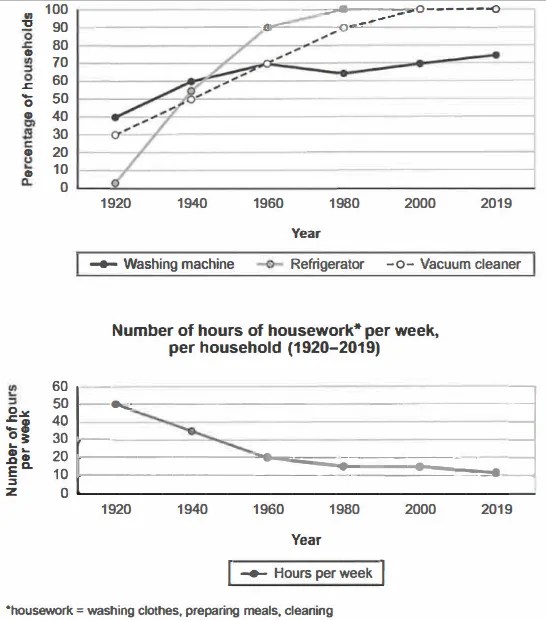
The charts below show the changes in ownership of electrical appliances and amount of time spent doing housework in households in one country between 1920 and 2019.
Summarise the information by selecting and reporting the main features, and make comparisons where relevant.
Percentage of households with electrical appliances (1920-2019)
Student answer (Band 4.0)
The line charts illustrate the differences in ownership of electrical appliances and number of hours spent doing housework in households in one country from 1920 to 2019.
Percentage of households with electrical appliances Washing machine, Refrigerator and Vacuum cleaner from 1920 to 2019.
In 1920, 40% oh households using washing machice, which was increasedand beame 70% in 1960 and than decreased and became about 62% in 1980 and and than again increased from 1980 to 2019 and became 72%.
Refriger
AI examiner evaluation
| Criterion | Band |
|---|---|
| Task Achievement / Task Response | 3.0 |
| Coherence and Cohesion | 3.5 |
| Lexical Resource | 5.0 |
| Grammatical Range and Accuracy | 4.5 |
| Overall | 4.0 |
Task Achievement / Task Response: Band 3.0
The opening identifies both charts and their subject, and the washing-machine figures show an attempt to describe change over time. However, the response is far too incomplete to summarise the task: it stops at “Refriger” and gives no information about refrigerators, vacuum cleaners, or weekly housework hours. It also lacks an overview of the main patterns, such as appliance ownership generally rising while housework time falls. The washing-machine figures are broadly close to the chart, though the 1980 and 2019 estimates are slightly low. At 72 words, the response is 78 words short of the 150-word minimum; the eight words copied from the prompt are excluded. Report the key trends for all four series and include a concise overview.
Coherence and Cohesion: Band 3.5
The response begins with a relevant introduction and then attempts to describe the washing-machine trend, so there is a basic sense of topic and sequence. However, the second line—“Percentage of households with electrical appliances Washing machine, Refrigerator and Vacuum cleaner from 1920 to 2019”—is a fragment rather than a complete, connected sentence. The account then ends abruptly at “Refriger,” leaving the information without a conclusion or logical progression across the charts. Linking expressions such as “while,” “by contrast,” and “overall” could help compare the appliance trends with the decline in housework hours. Use separate paragraphs for the overview and key details, and ensure each paragraph develops a complete point.
Lexical Resource: Band 5.0
The response uses some relevant task vocabulary, including “ownership,” “electrical appliances,” “households,” and “increased,” which makes the general topic clear. However, the range is limited, and the description relies on repeated forms of “became” and “increased” rather than varied language for trends and comparisons. Several spelling errors—“oh,” “machice,” and “beame”—make the text less polished, while “differences in ownership” is less precise than language describing changes over time. Build a small set of accurate trend expressions, such as “rose,” “declined,” “levelled off,” and “reached,” and use terms such as “proportion of households” and “weekly housework hours” to report the data more precisely.
Grammatical Range and Accuracy: Band 4.5
There is an attempt to use past-tense reporting and a time clause, as in “In 1920 … which was increased … in 1960,” but sentence control is weak. The opening data statement lacks a main verb (“In 1920, 40% of households using…”), and the next line is also a sentence fragment. The sequence “which was increased and became” uses an unsuitable passive construction, and the long sentence joined by repeated “and than” does not clearly organise its clauses. The response shows little variety beyond simple statements and does not demonstrate reliable control of sentence boundaries. Practise complete structures such as “The figure rose from 40% in 1920 to 70% in 1960, before falling slightly by 1980,” checking verb forms and punctuation.
See this exact question answered at other band scores. The same prompt compared across bands.
Browse more IELTS Writing model answers or get your own writing scored by the same AI examiner.