Band 5.5 IELTS Writing Task 1 Model Answer
Overall Band Score: 5.5 · Cambridge IELTS 16 · 2026-11-23
IELTS Writing Task 1 question
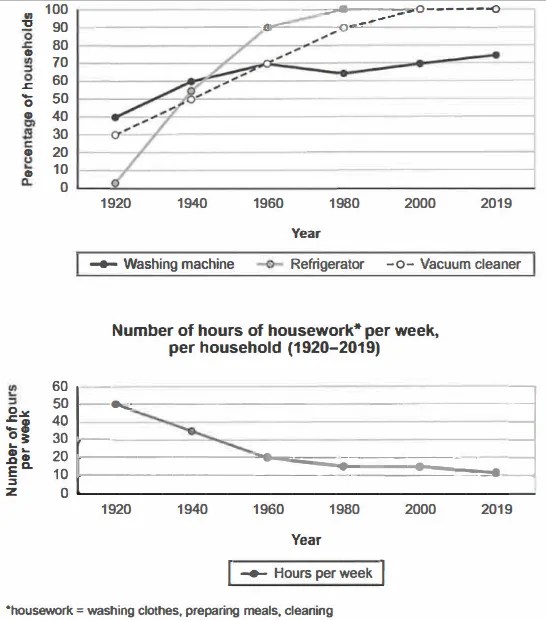
The charts below show the changes in ownership of electrical appliances and amount of time spent doing housework in households in one country between 1920 and 2019.
Summarise the information by selecting and reporting the main features, and make comparisons where relevant.
Percentage of households with electrical appliances (1920-2019)
Student answer (Band 5.5)
The first graph illustrates the proportion of households in a country owning three electrical appliances (washing machine, refrigerator, and vacuum cleaner), while the second graph demonstrates the number of hours spent per week on house chores from 1920 to 2019.
Overall, the utilization of all three appliance increased over the given period. Meanwhile, the hours spent doing housework declined. Refrigerator and vacuum cleaner experienced a surge in its ownership and proved to be the most popular choice.
At the beginning of the period, in 1920, individuals owning refrigerator were almost 0%, by 1950, almost more than half of the household had a refrigerator in their house. in 1960, ownership rose steadily to 90%, and in 1980, almost every house unit possessed one
AI examiner evaluation
| Criterion | Band |
|---|---|
| Task Achievement / Task Response | 5.0 |
| Coherence and Cohesion | 5.5 |
| Lexical Resource | 6.0 |
| Grammatical Range and Accuracy | 5.5 |
| Overall | 5.5 |
Task Achievement / Task Response: Band 5.0
You identify the two broad trends accurately: appliance ownership generally rose, while weekly housework hours fell. However, the response addresses the task only partially. It stops during the refrigerator description and gives no account of the washing-machine or vacuum-cleaner figures, nor the housework-hours data, so the main comparisons are not sufficiently reported. Some details are also inaccurate: the chart gives 1940, not 1950, for the point when refrigerator ownership was already above half, and the overview’s claim that refrigerators and vacuum cleaners were the most popular is not true throughout the period. The response is also below the required 150 words. To improve, complete the account with the key trends and endpoint comparisons for all four series.
Coherence and Cohesion: Band 5.5
The response has a recognisable structure: an introduction, an overview, and then a detail paragraph. The opening clearly signals that two graphs are being described, and “Overall” appropriately introduces the main trends. However, the progression is incomplete because the final paragraph ends abruptly after the refrigerator figures, leaving the other series unconnected and the report without a conclusion to its data description. Cohesion is also weakened by the shift from “1920” to “by 1950” and then back to “1960,” which disrupts the chart’s sequence. Develop separate, logically ordered detail paragraphs—for example, one for appliance ownership and one for housework hours—and use clear time references to guide the reader.
Lexical Resource: Band 6.0
You use a suitable range of task-related vocabulary, including “proportion,” “ownership,” “declined,” “surge,” and “steadily,” and the meaning is generally clear. There are also attempts to avoid repetition, such as “illustrates” and “demonstrates.” Some choices are imprecise or unnatural for describing chart data: “utilization” suggests use rather than household ownership, “house chores” is less formal than “housework,” and “most popular choice” implies preference rather than prevalence. “House unit” is also an awkward substitute for “household.” Aim for precise collocations such as “the proportion of households owning…” and “ownership reached…”; this will make the description more natural and accurate without requiring unnecessarily complex vocabulary.
Grammatical Range and Accuracy: Band 5.5
You attempt both simple and more complex sentence forms, including the contrast in “while the second graph…” and the overview transition “Meanwhile.” Most of the message remains understandable, but some errors in agreement, articles, capitalisation, and sentence completion reduce accuracy. For example, “all three appliance increased” needs plural agreement, and “Refrigerator and vacuum cleaner experienced a surge in its ownership” has mismatched number and pronoun reference. The final sentence lacks a full stop, while “in 1960” begins with a lower-case letter after a full stop. Check singular and plural forms, use articles consistently (“a refrigerator”), and proofread punctuation. Completing the unfinished final sentence would also help demonstrate control across a fuller range of structures.
See this exact question answered at other band scores. The same prompt compared across bands.
Browse more IELTS Writing model answers or get your own writing scored by the same AI examiner.