Band 5.0 IELTS Writing Task 1 Model Answer
Overall Band Score: 5.0 · Cambridge IELTS 16 · 2026-11-23
IELTS Writing Task 1 question
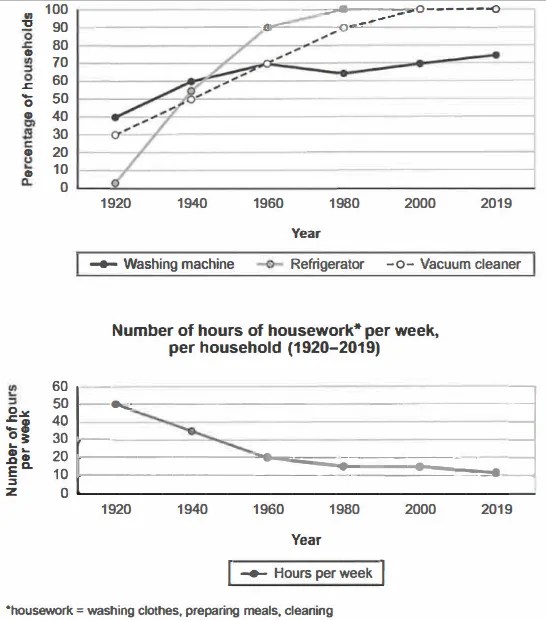
The charts below show the changes in ownership of electrical appliances and amount of time spent doing housework in households in one country between 1920 and 2019.
Summarise the information by selecting and reporting the main features, and make comparisons where relevant.
Percentage of households with electrical appliances (1920-2019)
Student answer (Band 5.0)
The first graph illustrates the percentage of households with electrical appliances between 1920 and 2019, while the second graph shows the number of hours of housework per week, per household between 1920 and 2019.
Overall, amount of time spent doing housework decreased from 50 hourse per week to roughly 10 hours per week betwen 1920 and 2019. Moreover, number of household having electrical appliances increased significantly during the same time window
AI examiner evaluation
| Criterion | Band |
|---|---|
| Task Achievement / Task Response | 4.0 |
| Coherence and Cohesion | 5.5 |
| Lexical Resource | 5.5 |
| Grammatical Range and Accuracy | 5.5 |
| Overall | 5.0 |
Task Achievement / Task Response: Band 4.0
You identify both visuals and give a relevant broad overview: housework time falls, while appliance ownership rises. However, the response addresses the task only minimally because it gives no specific comparisons among the three appliances and does not report their key figures or contrasting patterns. For example, refrigerators rise from almost no ownership to 100%, while washing machines increase more gradually and dip slightly around 1980; these important features are omitted. The overview also says only that appliance ownership increased significantly, without noting that refrigerators and vacuum cleaners reach full household coverage. The response is substantially below the required 150 words, leaving the main data and comparisons undeveloped. Add a concise overview and select several accurate figures to support it.
Coherence and Cohesion: Band 5.5
The response has a basic, sensible order: it first introduces the two graphs and then gives an overall summary. The linking word “while” clearly distinguishes the visuals, and “Moreover” signals an additional trend. However, the answer consists of only two short paragraphs and does not progress to detailed reporting or comparisons, so the organisation remains incomplete for this task. The second paragraph places two broad trends together without developing their relationship or separating the appliance data from the housework figures. Build a clearer progression with an introduction, an overview, and one or two detail paragraphs grouped by related trends. Use linking expressions to show comparisons, such as the contrast between the gradual rise in washing-machine ownership and the faster rise in refrigerator ownership.
Lexical Resource: Band 5.5
You use relevant task vocabulary, including “percentage,” “electrical appliances,” “housework,” and “per week,” and the meaning is generally clear. The range is limited, however, and several phrases are imprecise or awkward: “number of household having electrical appliances” does not accurately express the proportion of households, and “same time window” is less natural in a formal report. There are also spelling errors in “hourse” and “betwen,” which reduce accuracy. To improve, use precise trend language such as “the proportion of households owning…” and “declined steadily,” and check spelling carefully. A wider set of comparison terms would also help you describe the different appliance trends rather than relying on the general phrase “increased significantly.”
Grammatical Range and Accuracy: Band 5.5
The response includes a correctly formed introductory sentence with a useful contrast structure: “The first graph illustrates…, while the second graph shows…”. The overview also attempts a longer sentence beginning “Overall,” and the main trends remain understandable. However, grammatical control is uneven. In “Overall, amount of time…,” the noun phrase needs a determiner (“the amount of time”), and “number of household” requires a plural noun and a determiner (“the number/proportion of households”). The final sentence also lacks a full stop. Most sentence patterns are simple, and the short response offers little evidence of a wider range. Practise accurate articles and plural forms, then use varied comparison clauses to report the data while keeping each sentence complete and correctly punctuated.
See this exact question answered at other band scores. The same prompt compared across bands.
Browse more IELTS Writing model answers or get your own writing scored by the same AI examiner.