Band 5.5 IELTS Writing Task 1 Model Answer
Overall Band Score: 5.5 · Cambridge IELTS 16 · 2026-11-24
IELTS Writing Task 1 question
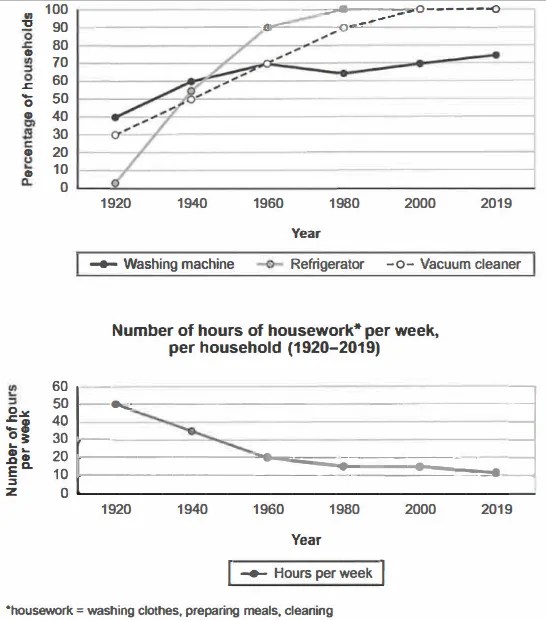
The charts below show the changes in ownership of electrical appliances and amount of time spent doing housework in households in one country between 1920 and 2019.
Summarise the information by selecting and reporting the main features, and make comparisons where relevant.
Percentage of households with electrical appliances (1920-2019)
Student answer (Band 5.5)
The charts demonstrate the changes in ownership of electrical machines and ratio of time spent in doing work in households in one country from 1920 to 2019.
Overall, the charts show the percentage of households who own electrical appliances and number of hours per week in which these appliances are used.
Initial chart describes the fluctation in ownership of electrical devices between 1920 and 2019. Washing machines, Refrigerators, vacuum cleaners gain increase in there ownership in given period of time.In begining refrigerators are not used but in ending it is 100% available in every housuhold. In start the vacuum cleaner is 30% available in every household. But in end it became necessary for any household because it is 100% available in every household. The washing machine is 40% used in households in 1920 and in 2019 it is approximately 75% used in houses.
The last chart illustrates the figure of hours per week that is spend in using electical appliances per household. The figure shows number of hours is gradually decreses from 1920 to 2019.
AI examiner evaluation
| Criterion | Band |
|---|---|
| Task Achievement / Task Response | 5.5 |
| Coherence and Cohesion | 6.0 |
| Lexical Resource | 5.0 |
| Grammatical Range and Accuracy | 5.0 |
| Overall | 5.5 |
Task Achievement / Task Response: Band 5.5
You identify the broad direction of change: appliance ownership generally rose, while weekly housework time fell. You also report several endpoint figures accurately, including washing machines at about 40% and 75%, and refrigerators and vacuum cleaners reaching 100%. However, the overview is not fully accurate: it says the hours show time spent using appliances, whereas the chart measures time spent doing housework. The account also omits key comparisons and intermediate trends, such as refrigerators reaching 100% by 1980, vacuum cleaners rising steadily, and washing-machine ownership dipping around 1980. The housework trend is only described generally, without figures. Covering both charts more precisely and selecting the main comparisons would make the summary more complete and developed.
Coherence and Cohesion: Band 6.0
The response has a recognisable structure, moving from an introduction and overview to separate paragraphs about the appliance chart and the hours chart. This makes the broad organisation easy to follow. Within the appliance paragraph, however, several points are repeated: refrigerators and vacuum cleaners are each described as becoming available in every household. Linking and punctuation are sometimes awkward, as in “But in end it became necessary…” and the run-together sentence beginning “Washing machines, Refrigerators…”. The final paragraph is very brief and does not develop the second chart. Use clearer transitions between comparisons and organise details by trend—for example, appliances that reached full ownership versus the washing-machine fluctuation—to create more consistent progression.
Lexical Resource: Band 5.0
You use some relevant task vocabulary, including “ownership,” “household,” “percentage,” and “gradually,” so the topic is generally identifiable. However, the range is limited and several choices are inaccurate or repetitive. “Ratio of time spent in doing work” is an awkward description of hours of housework, while “electrical machines” and “electical appliances” are less precise than the chart’s terminology. Phrases such as “100% available in every household” repeat the same idea rather than describing ownership directly. There are also noticeable spelling errors, including “fluctation,” “begining,” “housuhold,” and “decreses.” Build a more precise set of trend and measurement terms, and check spelling and collocations before submitting.
Grammatical Range and Accuracy: Band 5.0
You attempt both simple statements and longer sentences, and the main message is usually recoverable. However, the range is limited, and errors recur in sentence construction, agreement, articles, and verb forms. For example, “the figure of hours per week that is spend” has incorrect verb agreement and form; “Washing machines, Refrigerators, vacuum cleaners gain increase” is not a well-formed sentence; and “in ending it is 100% available” lacks a natural grammatical structure. Some sentences also run together without appropriate punctuation, particularly after “given period of time.” Practise accurate comparative and trend sentences, such as “Refrigerator ownership rose to 100% by 1980,” and check subject–verb agreement, articles, and sentence boundaries.
See this exact question answered at other band scores. The same prompt compared across bands.
Browse more IELTS Writing model answers or get your own writing scored by the same AI examiner.