Band 5.0 IELTS Writing Task 1 Model Answer
Overall Band Score: 5.0 · Cambridge IELTS 16 · 2026-11-24
IELTS Writing Task 1 question
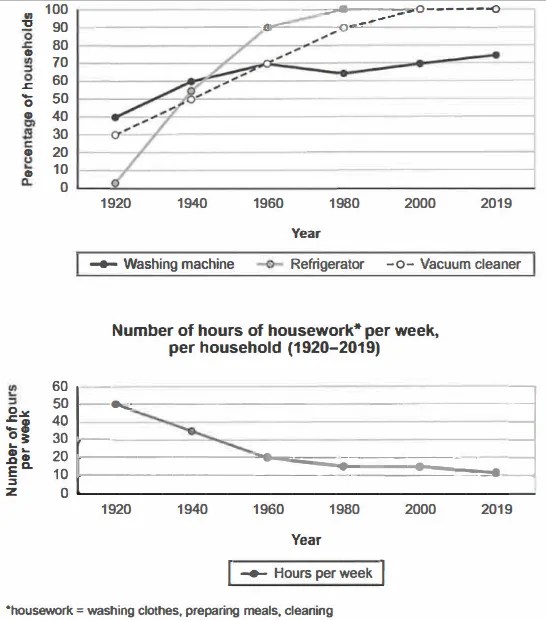
The charts below show the changes in ownership of electrical appliances and amount of time spent doing housework in households in one country between 1920 and 2019.
Summarise the information by selecting and reporting the main features, and make comparisons where relevant.
Percentage of households with electrical appliances (1920-2019)
Student answer (Band 5.0)
The line chart demonstrates the percentage of households with electrical appliances in one country between 1920 to 2019.
There are three equipments that play a significant role of electrical appliances and amount of time that spend doing in households that every house required in there houses which is very essntial for everyday household chores.
In 1920 the washing machine percentage of households is rising from 40% to 72% from 1920 to 2019. And other crucial factor is refrigerator percentage of households is rising from 0% to 100% between the year from 1920 to 2000. Moreover, The vacuum cleaner percentage of households rose from 30% to 100% from 1920 to 2019.
In contrast, the number of houses per week from 1920 to 2019. The chart illustrates that the number of hours per week is gradually diminish in 1920 the percentage is 50% which is eventually decline in 32% in 1940 as well as in 1960 it decrease from 32% to 20 % and in 1980 to 2000 it remain the same 12%. To sum up, in 2019 the number of hours of housework per week, per household is just remain only 10%.
AI examiner evaluation
| Criterion | Band |
|---|---|
| Task Achievement / Task Response | 5.0 |
| Coherence and Cohesion | 5.5 |
| Lexical Resource | 5.0 |
| Grammatical Range and Accuracy | 5.0 |
| Overall | 5.0 |
Task Achievement / Task Response: Band 5.0
You identify the main subject and report the broad trends: appliance ownership generally increased, while time spent on housework fell. However, the account is only partly accurate and the overview is not clearly stated. For example, washing-machine ownership rose from 40% to about 75%, not 72%, and refrigerator ownership was about 2% in 1920 rather than 0%. The housework figures are also misreported as percentages: they are hours per week, and the 1940 figure is about 35, not 32. The response gives little comparison between appliance series and does not highlight that refrigerators reached full ownership by 1980, earlier than vacuum cleaners. A concise overview and more carefully selected, accurate comparisons would make the report more complete.
Coherence and Cohesion: Band 5.5
The response has a basic sequence, moving from an introduction to appliance figures and then housework, and phrases such as “In contrast” signal a change of focus. However, the progression is not consistently clear: the second sentence combines several ideas without explaining their relationship, and the appliance details are presented as a list rather than grouped comparisons. Some linking is repetitive or awkward, including repeated uses of “from…to” and “Moreover” before another similar trend. The final “To sum up” repeats the last housework figure rather than providing a clear overall conclusion. Use separate paragraphs for the overview, appliance trends and housework, and connect figures through meaningful comparisons.
Lexical Resource: Band 5.0
You use some relevant task vocabulary, including “percentage of households,” “washing machine,” “refrigerator” and “housework,” so the topic is generally recognisable. However, the range is limited and several word choices or collocations make the meaning less natural, such as “three equipments,” “play a significant role of electrical appliances,” and “the number of houses per week.” “Diminish” is also used in an awkward form in “is gradually diminish,” while “essential” is misspelled as “essntial.” Take care to distinguish households, appliances and hours, and choose precise verbs such as “rose,” “fell” and “remained stable.” More accurate collocations would make the data description clearer and more fluent.
Grammatical Range and Accuracy: Band 5.0
You attempt both simple and longer sentences, but control is uneven, and errors in sentence structure and verb forms sometimes make the report difficult to follow. For instance, “between 1920 to 2019” uses an incorrect preposition pattern, while “the number of hours per week is gradually diminish” has an incorrect verb form. In “in 1980 to 2000 it remain the same,” the verb does not agree with the time reference, and the sentence lacks clear punctuation. The opening description also contains a long, incomplete construction beginning “There are three equipments…” Practise building clear subject–verb sentences, using past-tense verbs for historical changes, and checking articles, agreement and punctuation. This will help you express comparisons more reliably.
See this exact question answered at other band scores. The same prompt compared across bands.
Browse more IELTS Writing model answers or get your own writing scored by the same AI examiner.