Band 6.5 IELTS Writing Task 1 Model Answer
Overall Band Score: 6.5 · Cambridge IELTS 16 · 2026-11-25
IELTS Writing Task 1 question
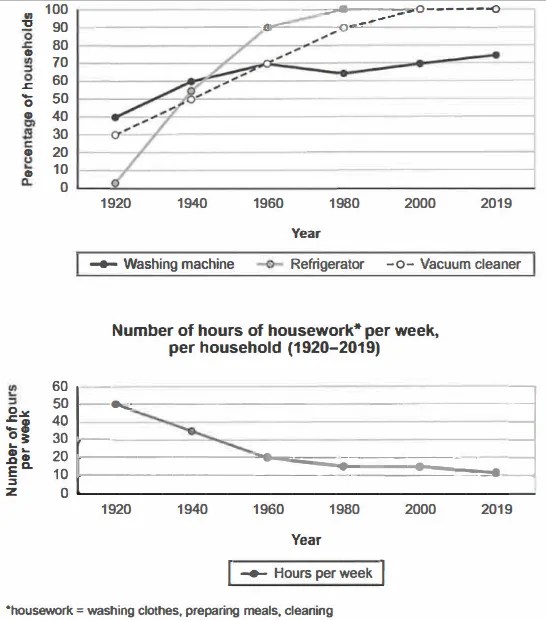
The charts below show the changes in ownership of electrical appliances and amount of time spent doing housework in households in one country between 1920 and 2019.
Summarise the information by selecting and reporting the main features, and make comparisons where relevant.
Percentage of households with electrical appliances (1920-2019)
Student answer (Band 6.5)
The two line graphs illustrate changes in household ownership of the three electrical appliances and the average number of hours spend on housework per week in one country between 1920 and 2019.
Overall, ownership of all three appliances increased, while the time spent on household is decreased significantly.
in 1920, for washing machine were owned by 40% compare with 30% of vacuum cleaners and almost 0% for the Refrigerator 0f household. By 1960, washing machine and vacuum cleaner ownership is reached 70%, where Refrigerator had rised sharply to 90%; it reached at 100% in 1980- where vacuum cleaner achieved the same figuer in 2000. washing machine ownership increased more gradually, reaching 75% by 2019.
Regarding housework, household spent 50 hours per week on domestic activities in 1920. the figure declined steadily, 35 hours in 1940 and 20 hours by 1960. it fell 15 hours in 1980 and unchanged until 2000. and reached 10 hours in 2019.
AI examiner evaluation
| Criterion | Band |
|---|---|
| Task Achievement / Task Response | 7.0 |
| Coherence and Cohesion | 7.0 |
| Lexical Resource | 6.0 |
| Grammatical Range and Accuracy | 5.5 |
| Overall | 6.5 |
Task Achievement / Task Response: Band 7.0
You cover both graphs and provide a clear overview: appliance ownership generally rose, while weekly housework time fell. The main comparisons are supported with relevant figures, including the refrigerator’s rise to 100% by 1980 and the vacuum cleaner reaching that level by 2000. You also describe the washing-machine trend and the decline in housework hours. Most reported values match the chart; “almost 0%” for refrigerators in 1920 and 10 hours in 2019 are reasonable approximations of about 2% and 11. To make the account more fully developed, include the notable dip in washing-machine ownership from 70% in 1960 to 65% in 1980, followed by its recovery. The overview could also distinguish the appliances that reached full ownership from the one that did not.
Coherence and Cohesion: Band 7.0
The response has a clear overall progression: an introduction, a concise overview, then separate discussion of appliance ownership and housework. This makes the two data sets easy to follow, and time markers such as “By 1960” and “in 1980” help establish chronology. However, the appliance paragraph compresses several comparisons into a long sequence, with punctuation that makes the relationships less clear: “it reached at 100% in 1980- where vacuum cleaner achieved the same figuer in 2000.” The housework paragraph also relies on a series of short, loosely connected statements. Use full stops and linking phrases more deliberately, and make the comparison between the three appliance trends easier to track. Overall, the organisation is logical, though cohesion is not consistently smooth.
Lexical Resource: Band 6.0
You use an adequate range of task-relevant vocabulary, including “ownership,” “declined steadily,” “reached,” and “domestic activities.” These choices communicate the main trends, and the response includes some variation rather than repeating one verb throughout. However, several word choices or collocations are inaccurate or awkward, such as “time spent on household,” “washing machine were owned,” and “reached at 100%.” There are also spelling errors in “rised” and “figuer,” and inconsistent capitalisation of “Refrigerator.” These do not prevent understanding, but they reduce precision and control. Aim for standard chart-reporting phrases such as “the proportion of households owning…” and check spelling and word forms carefully. More precise language for rises, falls, and plateaus would strengthen the description.
Grammatical Range and Accuracy: Band 5.5
You attempt both simple and more complex sentence forms, and the opening sentence successfully introduces the two measures and the time period. However, some grammatical errors remain across the response. For example, “the average number of hours spend” needs a past participle, while “for washing machine were owned by 40%” has an incorrect sentence structure and agreement. Tense control is also uneven in “ownership is reached” and “had rised,” and several sentences begin with lowercase letters after full stops. The sequence “it fell 15 hours in 1980 and unchanged until 2000” lacks a complete parallel clause. These issues do not obscure the overall message, but they limit accuracy. Practise forming complete clauses and maintaining consistent past-tense reporting, while retaining your attempts at varied sentence structures.
See this exact question answered at other band scores. The same prompt compared across bands.
Browse more IELTS Writing model answers or get your own writing scored by the same AI examiner.