Band 4.0 IELTS Writing Task 1 Model Answer
Overall Band Score: 4.0 · Cambridge IELTS 16 · 2026-11-25
IELTS Writing Task 1 question
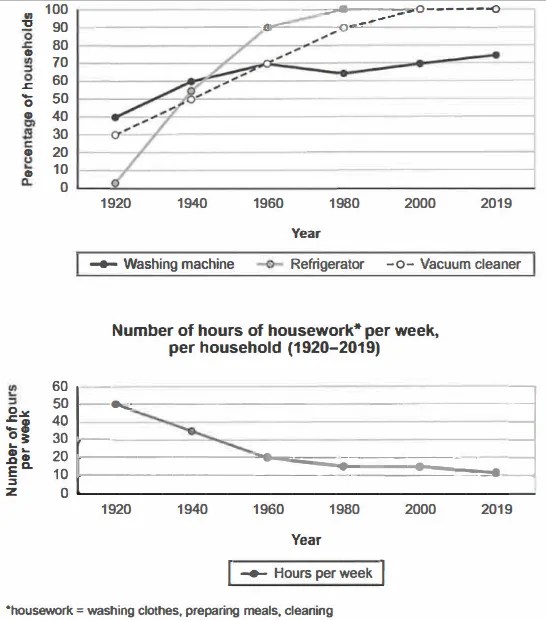
The charts below show the changes in ownership of electrical appliances and amount of time spent doing housework in households in one country between 1920 and 2019.
Summarise the information by selecting and reporting the main features, and make comparisons where relevant.
Percentage of households with electrical appliances (1920-2019)
Student answer (Band 4.0)
the chart illustrate that the changes in ownership of electrical appliances. and amount of time spent doing housework in one country between 1920 to 2019.
overall, in this charts show the electric appliances and amount of time spent doing housework. in 1920 the washing machine is huge amount of people used it. the 40 percent people used the washing machine. but in 2019 the refrigerator is most popular and highly used appliances approximately 100 percent people used the refrigerator.
AI examiner evaluation
| Criterion | Band |
|---|---|
| Task Achievement / Task Response | 3.0 |
| Coherence and Cohesion | 3.5 |
| Lexical Resource | 4.5 |
| Grammatical Range and Accuracy | 4.5 |
| Overall | 4.0 |
Task Achievement / Task Response: Band 3.0
The response identifies the topic and gives two relevant figures: washing-machine ownership was 40% in 1920, and refrigerator ownership reached about 100% in 2019. However, it reports very little of the chart and does not describe the major overall patterns, such as the rise in ownership of all three appliances or the fall in weekly housework from 50 to 11 hours. The claim that the washing machine was used by a “huge amount” of people in 1920 is not a useful comparison, and the response omits the vacuum-cleaner data entirely. It also contains only 55 words, well below the 150-word minimum; 24 words copied from the task prompt were not counted. Include a clear overview and select key comparisons from both graphs.
Coherence and Cohesion: Band 3.5
There is a basic attempt to organise the response, with an opening statement followed by an overview-like paragraph, and the contrast between 1920 and 2019 gives the reader a simple point of comparison. However, the ideas do not progress into a clear summary of the charts: the second paragraph repeats the general topic before giving only two details. The linking word “but” signals contrast, though the relationship between the two figures could be expressed more precisely. The opening is also split into an incomplete sentence, which interrupts the flow. To improve, use a clear introduction, a concise overview, and a paragraph grouping the main appliance trends and housework figures, with links such as “while” and “by contrast.”
Lexical Resource: Band 4.5
The response uses some relevant task vocabulary, including “ownership,” “electrical appliances,” “washing machine,” and “refrigerator,” so the subject is generally recognisable. However, the range is narrow and several expressions are imprecise or unnatural, such as “huge amount of people used it” and “most popular and highly used appliances.” These phrases do not clearly describe the percentage of households owning an appliance. Repetition of “used” also limits precision. Use vocabulary suited to chart reporting, such as “the proportion of households owning,” “rose,” “reached,” and “remained stable.” This would make comparisons clearer and help the response describe trends rather than relying on general statements about popularity or use.
Grammatical Range and Accuracy: Band 4.5
The response attempts simple statements and a contrast, and the intended meaning can usually be understood. However, sentence control is inconsistent. The opening, “the chart illustrate that the changes,” is not a complete, well-formed sentence, and “in this charts show” lacks a clear grammatical subject. There are also errors in agreement and sentence construction in “the washing machine is huge amount of people used it” and “the refrigerator is most popular.” Capitalisation and punctuation are inconsistent, including the lowercase start and the full stop separating the opening fragment from the next clause. Practise complete sentences with accurate subjects and verbs, for example: “The charts show changes in appliance ownership and housework hours.”
See this exact question answered at other band scores. The same prompt compared across bands.
Browse more IELTS Writing model answers or get your own writing scored by the same AI examiner.