Band 6.0 IELTS Writing Task 1 Model Answer
Overall Band Score: 6.0 · Cambridge IELTS 16 · 2026-11-25
IELTS Writing Task 1 question
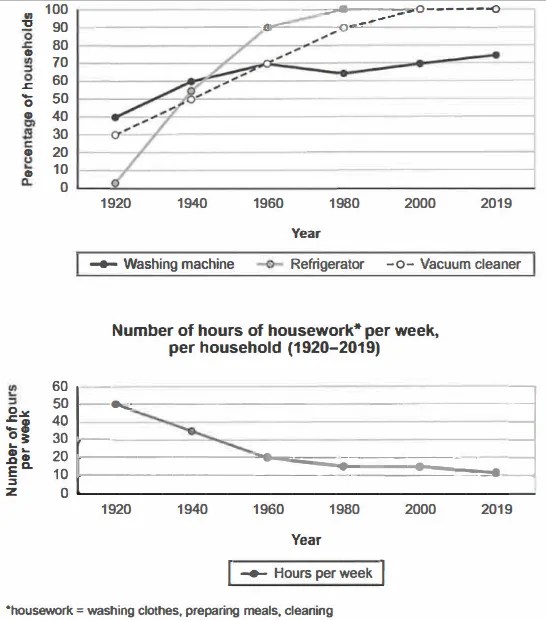
The charts below show the changes in ownership of electrical appliances and amount of time spent doing housework in households in one country between 1920 and 2019.
Summarise the information by selecting and reporting the main features, and make comparisons where relevant.
Percentage of households with electrical appliances (1920-2019)
Student answer (Band 6.0)
The charts illustrate the shifts in ownership of electrical devices and the amount of time people spend in their households work in a country from 1920 to 2019.
Overall, the proportion of households owning electrical equipment increase over the period. Households owning refrigerator increased significantly, whereas the figures for washing machine fluctuated a little. Households with vacuum cleaner increased steadily compared with other appliances. Additionally, the number of hours people spend in housework decreased over the years.
In 1920, the proportion of households owning washing machine and vacuum cleaner was 40% and 30% respectively, whereas the figure for Refrigerator was nearly 0%. However, this trend changed after 1940, the figure for vacuum cleaner increased sharply and overtook other equipment by 1960. The figure for vacuum cleaner also showed steady increase and overtook washing machine by 1980 and matched with refrigerator in 2000 at 100%. However, households owning washing machine increased 1960 and fluctuated a little then reached approximately 75% in 2019.
The amount of time people spend in households work decreased over the period as it reached from 50 hours to 20 between 1920 and 1960. From 1960 to 2019 the figure decreased slightly and reached 10 hours.
AI examiner evaluation
| Criterion | Band |
|---|---|
| Task Achievement / Task Response | 6.5 |
| Coherence and Cohesion | 6.0 |
| Lexical Resource | 6.5 |
| Grammatical Range and Accuracy | 5.5 |
| Overall | 6.0 |
Task Achievement / Task Response: Band 6.5
You cover both charts and provide a clear overview: appliance ownership generally rose, while housework time fell. Several key comparisons are also accurate, including the vacuum cleaner reaching 100% by 2000 and washing machines ending at about 75%. This meets the task well, with some features developed in useful detail. However, one comparison is unclear or inaccurate: vacuum cleaner ownership did not overtake the other appliances by 1960; it was level with washing machines at about 70% and remained below refrigerators. The housework description also compresses the later trend: it fell from 20 hours in 1960 to 15 in 1980, stayed level in 2000, and then reached about 11 in 2019. More precise reporting of these stages would strengthen the response.
Coherence and Cohesion: Band 6.0
The response has a coherent overall arrangement: an introduction and overview are followed by appliance details and then the housework figures. This makes the main topics easy to identify. You also use linking expressions such as “Overall,” “whereas,” and “Additionally” to signal relationships. At times, however, cohesion is mechanical or the reference is unclear. “However, this trend changed after 1940” does not clearly identify which trend is changing, and the following sentence repeats “the figure for vacuum cleaner” without a clear new comparison. The repeated “However” also does not always express a contrast. Organise the appliance paragraph chronologically and use explicit comparisons between the three series to make progression smoother.
Lexical Resource: Band 6.5
You use an adequate range of task-related vocabulary, including “proportion,” “ownership,” “fluctuated,” “increased steadily,” and “decreased.” These choices help describe trends and comparisons, and the meaning is generally clear. There are some imprecise or unnatural combinations, however, such as “households work” and “matched with refrigerator”; these reduce the naturalness of the report. “Electrical devices” is understandable, though “electrical appliances” is more precise for this chart. You also repeat “figure” and “increased” several times, limiting flexibility. Aim to vary trend language and use accurate collocations, for example “housework,” “was equal to,” “rose,” and “declined,” while keeping descriptions concise and data-focused.
Grammatical Range and Accuracy: Band 5.5
You attempt a mix of simple and complex sentences, including comparisons with “whereas” and time clauses such as “between 1920 and 1960.” Most sentences communicate the intended trend, but some grammatical errors remain. In the overview, “the proportion … increase” needs a past-tense verb (“increased”), and “the figure for Refrigerator increased” would be clearer with an article and consistent lower-case naming. The sentence beginning “However, this trend changed after 1940, the figure…” joins two independent clauses with only a comma. There are also missing articles in phrases such as “owning washing machine” and “owning vacuum cleaner.” Review tense consistency, articles, and sentence boundaries; these corrections would improve accuracy while preserving your range of structures.
See this exact question answered at other band scores. The same prompt compared across bands.
Browse more IELTS Writing model answers or get your own writing scored by the same AI examiner.