Band 6.0 IELTS Writing Task 1 Model Answer
Overall Band Score: 6.0 · Cambridge IELTS 16 · 2026-11-25
IELTS Writing Task 1 question
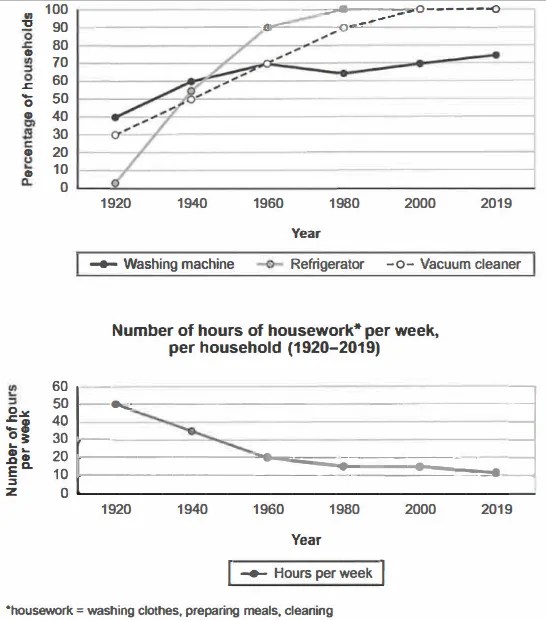
The charts below show the changes in ownership of electrical appliances and amount of time spent doing housework in households in one country between 1920 and 2019.
Summarise the information by selecting and reporting the main features, and make comparisons where relevant.
Percentage of households with electrical appliances (1920-2019)
Student answer (Band 6.0)
The bar charts illustrate, the key changes in the possession of electrical appliances as well as the amount of time of time spent doing three distanct activities, in households in a country from 1920 to 2019.
Overall, the ownership of refrigerator rise significantly from the lowest to the highest during the period. Moreover, the demand for ownership of vacuum cleaner was also faced a sharp increase, while washing machine was increasing at the start than faced some decrease and than retained its old value. In addition, the number of hours per week decreased from the start to the end of the period.
In 1920, less than 0% people have owned refrigerators and that number rose drammatically to 100% in the 1980, and than remained the same at the end of the period. Similarly, the vaccum cleaner was around 30% at the start, than increased gradually every 20 years to reach 100% in the 2000, and hold that position until the end of the period. On the other hand, the washing machine was increasing at the start until the end, but only decrease was observed between 1960 to 1980.
The number of hours for housework decrease frrom start to the end, starting with 50 hours per week and ending with around 10 hours.
AI examiner evaluation
| Criterion | Band |
|---|---|
| Task Achievement / Task Response | 6.5 |
| Coherence and Cohesion | 6.5 |
| Lexical Resource | 5.5 |
| Grammatical Range and Accuracy | 5.5 |
| Overall | 6.0 |
Task Achievement / Task Response: Band 6.5
You cover both charts and provide a clear overall picture: appliance ownership generally rose, while weekly housework hours fell. Several key figures and trends are accurately selected, including refrigerators reaching 100% by 1980 and vacuum cleaners reaching full ownership by 2000. However, some details are inaccurate or unclear: refrigerators began at about 2%, not “less than 0%,” and washing-machine ownership did not simply retain its old value; after falling from 70% to 65%, it rose to about 75% by 2019. The overview also says washing-machine ownership increased “at the start” but does not clearly summarise its later recovery. More precise reporting of these changes, alongside the housework figures, would make the coverage more complete.
Coherence and Cohesion: Band 6.5
The response has a coherent overall arrangement, with an introduction, an overview and separate paragraphs for appliance ownership and housework. The main trends are generally easy to follow, and linking expressions such as “Overall,” “Similarly” and “On the other hand” help signal relationships. Some cohesion is less controlled, however: “Moreover” and “In addition” make the overview feel like a list, while “than” is repeatedly used where a sequence marker such as “then” is needed. The washing-machine sentence in the final appliance paragraph is also difficult to follow because it says ownership was increasing “until the end” before mentioning a decrease. Grouping the appliance trends more clearly and using transitions selectively would strengthen progression.
Lexical Resource: Band 5.5
You use relevant task vocabulary, including “ownership,” “increased gradually,” “remained the same” and “hours per week,” so the main information is usually understandable. However, several word choices and collocations are inaccurate or awkward: “demand for ownership” does not describe the proportion of households that own an appliance, and “three distant activities” misidentifies the chart, which shows appliances and housework time. There are also noticeable spelling errors, including “distanct,” “drammatically,” “vaccum” and “frrom.” Some repetition of “increase” and “start” limits flexibility. Choose precise terms such as “ownership rate” or “proportion of households,” and proofread spelling and word forms to improve clarity and control.
Grammatical Range and Accuracy: Band 5.5
You attempt both simple and more complex sentence forms, and the response is divided into clear sentences that usually communicate the intended trends. However, errors in verb forms, agreement and sentence construction recur. For example, “the ownership of refrigerator rise” needs a plural or article adjustment and a past-tense verb, while “was also faced a sharp increase” combines incompatible verb patterns. In “the washing machine was increasing … but only decrease was observed,” the tense and structure are not well controlled. The opening also contains a comma after “illustrate” that interrupts the sentence. These errors do not prevent the reader from understanding the broad message, but they reduce accuracy. Practise consistent past-tense reporting and simpler, well-formed comparisons before adding complex clauses.
See this exact question answered at other band scores. The same prompt compared across bands.
Browse more IELTS Writing model answers or get your own writing scored by the same AI examiner.