Band 5.0 IELTS Writing Task 1 Model Answer
Overall Band Score: 5.0 · Cambridge IELTS 16 · 2026-11-26
IELTS Writing Task 1 question
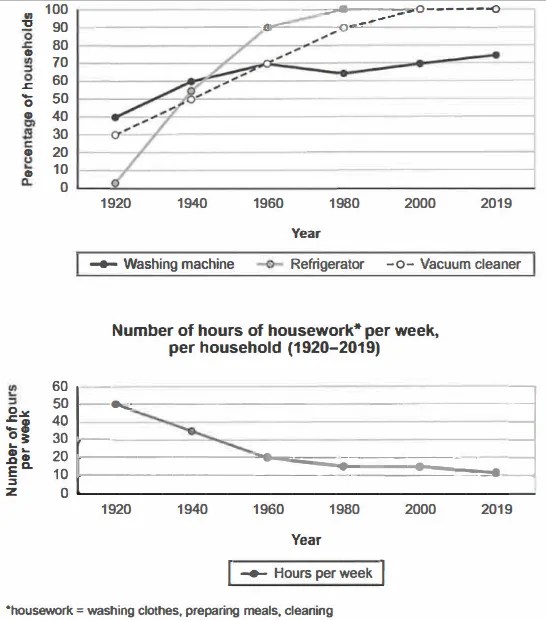
The charts below show the changes in ownership of electrical appliances and amount of time spent doing housework in households in one country between 1920 and 2019.
Summarise the information by selecting and reporting the main features, and make comparisons where relevant.
Percentage of households with electrical appliances (1920-2019)
Student answer (Band 5.0)
the line graphs illustrate that the from 1920 to 2019 how much the ownship of different electrical appliances changes by observing the line graph 1 the informaion explains that from 1920 to 2019 the ownership of washing machies incresed sharply in 20 years then after 1960 the ownership start declining at moderate rate. however the the refrigerators ownership was zero in 1920 but after 1920 the ownership of refrigerators also incresed sharply but after 2000 itdeclined slighty.For the vacuum cleaners from 1920 the ownership was increasing with steady demand.the secong line graph illustrate that overall the the number of hours spent b households on house work declined from 1920 to 2019 due to incresed in the use of electrical appliance in the daily life of households.
AI examiner evaluation
| Criterion | Band |
|---|---|
| Task Achievement / Task Response | 4.5 |
| Coherence and Cohesion | 5.0 |
| Lexical Resource | 5.5 |
| Grammatical Range and Accuracy | 5.0 |
| Overall | 5.0 |
Task Achievement / Task Response: Band 4.5
The response identifies the broad topic and notes the overall fall in housework, but it reports the appliance trends inaccurately and gives little supporting detail. For example, washing-machine ownership did not decline steadily after 1960: it dipped slightly by 1980, then rose again. Refrigerator ownership was not zero in 1920, and it reached 100% by 1980 before remaining stable; it did not decline after 2000. The vacuum-cleaner trend is mentioned only generally. The link between appliance use and reduced housework is plausible, but the charts do not establish that cause. The response is also 24 words below the required minimum. To address the task more fully, include a clear overview and accurate comparisons with key figures.
Coherence and Cohesion: Band 5.0
There is a basic sequence from the first graph to the second, and linking words such as “however” and “overall” show an attempt to connect ideas. However, the response is presented as one long paragraph, with no clear separation between an overview and supporting details. Several transitions are awkward or repetitive, including “from 1920 to 2019” appearing repeatedly and “however the the.” The reader can follow the general topic, but the progression between appliance trends is not consistently clear, and the second graph receives only one brief sentence. Organise the response into a short introduction, an overview, and paragraphs comparing the appliance data and housework figures; use linking expressions selectively to make those relationships clearer.
Lexical Resource: Band 5.5
The response uses some relevant task vocabulary, including “ownership,” “increased,” “declined,” and “hours spent,” so the main subject is generally recognisable. There is also an attempt to describe trends with phrases such as “increased sharply” and “steady demand.” However, the range is limited and several choices are inaccurate or unnatural: “the ownship,” “washing machies,” and “with steady demand” do not express the intended information clearly. Spelling errors such as “informaion,” “incresed,” and “secong” are noticeable, while “electrical appliance” should be plural when referring to several items. Build a more precise set of trend terms and check spelling and collocations before submitting.
Grammatical Range and Accuracy: Band 5.0
The response attempts to combine ideas using clauses, for example, “the ownership of washing machines increased sharply … then after 1960,” but sentence control is weak and errors recur. The opening, “illustrate that the from 1920 to 2019 how much,” has an incomplete and confused structure. There are also problems with articles, agreement, and sentence boundaries, as in “the refrigerators ownership was zero” and “the number of hours spent b households … declined.” Repeated words and punctuation, including “however the the,” further affect readability. Most sentences rely on similar, extended patterns, and the complex attempts are often faulty. Practise writing shorter, complete sentences first, then combine them with accurate clauses and consistent past-tense reporting.
See this exact question answered at other band scores. The same prompt compared across bands.
Browse more IELTS Writing model answers or get your own writing scored by the same AI examiner.