Band 6.0 IELTS Writing Task 1 Model Answer
Overall Band Score: 6.0 · Cambridge IELTS 16 · 2026-11-26
IELTS Writing Task 1 question
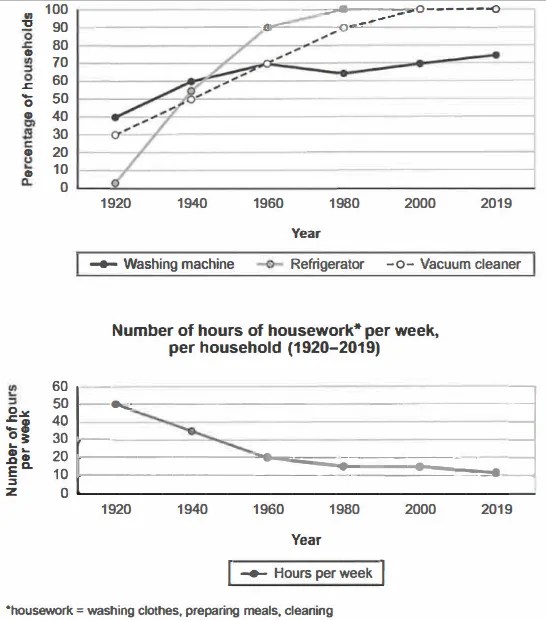
The charts below show the changes in ownership of electrical appliances and amount of time spent doing housework in households in one country between 1920 and 2019.
Summarise the information by selecting and reporting the main features, and make comparisons where relevant.
Percentage of households with electrical appliances (1920-2019)
Student answer (Band 6.0)
The line chart illustrates the transferring of ownership of electrical appliances and total time spent doing housework and households in single country between 1920 and 2019.
Overall, the major increase in percentage of electrical maxchines is in refrigerator and washing machines also rise a liitle bit between 1920 and 2019.
in 1920, percentage of refrigerater is 0% and then they started to rise and reached the percentage of 100% in 1980 and remains unchanged over the period. In addition, washing machines started with 30% in 1920 and then they experienced some ups and downs and reached 75% in 2019. Vacuum cleaner also reached 100% in 2019 and they just started with 30% in 1920.
Furthermore, numbers of hours housework per weekalso decreased over the period. In 1920, 50 hours of work drops to 20 hours in 1960 and then again drops to just 10 hours in 2019 because of electrical appliances.
AI examiner evaluation
| Criterion | Band |
|---|---|
| Task Achievement / Task Response | 6.0 |
| Coherence and Cohesion | 6.5 |
| Lexical Resource | 5.0 |
| Grammatical Range and Accuracy | 5.5 |
| Overall | 6.0 |
Task Achievement / Task Response: Band 6.0
You cover both charts and identify the broad patterns: appliance ownership generally rose, while weekly housework time fell. You also include several relevant figures, such as refrigerators reaching 100% by 1980 and housework declining from 50 hours in 1920. However, some details are inaccurate or unclear: refrigerators were about 2%, not 0%, in 1920, and washing machines began at 40%, not 30%. The overview also overlooks the vacuum cleaner’s steady rise to full ownership and the slight dip in washing-machine ownership around 1980. Your final explanation that housework fell “because of electrical appliances” goes beyond what the charts establish. More precise comparisons and a fuller overview would make the report more complete.
Coherence and Cohesion: Band 6.5
The response has a recognisable structure: an introduction, an overview, a paragraph about appliance ownership, and a final paragraph about housework. This gives the reader a generally coherent route through the information, and transitions such as “In addition” and “Furthermore” help connect points. The progression is not fully controlled, however. The overview mentions only refrigerators and washing machines, while the vacuum cleaner is introduced later without a clear comparison with the other appliances. Some references, such as “they” after “refrigerator,” are also unclear, and the final causal statement shifts from reporting data to explaining it. Grouping the appliance trends more systematically and using clearer references would strengthen the flow.
Lexical Resource: Band 5.0
You use relevant chart vocabulary, including “percentage,” “reached,” “remains unchanged,” and “decreased,” so the main trends are usually understandable. However, the range is limited and several word choices or collocations are inaccurate, which makes parts of the report less natural. “Transferring of ownership” does not describe the chart’s subject; “ownership of appliances” is more suitable. “Electrical maxchines” is both misspelled and imprecise, while “the percentage of refrigerater” is not a natural way to describe the figure. Spelling errors such as “liitle” and “refrigerater” are noticeable. Aim for accurate, varied trend language and check spelling carefully.
Grammatical Range and Accuracy: Band 5.5
You attempt both simple and more developed sentence forms, and the main message is generally recoverable. Some grammatical errors remain, particularly in sentence construction, articles, agreement, and punctuation. For example, the opening phrase “and households in single country” is not grammatically complete, and “the major increase … is in refrigerator” has an unclear structure. In “washing machines started with 30% … and then they experienced,” the plural pronoun does not refer smoothly to the ownership percentage. Capitalisation is also inconsistent after full stops, as in “in 1920.” Use complete, carefully punctuated sentences and check article use and subject–verb relationships; this will improve accuracy while preserving your attempts at complex sentences.
See this exact question answered at other band scores. The same prompt compared across bands.
Browse more IELTS Writing model answers or get your own writing scored by the same AI examiner.