Band 5.0 IELTS Writing Task 1 Model Answer
Overall Band Score: 5.0 · Cambridge IELTS 16 · 2026-11-27
IELTS Writing Task 1 question
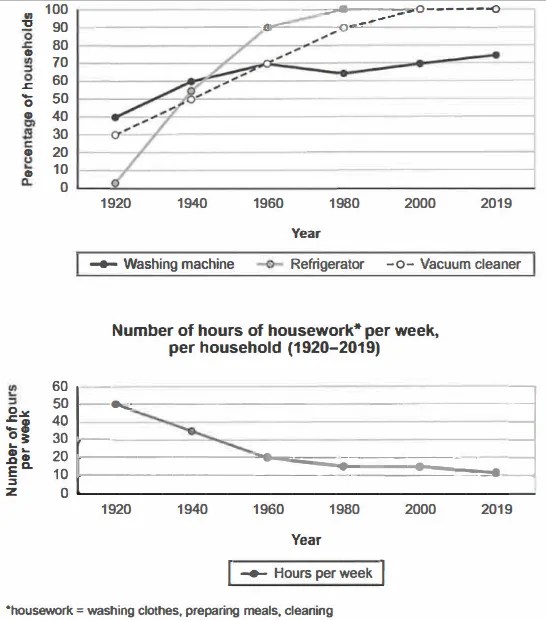
The charts below show the changes in ownership of electrical appliances and amount of time spent doing housework in households in one country between 1920 and 2019.
Summarise the information by selecting and reporting the main features, and make comparisons where relevant.
Percentage of households with electrical appliances (1920-2019)
Student answer (Band 5.0)
The given charts below illustrates the changes in ownership of electrical equipments and amount of time spent doing housework in houses in one country between 1920 and 2019.
In the year of 1920 people started buying mostly appliances of households. The most demanding equipment in households was refrigerator the demand of refrigerator owned almost zero percent before 1920 but after year of 1920 to year 2019 the percentage of refrigerator was upto 100 percent. People less owned vacuum cleaner which started from 30 percent to almost 100 percent between 1920 to 2019.The least owned appliance was washing machine it started from 40 percent to 75 percent between 1920 to 2019.
The second chart displays the number of hours spend on housework. People mostly spent more time in cleaning. In 1920 people spent 50 hours per week but with the time this number became less and remains almost 10 hours per week.
AI examiner evaluation
| Criterion | Band |
|---|---|
| Task Achievement / Task Response | 5.0 |
| Coherence and Cohesion | 5.5 |
| Lexical Resource | 5.0 |
| Grammatical Range and Accuracy | 5.0 |
| Overall | 5.0 |
Task Achievement / Task Response: Band 5.0
You identify the broad subject of both charts and report several relevant trends, including refrigerator ownership rising to 100% and housework time falling from 50 hours to about 10. However, the response only partially covers the task: it gives no clear overview comparing the overall patterns, and some details are inaccurate or unclear. For example, refrigerators were already owned by about 2% of households in 1920, rather than “almost zero percent before 1920,” and washing machines were not the least-owned appliance throughout the period. The claim that people “mostly spent more time in cleaning” is unsupported; the chart shows total housework hours, not time spent specifically cleaning. The response is also 143 words, below the required 150. Add a concise overview and select accurate comparisons.
Coherence and Cohesion: Band 5.5
The response has a basic structure: an introduction, a paragraph about appliance ownership, and a final paragraph about housework. This gives the reader some sense of the two chart topics. However, the information does not progress clearly within the appliance paragraph: the discussion moves from refrigerators to vacuum cleaners and washing machines without a consistent comparison or time-based grouping. Linking phrases such as “but after” and “with the time” are either awkward or do not clearly show the relationship between figures. The final paragraph is very brief and does not connect the two charts through an overall comparison. Organise the body around the main trends, and use clear references such as “By contrast” or “Meanwhile” to guide the reader.
Lexical Resource: Band 5.0
You use some relevant chart vocabulary, including “percentage,” “owned,” “started from,” and “per week,” so the topic is generally understandable. However, the range is limited and several word choices or collocations are inaccurate, which makes parts of the report difficult to interpret. “Electrical equipments” is not the natural form; use “electrical appliances.” “The most demanding equipment” does not clearly mean the most widely owned appliance, and “people less owned vacuum cleaner” is not an appropriate way to describe a falling or lower ownership figure. Repeated use of “people,” “started,” and “percent” also limits precision. Practise language for describing proportions and trends, such as “ownership rose,” “reached,” and “remained stable.”
Grammatical Range and Accuracy: Band 5.0
The response communicates its main topic using mostly simple statements, and it attempts some longer structures, for example, “but with the time this number became less.” However, the range of sentence forms is limited, and errors occur frequently enough to make several sentences awkward or unclear. Examples include subject–verb agreement in “The given charts below illustrates,” the incorrect construction “the percentage of refrigerator was upto 100 percent,” and missing or incorrect articles and prepositions in “In the year of 1920” and “between 1920 to 2019.” The sentence about refrigerator demand also joins ideas without clear punctuation. Build accuracy first with straightforward comparative sentences, then practise combining them using clauses such as “while” and “whereas.”
See this exact question answered at other band scores. The same prompt compared across bands.
Browse more IELTS Writing model answers or get your own writing scored by the same AI examiner.