Band 5.5 IELTS Writing Task 1 Model Answer
Overall Band Score: 5.5 · Cambridge IELTS 16 · 2026-11-27
IELTS Writing Task 1 question
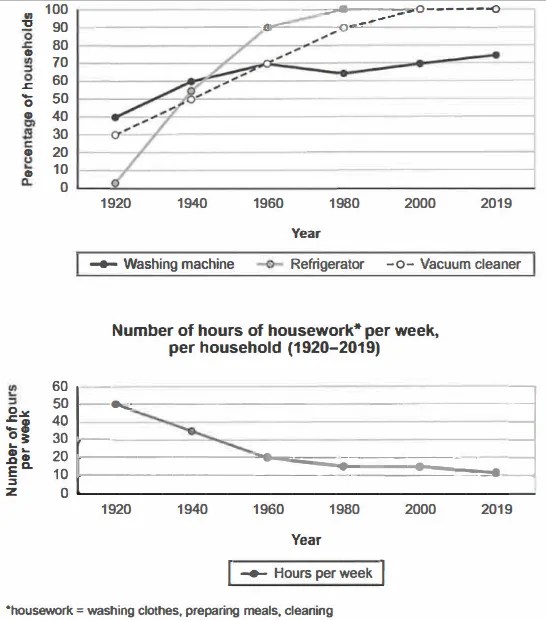
The charts below show the changes in ownership of electrical appliances and amount of time spent doing housework in households in one country between 1920 and 2019.
Summarise the information by selecting and reporting the main features, and make comparisons where relevant.
Percentage of households with electrical appliances (1920-2019)
Student answer (Band 5.5)
The line graph illustrates the owners shares in electrical products, between the years 1920 to 2019, While the next graph tells that, how many hours spent by using Washing machine, Refrigerator, Vacuum cleaner in the same time line.
Overall, there are three different types of house works washing clothes, preparing meals, cleaning.
Starting with the fridge, among all it has no downfall and raises well till the end. In 1920, it starts with 0 and goes to it's maximum values by 2019. Subsequently, Vacuum cleaner follows in same pattern. But, at the innitial stage it starts with 30 percent. Thereafter, Washing machine, their values are fluctuating in the middle years.
Considering all 3 different works, they setup a 60 hours for work in a week. However, in ealy 1920's, the work is more and spend atlest 50 hours in a week. To the next four decades, the equations, are fallen to 20 hours. After 1960's, it stays above 10 hours.
AI examiner evaluation
| Criterion | Band |
|---|---|
| Task Achievement / Task Response | 5.5 |
| Coherence and Cohesion | 5.5 |
| Lexical Resource | 5.0 |
| Grammatical Range and Accuracy | 5.0 |
| Overall | 5.5 |
Task Achievement / Task Response: Band 5.5
You identify the broad trends: refrigerator ownership rises to a maximum, vacuum-cleaner ownership increases, washing-machine ownership fluctuates, and weekly housework time declines. However, the account is only partial because several descriptions are vague or inaccurate. The refrigerator starts at about 2%, not 0%, and reaches 100% by 1980 rather than only “by 2019”; vacuum-cleaner ownership also reaches 100% by 2000. The overview focuses instead on the three types of housework, which the chart defines in a note, rather than clearly summarising the main changes across both graphs. The housework figures are also imprecise: time falls from 50 to 20 hours by 1960, then remains around 15 hours until 2000 before dropping to 11. Include these key comparisons to make the report more complete.
Coherence and Cohesion: Band 5.5
The response has separate paragraphs for the introduction, appliance trends and housework, so the reader can recognise a basic structure. Some linking expressions, such as “Starting with,” “Subsequently” and “However,” also indicate movement between points. Nevertheless, progression within the paragraphs is not always clear. The overview gives the definition of housework rather than a summary of the trends, and “Considering all 3 different works” makes the next paragraph’s focus difficult to follow. References such as “it,” “their values” and “the equations” are unclear, while “To the next four decades” does not precisely connect the time period to the figures. Organise the report around a concise overview followed by clear comparisons, and use explicit references to each appliance or the housework-hours line.
Lexical Resource: Band 5.0
You use some task-relevant vocabulary, including “fluctuating,” “maximum values” and “hours … in a week,” and the reader can generally identify the subjects being discussed. However, the range is limited and several word choices or collocations make the meaning awkward: “owners shares,” “raises well,” “setup a 60 hours” and “the equations, are fallen” do not describe the chart naturally. There are also spelling errors such as “innitial,” “ealy” and “atleast.” Choose precise verbs for trends—such as rise, fall, remain stable and reach—and use standard terms like “households” and “housework hours.” This would make the descriptions clearer and more appropriate to an academic report.
Grammatical Range and Accuracy: Band 5.0
The response attempts both simple and more complex sentences, including “While the next graph tells that…” and “Thereafter, Washing machine, their values are fluctuating…”. However, these attempts are often faulty, and errors in sentence structure, agreement, articles and punctuation sometimes make the meaning difficult to follow. For example, “the owners shares” lacks a clear grammatical construction, “it starts with 0 and goes to it's maximum values” has problems with agreement and possessive form, and “the equations, are fallen” is not a correct verb construction. Capitalisation and comma use are also inconsistent, including the comma before “While” in the opening. Practise accurate trend-reporting patterns, such as “ownership rose from … to …” and “the figure remained stable at …,” before adding more complex clauses.
See this exact question answered at other band scores. The same prompt compared across bands.
Browse more IELTS Writing model answers or get your own writing scored by the same AI examiner.