Band 5.0 IELTS Writing Task 1 Model Answer
Overall Band Score: 5.0 · Cambridge IELTS 16 · 2026-11-27
IELTS Writing Task 1 question
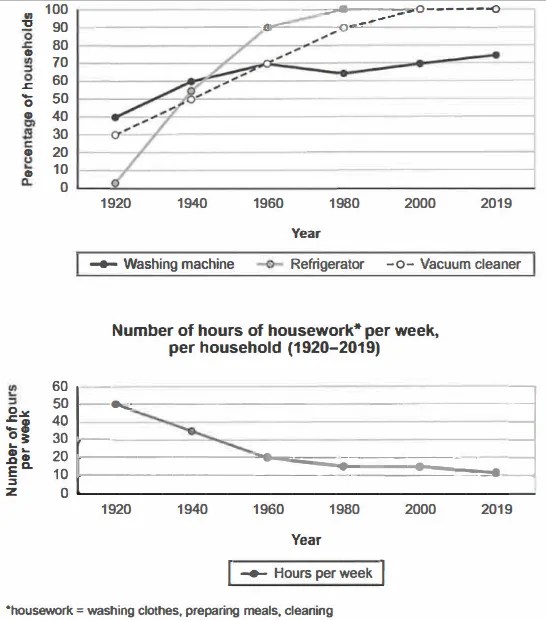
The charts below show the changes in ownership of electrical appliances and amount of time spent doing housework in households in one country between 1920 and 2019.
Summarise the information by selecting and reporting the main features, and make comparisons where relevant.
Percentage of households with electrical appliances (1920-2019)
Student answer (Band 5.0)
The line chart illustrates the proportion of homes that own electrical appliances and the number of time they spend doing the work in one country from [redacted phone].
Overall, the use of washing machine remained steady over the years. While, consumption of refrigerator and vaccum cleaner increased dramatically with time.
From the years 1920 to 1960, washing machine, refrigerator and vaccum cleaner was used by around average 50 percent of the households. However, in 1960 the percentage of refrigerator went up to 90 whereas, washing machine and vaccum cleaner went up by around 10-15 percent reaching 70. From being the lowest, refrigerator reached the highest percentage in these 2 decades.
After 1960, use of refrigerator stayed contant reaching maximum 100%. Moreover, The vaccum cleaner drastically rose up to 100% as well. Whilst, the washing machine remianed pleateu rising till under 80. The ownership of refrigerator increased the most followed by vaccum cleaner and washing machine respectively.
AI examiner evaluation
| Criterion | Band |
|---|---|
| Task Achievement / Task Response | 4.0 |
| Coherence and Cohesion | 5.5 |
| Lexical Resource | 5.5 |
| Grammatical Range and Accuracy | 5.5 |
| Overall | 5.0 |
Task Achievement / Task Response: Band 4.0
The response identifies the broad topic and notes that refrigerator and vacuum-cleaner ownership rose, but it does not adequately summarise the task’s main features. Most importantly, it omits the second chart entirely: the substantial fall in weekly housework, from about 50 hours to 11, is a central trend. The overview also says washing-machine use “remained steady,” although ownership rose overall from roughly 40% to 75%, with a dip around 1980. Some details are inaccurate or unclear: the three appliance figures were not all around 50% from 1920 to 1960, and the refrigerator had already reached 90% by 1960. To improve, give a clear overview covering both charts, then select accurate comparisons and key figures across the period.
Coherence and Cohesion: Band 5.5
There is a recognisable structure: an introduction, an overview and two body paragraphs, and the time-based division gives the reader some sense of progression. However, the organisation is incomplete because the second chart is not discussed, and the appliance details are not consistently grouped or sequenced. Connectors such as “However,” “Moreover,” and “Whilst” are used, but some links are awkward or do not clearly show the relationship between the figures; for example, “From being the lowest” has an unclear reference. The final sentence repeats a ranking rather than adding a distinct comparison. A clearer plan—overview of both trends, followed by one paragraph per chart—would make the progression more coherent and the comparisons easier to follow.
Lexical Resource: Band 5.5
The response uses some relevant task vocabulary, including “proportion,” “percentage,” “increased,” and “reaching maximum,” so the general subject is usually understandable. However, range and precision are limited, and several word choices or collocations are inaccurate: “consumption” is not the right term for household ownership, “the number of time” is unnatural, and “use of refrigerator” does not precisely describe the percentage of households owning one. Spelling errors such as “vaccum,” “contant,” and “remianed” also reduce accuracy. Use consistent terms such as “ownership,” “the proportion of households with…,” and “weekly hours of housework.” Check spelling carefully and choose verbs that describe the data rather than appliance use.
Grammatical Range and Accuracy: Band 5.5
The response attempts both simple and more complex sentences, including a contrast with “While” and a time clause beginning “From the years 1920 to 1960.” Meaning is generally recoverable, but grammatical control is uneven. Examples include “the number of time they spend,” where the noun phrase is incorrectly formed, and “washing machine, refrigerator and vaccum cleaner was used,” where the subject and verb do not agree. The opening overview fragment, “While, consumption…,” is also incorrectly punctuated and structured. Articles and plural forms are often missing or inconsistent, as in “use of refrigerator” and “the washing machine.” Build accurate sentences around plural subjects and use past-tense reporting consistently, while checking commas after introductory clauses.
See this exact question answered at other band scores. The same prompt compared across bands.
Browse more IELTS Writing model answers or get your own writing scored by the same AI examiner.